January 31, 2014 at 16:30
Rule 3h when building a Preply startup team
My name is Cyril and I am a co-founder of Preply.com startup. Preply is a classic marketplace for local and skype tutors in English. In this introductory article, I would like to talk about the Preply team. It has repeatedly changed its composition and in general, we made a sufficient number of mistakes until we came to its modern appearance. Now our team can be described with a simple 3h rule. The rule is used when building a startup team and suggests that co-founders should have three types of functions and characters: Hacker, Hipster and Hustler.
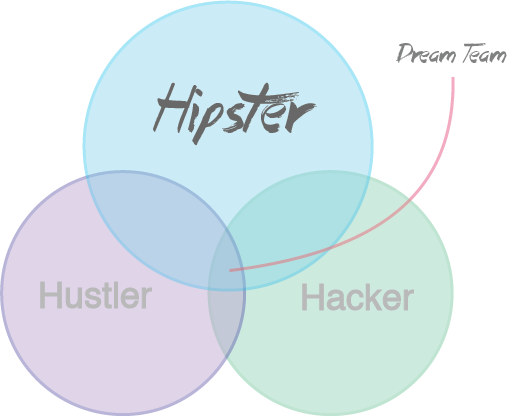
You probably already guessed what each of them has the task, but let me tell you more in detail from my own experience. The Hacker is a master of code and it is important that such a person is a practitioner who knows how to build real things. The Hipster is your ninja design, he must have good UI and UX skills to make the product not only beautiful and nice, but also convenient to use. The last guy, The Hustler, needs to know how to sell things, this person is a speaker, a dream seller.
In functional areas, the situation is clear, but what about the types of characters? The same 3h approach works here. The Hacker is a person who thinks how to get around an established system. The Hipster is creative in every task. The Hustler cries “forward” all the time and motivates him to move.
Let's now take a closer look at the examples from the Preply startup. We have three co-founders in our team: Dmitry, Sergey and I. In our case, the functional and mental types coincided.
Our service station Dmitry is a multilingual developer, versed in architecture, working with both the frontend and the backend. In addition, he has a good background in Internet marketing and PR.

Dmitry will tell about examples of our solutions himself:
“Preply.com development is a fascinating activity. Since the project is quite marketing, most of the work is at the intersection of programming and marketing. We do not have one “rocket science” technology in the project, on which everything rests and which is the key to the success of the project, but there are many interesting “bricks” that together build a rather interesting architecture. I will give a few examples when the correct integration of marketing into programming together gives a tangible business result:
We have Sergey as a hipster. His tasks include what is usually described in terms of User Experience and User Interface.

A few examples of how his work is organized:
I do customer support, marketing and finance. I must be able to properly sell the product and idea to everyone: users, the press, investors and my team. The responsibilities of the hustler also include maintaining the morale, productivity and motivation of the team. I was very lucky that this burden was shared with me by Dima and Sergey.

What are some typical tasks you may encounter:
Building a good team is not an easy process and it is worth paying attention to many factors. I would single out the 3h rule, which distributes functions well between co-founders. My favorite example is the airbnb team. Brian Chesky as a hustler, Nathan Blecharczyk as a hacker and Joe Gebbia as a designer.
I would also add that each of the co-founders should be a T-shape specialist, i.e. have one key expertise and a number of subsidiary ones. By the example of Preply, it is clearly seen that the ability to close tasks adjacent to the main activity helped us a lot. So Sergey closes the entire front line of User Experience work, from prototyping to texts and style of communication with clients. Dmitry closes all development and does many marketing tasks, some of which include the need for programming. This is analytics, contextual advertising, affiliate programs, social integration and a number of other growthhacks. I, in turn, close communication with clients and investors, a number of marketing areas, including SEO, PR and workflow management for SMM and content marketing.
In addition, I would note the speed of obtaining new knowledge and skills. We had to learn a lot during the construction of Preply, and I am sure that we will have to learn even more in the future. The ability to learn quickly is important not only for the co-founders, but also for subsequent employees in a modern, rapidly changing business environment.
What do you think about the 3h rule and building the perfect team?
You probably already guessed what each of them has the task, but let me tell you more in detail from my own experience. The Hacker is a master of code and it is important that such a person is a practitioner who knows how to build real things. The Hipster is your ninja design, he must have good UI and UX skills to make the product not only beautiful and nice, but also convenient to use. The last guy, The Hustler, needs to know how to sell things, this person is a speaker, a dream seller.
In functional areas, the situation is clear, but what about the types of characters? The same 3h approach works here. The Hacker is a person who thinks how to get around an established system. The Hipster is creative in every task. The Hustler cries “forward” all the time and motivates him to move.
Let's now take a closer look at the examples from the Preply startup. We have three co-founders in our team: Dmitry, Sergey and I. In our case, the functional and mental types coincided.
The hacker
Our service station Dmitry is a multilingual developer, versed in architecture, working with both the frontend and the backend. In addition, he has a good background in Internet marketing and PR.
Dmitry will tell about examples of our solutions himself:
“Preply.com development is a fascinating activity. Since the project is quite marketing, most of the work is at the intersection of programming and marketing. We do not have one “rocket science” technology in the project, on which everything rests and which is the key to the success of the project, but there are many interesting “bricks” that together build a rather interesting architecture. I will give a few examples when the correct integration of marketing into programming together gives a tangible business result:
- At the very beginning of development, we saw the potential in affiliate programs in the “white label” format or branded widgets. Using Django-tastypie in conjunction with Backbone to develop the API, from the very beginning we developed an architecture for easy integration of third-party services through our API. Our affiliate programs bring us 4% of the traffic right now and the percentage of traffic from this channel will grow.
- Deep digging in Google Analytics and Yandex.Metrica in the first months of the project gave us an insight that the issuance of tutors is the main factor that affects the conversion. The user has more than 10 different filters. How relevant the system produces results directly affects whether it leaves a request. Therefore, it was necessary to write your own little "Google", which sorts tutors. Now it is based on more than 30 parameters: response speed, profile fullness, query and filter matching, reviews, tutor conversion, CTR profile, etc. The output is generated in real time, memcached is cached, ratings are recounted asynchronously via RabbitMq + Celery. The result - the conversion is growing from month to month.
- The last thing I can immediately recall is a scientific approach to problems. One of the problems that we face is the user's desire to deceive us and exchange contacts with a tutor through the internal message system of the site. At first we blocked such attempts manually, but with traffic growth we had to write a simple Machine Learning system based on the Machine Learning course by Professor Andrew Ng (Coursera). The system quite accurately identifies violators of the rules and automatically blocks them. Thus, we have more than 2 (!) Times increased the conversion of applications in payment. ”
The hipster
We have Sergey as a hipster. His tasks include what is usually described in terms of User Experience and User Interface.
A few examples of how his work is organized:
- It so happened that in our team most of the texts for the site are written or edited by the designer. This approach gives the designer more freedom and shortens the development chain - we do not have to involve a copywriter in the process. At the same time, one has to develop in such areas as information editing and copywriting.
- When planning key changes on the site, we always start by analyzing the data that was collected using Crazy Egg, Google Analytics, Yandex Metrics. This helps us to understand the design objectives correctly and, first of all, to focus on their achievement.
- If we talk about the early stages of product development, work began with design. We used the key principles of the technique described by Alan Cooper: we created the characters, their main scenarios for using the product, then we designed prototypes using Axure and tested them on potential users.
The hustler
I do customer support, marketing and finance. I must be able to properly sell the product and idea to everyone: users, the press, investors and my team. The responsibilities of the hustler also include maintaining the morale, productivity and motivation of the team. I was very lucky that this burden was shared with me by Dima and Sergey.
What are some typical tasks you may encounter:
- Attracting investment. In fact, this is a specific sales process, i.e. you build a funnel from lead to deal and start working with it. Naturally, you need to prepare well:
- choose the most suitable investors for you;
- find people who can intro these investors;
- Build your business model and business model of competitors;
- highlight key financial indicators;
- project their growth;
- put all information about the company and all research on paper and place it on the executive summary and pitch deck.
- We started building a marketplace with the simplest thing - we made a landing page with an application form and started driving targeted traffic there. I processed each request manually through calls. So in a fairly short period of time, I was able to make high-quality customer development. Based on the collected information, we built a platform.
- For us, one of the channels for attracting users is search engine optimization. I had to master knowledge in this direction for a fairly short period of time. Recently, just a year has passed since I do SEO and during this time I have already become acquainted in sufficient detail with all the key promotion factors in both Google and Yandex. Now our positions are constantly growing.
Key findings from the Preply team building experience:
Building a good team is not an easy process and it is worth paying attention to many factors. I would single out the 3h rule, which distributes functions well between co-founders. My favorite example is the airbnb team. Brian Chesky as a hustler, Nathan Blecharczyk as a hacker and Joe Gebbia as a designer.
I would also add that each of the co-founders should be a T-shape specialist, i.e. have one key expertise and a number of subsidiary ones. By the example of Preply, it is clearly seen that the ability to close tasks adjacent to the main activity helped us a lot. So Sergey closes the entire front line of User Experience work, from prototyping to texts and style of communication with clients. Dmitry closes all development and does many marketing tasks, some of which include the need for programming. This is analytics, contextual advertising, affiliate programs, social integration and a number of other growthhacks. I, in turn, close communication with clients and investors, a number of marketing areas, including SEO, PR and workflow management for SMM and content marketing.
In addition, I would note the speed of obtaining new knowledge and skills. We had to learn a lot during the construction of Preply, and I am sure that we will have to learn even more in the future. The ability to learn quickly is important not only for the co-founders, but also for subsequent employees in a modern, rapidly changing business environment.
What do you think about the 3h rule and building the perfect team?