September 19, 2013 at 21:10
External 3D / IR sensor for mobile devices raised $ 500k in 2 days
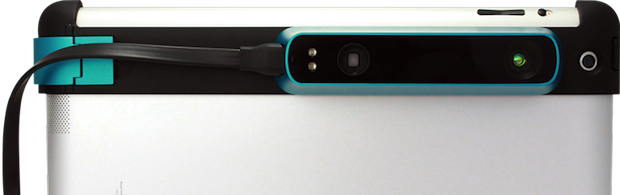
External 3D sensor beats records at the box office on Kickstarter . The planned $ 100,000 was collected in just 3.5 hours, and on the second day half a million are already running. The "structural sensor", as the developers call it, is something like a Kinect miniature and attached to the camera of a mobile device. The demo application attached to the sensor already allows you to:
- Scan objects - capture models of objects and export them to CAD or 3D printing, in OBJ, STL, or PLY format, which can be immediately uploaded to Shapeways.com for 3D printing.
- Build a room model - Easily capture a 3D model of a room by simply spinning around. Then, touching any two points, you can get the distance between them.
- Augmented reality - in the room in which you are located you can place a virtual pet that will interact with real objects
Two IR LEDs and an additional camera allow you to receive information about the distance to objects

and enable night vision mode

On the left is a regular photo, and on the right is IR vision with an IR flash
Nutrition
The battery charge (apparently the device has its own battery) lasts for 4 hours of active use, or for more than 1000 standby times.
SDK
An SDK has already been developed for iOS developers that allows you to work with the sensor.


Using a special hacker cable and drivers (Windows, Android, OS X, Linux), you can connect the sensor to almost any device, for example, Oculus Rift.

Specifications


And now about the sad
Such a toy costs about $ 400. And it is designed to work with devices that have an Apple Lightning connector, and this is not even all iPhones and iPads.

This limitation is due to the increased bandwidth of Apple Lightning, which does not allow to provide a 30 pin connector.
One can only hope that after such an impressive success, developers will make adjustments to development plans, reduce the price of the final device and expand the list of supported platforms.
Plans