August 24, 2013 at 11:53
The App Store changes the ranking algorithm
- Transfer
Apple is probably testing changes in the iTunes App Store ranking algorithms - now user reviews and some other new factors are taken into account to calculate the position of the application. Whether such changes are experimental in nature or indicate a new redistribution of ratings is not yet clear. However, they already lead to changes in the positions of applications in the tops - without increasing or decreasing the number of downloads.
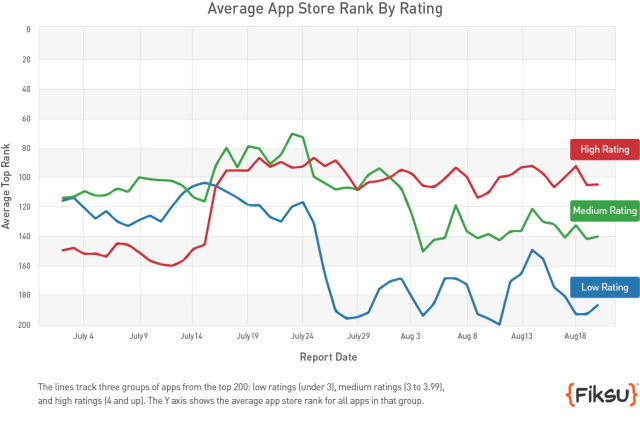
The first taking place in late July saw the company Fiksu - with an estimate of the application of 4 or more got the best position in the rankings. At the same time, applications with a score of three or lower lost their position, despite the fact that the number of downloads they have remained relatively unchanged. Applications with average ratings (from 3 to 4) practically remained in their places.
Previously, the number of downloads was the main parameter for determining the position of the application on the charts for the App Store. Now, it seems that the opinions of users have also begun to be taken into account.
There is also some evidence that ratings for the new version of the application may have a greater impact on the tops than ratings for the old - and in general this is quite logical. Imagine a scenario in which a developer releases an update to a well-known and well-established application that users really dislike - for example, it pinches monetization. They begin to “minus” it - in such a situation, a drop in the positions of applications in the rating seems quite logical. In addition, taking feedback into account can prevent applications that deal with, for example, explicit spam from getting to the top - yes, they will get downloads, but negative user reviews will prevent them from becoming leaders.
Another change noticed by Fiksu is the update frequency of the tops. In the past, they were updated every 15 minutes, which allowed developers to observe (and change) practically in real time how the settings affect the positions of the application. Now positions change every three hours.
It is said that this change will help the App Store fight those who use automated wrapping tools. Potentially, the slowdown will give Apple time to identify “short peak downloads,” explains Fiksu, which is typically associated with robots and other inorganic reasons for downloads. In theory, a delay could also allow Apple to explore anomalies in how downloads flow and prevent charts of the apps that buy them from getting on the charts.
Director of Appsfire Oriel Oyon also notes that some developers have discovered that Apple has begun to account for refunds and in a different way to process money data for free-to-play games. He specifically drew attention to changes in the Top Grossing Ranks, noting that Pandora and Rdio had never reached such a position before.
However, he warns that these changes do not yet mean that Apple has completely eliminated the possibility of rating manipulation. “Everyone is still playing ratings, and position improvement can still be achieved through many ad networks, even with a reduction in update time of up to 3 hours,” he adds.
The head of MobileDevHQ, Jan Sefferman, noticed another change in the App Store. Search results for iPhone apps vary when looking from iPad or iPhone. Given Fisku’s data on the changes, it can be assumed that Apple has finally taken up the process of opening applications, rather than simply improving the charts.
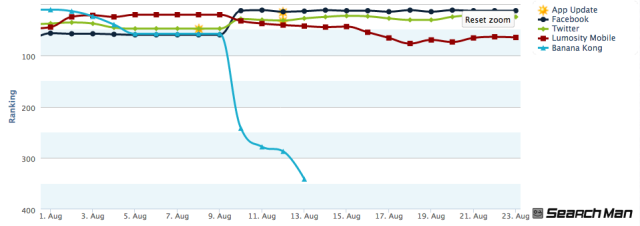
SearchMan’s Niren Hiro also reports that developers in the US and Japan talked about the impact of user engagement (time spent in the application, number of launches, etc.) on positions in the category, and that from August 5, these changes are taken into account in all countries.
Like any changes, Apple’s new algorithms will certainly be the subject of close attention of developers. They will try to minimize the damage from innovations - for example, in the case of ratings, redirect negative reviews to third-party services, and only positive ones in the App Store. It’s up to Apple to keep track of this and maintain the integrity of its store and ranking algorithms. New factors seem interesting enough and objective for developers - in the end, both we and Apple want to see high-quality and exciting applications in leading positions in the store.
The first taking place in late July saw the company Fiksu - with an estimate of the application of 4 or more got the best position in the rankings. At the same time, applications with a score of three or lower lost their position, despite the fact that the number of downloads they have remained relatively unchanged. Applications with average ratings (from 3 to 4) practically remained in their places.
Previously, the number of downloads was the main parameter for determining the position of the application on the charts for the App Store. Now, it seems that the opinions of users have also begun to be taken into account.
There is also some evidence that ratings for the new version of the application may have a greater impact on the tops than ratings for the old - and in general this is quite logical. Imagine a scenario in which a developer releases an update to a well-known and well-established application that users really dislike - for example, it pinches monetization. They begin to “minus” it - in such a situation, a drop in the positions of applications in the rating seems quite logical. In addition, taking feedback into account can prevent applications that deal with, for example, explicit spam from getting to the top - yes, they will get downloads, but negative user reviews will prevent them from becoming leaders.
Another change noticed by Fiksu is the update frequency of the tops. In the past, they were updated every 15 minutes, which allowed developers to observe (and change) practically in real time how the settings affect the positions of the application. Now positions change every three hours.
It is said that this change will help the App Store fight those who use automated wrapping tools. Potentially, the slowdown will give Apple time to identify “short peak downloads,” explains Fiksu, which is typically associated with robots and other inorganic reasons for downloads. In theory, a delay could also allow Apple to explore anomalies in how downloads flow and prevent charts of the apps that buy them from getting on the charts.
Director of Appsfire Oriel Oyon also notes that some developers have discovered that Apple has begun to account for refunds and in a different way to process money data for free-to-play games. He specifically drew attention to changes in the Top Grossing Ranks, noting that Pandora and Rdio had never reached such a position before.
However, he warns that these changes do not yet mean that Apple has completely eliminated the possibility of rating manipulation. “Everyone is still playing ratings, and position improvement can still be achieved through many ad networks, even with a reduction in update time of up to 3 hours,” he adds.
The head of MobileDevHQ, Jan Sefferman, noticed another change in the App Store. Search results for iPhone apps vary when looking from iPad or iPhone. Given Fisku’s data on the changes, it can be assumed that Apple has finally taken up the process of opening applications, rather than simply improving the charts.
SearchMan’s Niren Hiro also reports that developers in the US and Japan talked about the impact of user engagement (time spent in the application, number of launches, etc.) on positions in the category, and that from August 5, these changes are taken into account in all countries.
Like any changes, Apple’s new algorithms will certainly be the subject of close attention of developers. They will try to minimize the damage from innovations - for example, in the case of ratings, redirect negative reviews to third-party services, and only positive ones in the App Store. It’s up to Apple to keep track of this and maintain the integrity of its store and ranking algorithms. New factors seem interesting enough and objective for developers - in the end, both we and Apple want to see high-quality and exciting applications in leading positions in the store.