PRIMERGY RX900 S2: Fujitsu monolithic 8-processor server
There are two ways to increase computing power: increasing the number of processors in each computing node (vertical scaling) and increasing the number of computing nodes (horizontal scaling). Currently, the first path is implemented by SMP-systems (UMA and NUMA), in the second - by distributed computing. Regardless of which path will be preferred, Fujitsu is ready to provide its solutions for any of them:
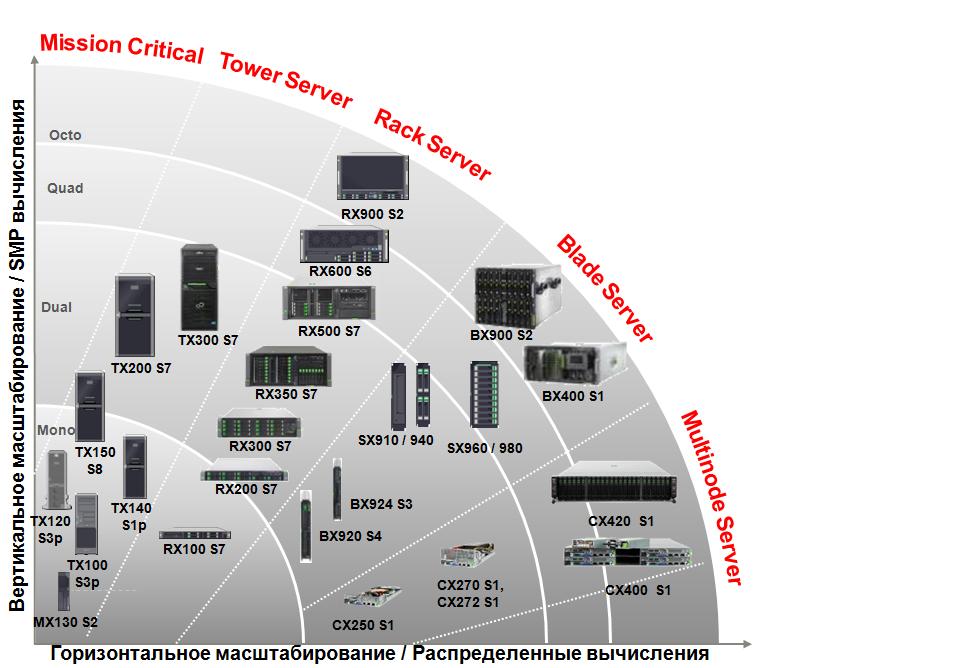
At the very top of the diagram, there is the flagship of the Fujitsu PRIMERGY server family - the RX900 S2 server, which features eight processor sockets. This server will be discussed today.
The PRIMERGY RX900 S2 server is a modern 8U rackmount server with 8 processor sockets for Intel Xeon processors of the E7-8800 family, which includes models with 8 and 10 cores. Thus, the RX900 can have up to 80 processor cores, and through Intel Hyper-Threading technology to process 160 threads simultaneously. Such an impressive number of cores requires an appropriate amount of RAM, the maximum size of which in this server can reach 4 TB. This amount is achieved by installing 128 DIM3 DDR3 modules with ECC support of 32 GB each.
To improve reliability and fault tolerance, memory mirroring can be used, and the built-in RAS functions in the processor can effectively bypass errors, eliminating the appearance of a "blue screen of death" (BSOD).
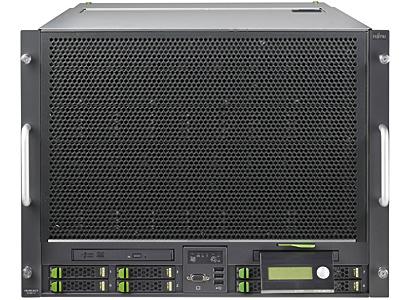
The disk subsystem of the server in question includes up to 8 SAS 2.0 hard drives or SSDs (2.5 ") with an interface speed of 6 Gb / s with a total capacity of up to 8 TB, which can be organized in RAID levels 0/1/5/6/10 / 50/60 using a hardware RAID controller.In addition, the RX900 supports up to 4 PCI-Express 2.0 x4 SSD drives with a total capacity of up to 4.8 TB.If this is not enough, use Fujitsu ETERNUS JX40 Direct Attach Storage (DAS) , which takes an extra 2U in the rack, you can add another 24 2.5 "drives.

The PRIMERGY RX900 S2 I / O subsystem contains 6 gigabit Ethernet ports and up to two 10 Gb / s Ethernet ports with SFP + slots that allow you to install both optical SFP + modules and direct-connected cables up to 10 m long. If the bandwidth of these network interfaces is not enough , you can install additional Fiber Channel, Infiniband or Ethernet adapters and others, using the available 16 PCI-Express 2.0 slots: 2 x4 slots (this uses a physical x8 slot), the rest x8.
The RX900 power system includes up to 4 2000 W power supplies each, capable of providing 2 + 1 and 2 + 2 redundancy with the possibility of using independent power sources to increase server fault tolerance. To increase the latter and reduce server shutdown time for the time of work on the replacement of various components, the server widely uses hot-swappable technologies: for example, without turning off the server, you can replace power supplies, hard drives, cooling fans and some PCI-Express devices.
The Fujitsu PRIMERGY RX900 S2 server is built on the Intel QuickPath Interconnect (QPI) architecture, which implies the presence of a memory controller in the processor and the use of a high-speed QPI bus to connect processors to each other and to I / O hubs (IOH). At the same time, the memory uses the NUMA architecture: its own memory for each processor is local, and the memory connected to other processors is remote. Another feature of this architecture is the scaling of I / O bandwidth depending on the number of I / O hubs.
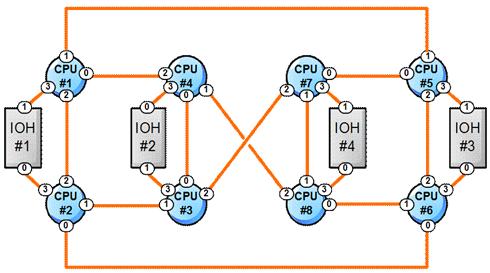
Each of the Intel Xeon processors of the E7-8800 family has 4 QPI buses, while each IOH has 2. The connection diagram of the processors (CPU) and hubs (IOH) is shown in the figure below:
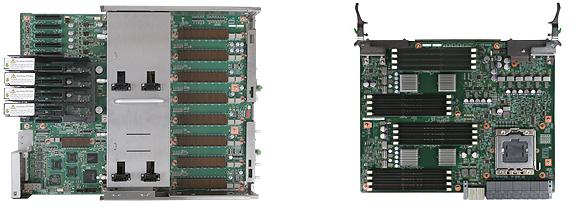
Considering the specifics of the QPI architecture, in the PRIMERGY RX900 S2 processors are connected to the system board not directly, but through a special riser (CPUMemory Board - CPUMEMR), which also has its local RAM. At the same time, each processor is placed on a separate CPUMEMR with one processor socket and 16 RAM slots. This design has increased the density of components in the server. In the photographs below: on the left is the motherboard, on the right is CPUMEMR.
Fujitsu PRIMERGY RX900 S2 servers initially have extensive linear scalability capabilities, which, thanks to the Intel QPI architecture, are implemented inside the server chassis without requiring additional equipment that could lead to a change in the existing data center infrastructure.
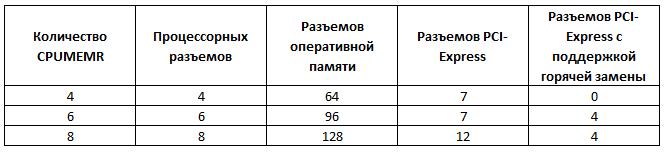
In the basic configuration, the RX900 has 4 processor sockets and 64 RAM sockets (4 CPUMEMR). Further building is done by adding additional processor risers, while configurations with 6 and 8 processors are supported. In addition, adding every two CPUMemory Boards activates an additional I / O hub, enabling the inclusion of appropriate PCI-Express slots. Thus, a simultaneous increase in I / O performance, memory size and processing power is provided.
Depending on the number of CPUMEMR, the PRIMERGY RX900 S2 server will have the following number of corresponding connectors:
Servers with 8 processor sockets are usually perceived as very expensive and niche devices. This opinion is quite justified, because the cost of such decisions often exceeds the mark of $ 100,000. The high cost imposes an appropriate responsibility when making decisions related to the acquisition of such servers, thereby increasing the demand for brand-name ready-made solutions, the operability and compatibility of components of which are guaranteed by the manufacturer.
The second generation of the Fujitsu PRIMERGY RX900 servers, which at a reasonable price, provides much more serious levels of reliability and fault tolerance, is precisely such a solution. At the same time, the RX900 is designed specifically for mission-critical applications, enterprise databases and large-scale consolidation of virtual machines, taking into account the requirements imposed by the respective tasks. It is the monolithic design of PRIMERGY RX900 that makes full use of the hot-swappable functionality of components, in contrast to solutions composed of two 4-processor systems, the design of which requires the entire system to be stopped to access some internal components or power supplies to replace them.
It is also important that Fujitsu provides a three-year warranty on this server with service on site. You can also purchase various support options, including round-the-clock service with on-site departure for four hours. Thus, the presence of various technologies for protection against failures together with high-quality service significantly reduce the time of forced downtime of expensive equipment.
At the very top of the diagram, there is the flagship of the Fujitsu PRIMERGY server family - the RX900 S2 server, which features eight processor sockets. This server will be discussed today.
Specifications
The PRIMERGY RX900 S2 server is a modern 8U rackmount server with 8 processor sockets for Intel Xeon processors of the E7-8800 family, which includes models with 8 and 10 cores. Thus, the RX900 can have up to 80 processor cores, and through Intel Hyper-Threading technology to process 160 threads simultaneously. Such an impressive number of cores requires an appropriate amount of RAM, the maximum size of which in this server can reach 4 TB. This amount is achieved by installing 128 DIM3 DDR3 modules with ECC support of 32 GB each.
To improve reliability and fault tolerance, memory mirroring can be used, and the built-in RAS functions in the processor can effectively bypass errors, eliminating the appearance of a "blue screen of death" (BSOD).
The disk subsystem of the server in question includes up to 8 SAS 2.0 hard drives or SSDs (2.5 ") with an interface speed of 6 Gb / s with a total capacity of up to 8 TB, which can be organized in RAID levels 0/1/5/6/10 / 50/60 using a hardware RAID controller.In addition, the RX900 supports up to 4 PCI-Express 2.0 x4 SSD drives with a total capacity of up to 4.8 TB.If this is not enough, use Fujitsu ETERNUS JX40 Direct Attach Storage (DAS) , which takes an extra 2U in the rack, you can add another 24 2.5 "drives.
The PRIMERGY RX900 S2 I / O subsystem contains 6 gigabit Ethernet ports and up to two 10 Gb / s Ethernet ports with SFP + slots that allow you to install both optical SFP + modules and direct-connected cables up to 10 m long. If the bandwidth of these network interfaces is not enough , you can install additional Fiber Channel, Infiniband or Ethernet adapters and others, using the available 16 PCI-Express 2.0 slots: 2 x4 slots (this uses a physical x8 slot), the rest x8.
The RX900 power system includes up to 4 2000 W power supplies each, capable of providing 2 + 1 and 2 + 2 redundancy with the possibility of using independent power sources to increase server fault tolerance. To increase the latter and reduce server shutdown time for the time of work on the replacement of various components, the server widely uses hot-swappable technologies: for example, without turning off the server, you can replace power supplies, hard drives, cooling fans and some PCI-Express devices.
Architecture features
The Fujitsu PRIMERGY RX900 S2 server is built on the Intel QuickPath Interconnect (QPI) architecture, which implies the presence of a memory controller in the processor and the use of a high-speed QPI bus to connect processors to each other and to I / O hubs (IOH). At the same time, the memory uses the NUMA architecture: its own memory for each processor is local, and the memory connected to other processors is remote. Another feature of this architecture is the scaling of I / O bandwidth depending on the number of I / O hubs.
Each of the Intel Xeon processors of the E7-8800 family has 4 QPI buses, while each IOH has 2. The connection diagram of the processors (CPU) and hubs (IOH) is shown in the figure below:
Considering the specifics of the QPI architecture, in the PRIMERGY RX900 S2 processors are connected to the system board not directly, but through a special riser (CPUMemory Board - CPUMEMR), which also has its local RAM. At the same time, each processor is placed on a separate CPUMEMR with one processor socket and 16 RAM slots. This design has increased the density of components in the server. In the photographs below: on the left is the motherboard, on the right is CPUMEMR.
Scaling
Fujitsu PRIMERGY RX900 S2 servers initially have extensive linear scalability capabilities, which, thanks to the Intel QPI architecture, are implemented inside the server chassis without requiring additional equipment that could lead to a change in the existing data center infrastructure.
In the basic configuration, the RX900 has 4 processor sockets and 64 RAM sockets (4 CPUMEMR). Further building is done by adding additional processor risers, while configurations with 6 and 8 processors are supported. In addition, adding every two CPUMemory Boards activates an additional I / O hub, enabling the inclusion of appropriate PCI-Express slots. Thus, a simultaneous increase in I / O performance, memory size and processing power is provided.
Depending on the number of CPUMEMR, the PRIMERGY RX900 S2 server will have the following number of corresponding connectors:
Application Features and Benefits
Servers with 8 processor sockets are usually perceived as very expensive and niche devices. This opinion is quite justified, because the cost of such decisions often exceeds the mark of $ 100,000. The high cost imposes an appropriate responsibility when making decisions related to the acquisition of such servers, thereby increasing the demand for brand-name ready-made solutions, the operability and compatibility of components of which are guaranteed by the manufacturer.
The second generation of the Fujitsu PRIMERGY RX900 servers, which at a reasonable price, provides much more serious levels of reliability and fault tolerance, is precisely such a solution. At the same time, the RX900 is designed specifically for mission-critical applications, enterprise databases and large-scale consolidation of virtual machines, taking into account the requirements imposed by the respective tasks. It is the monolithic design of PRIMERGY RX900 that makes full use of the hot-swappable functionality of components, in contrast to solutions composed of two 4-processor systems, the design of which requires the entire system to be stopped to access some internal components or power supplies to replace them.
It is also important that Fujitsu provides a three-year warranty on this server with service on site. You can also purchase various support options, including round-the-clock service with on-site departure for four hours. Thus, the presence of various technologies for protection against failures together with high-quality service significantly reduce the time of forced downtime of expensive equipment.