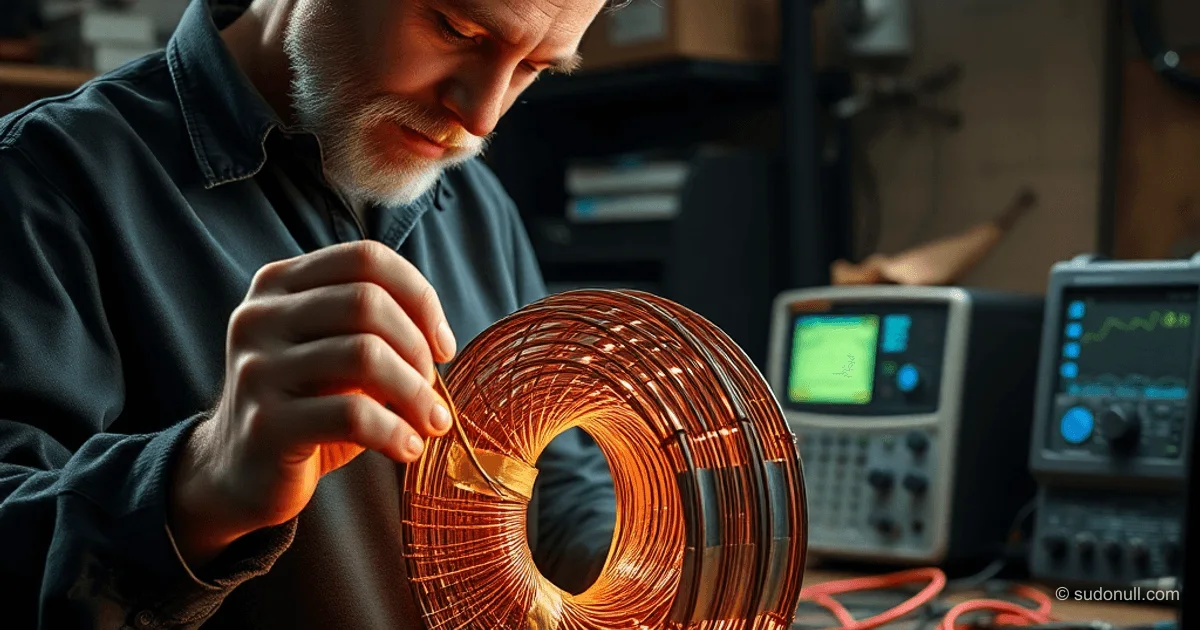
# Safe Measurements in the Primary Circuit: How to Build a Powerful Isolation Transformer for Electronics Repair
Repairing switching power supplies requires special caution: standard oscilloscopes with grounded inputs create short-circuit risks when probing the primary side. This article breaks down the design of a powerful isolation transformer (1–2 kVA) that delivers safe power not just to individual boards but to entire household appliances during diagnostics.
Why Standard Oscilloscopes Are Dangerous When Working with the Primary Side of Power Supplies?
Most desktop oscilloscopes connect the ground of all channels to the protective earth (PE) conductor via the power cord. Hooking up a probe to the primary circuit of a switching power supply (say, to one of the mains terminals) creates a direct path to ground. This can short the phase to neutral through the scope's internal circuitry. Outcomes range from tripping the breaker to frying the oscilloscope or the device under test. It's especially critical when diagnosing gear without galvanic isolation, like washing machines or power supplies for beefy audio rigs.
Three Options for Safe Measurements: Comparison and Choice
There are three technical approaches to isolating test equipment:
- Portable oscilloscope with isolated channels — provides full galvanic isolation, but pro models (like those from Keysight or Tektronix) cost over 500,000 rubles. Great for fieldwork, but overkill and pricey for a home workshop.
- Differential high-voltage probe — measures potential differences between any two points in the circuit. But quality units (1000–2000 V) run 70,000–150,000 rubles—about the price of a scope. Key drawback: it only handles measurements, not safe powering of the full device from the mains.
- Isolation transformer — creates galvanic isolation between the mains and load. Lets you safely power individual boards or whole appliances (washing machines, amplifiers). Upfront build cost, but pays off with regular repairs.
For a complete solution (safe measurements + full-load device testing), the isolation transformer is the way to go.
Power Matters: Why You Need a 1–2 kVA Transformer?
Low-power lab transformers (100–300 VA) won't cut it for household gear diagnostics. A washing machine in heating and spin modes pulls up to 2.5 kW, with motor inrush currents 3–5 times rated. For proper testing, the transformer must handle:
- Short-term overloads of 200–300% rated
- Reactive loads (motors, compressors)
- Peak currents without voltage sag
A 1–2 kVA unit gives headroom for the heating element (2–2.5 kW), pump, and motor all at once. Essential for spotting faults that only show up under load.
Isolation Transformer Market: Shortages and Marketing Hype
Hunting for off-the-shelf options reveals two issues. First, Russia lacks mass production of affordable 1–2 kVA units with high-voltage isolation. Flea markets only stock puny models (100–300 VA) that don't meet the spec. Second, in the Hi-Fi audio world, "power conditioners" promise sonic bliss but lack spec transparency. At 500,000–1,000,000 rubles, they're unjustifiable for repair work—often just repackaged standard transformers without beefed-up isolation.
Key Parameters for Designing an Isolation Transformer
For a DIY build, keep these in mind:
- Toroidal core — minimizes stray fields and keeps it compact. Sizing: for 2 kVA, need a core with cross-section of at least 35 cm² (e.g., OL50/80-60).
- High-voltage insulation — between primary and secondary windings, and between layers of the same winding. Use Mylar film 0.1–0.2 mm thick with double voltage margin (at least 4 kV).
- Electrostatic shield — 0.05–0.1 mm copper foil between windings, grounded via a 1–10 nF capacitor. Cuts capacitive coupling and noise.
- Winding quality — strictly layer-by-layer with interlayer insulation. "Rope" winding spikes no-load current, causes overheating, and tanks efficiency.
Pay special attention to lead mounting: use stranded flexible wire (2.5 mm² cross-section) to avoid breaks from vibration. Input/output connectors must match the power (e.g., IEC 320 C14 for primary).
What Matters
- A 1–2 kVA isolation transformer is essential for safely load-testing household appliances, not just boards.
- Insulation quality trumps rated power: skimpy interlayer insulation or no shield makes it unsafe.
- DIY winding demands precise turn counts and tight layer packing—sloppy "rope" winding boosts parasitics and hurts reliability.
- For a home shop, the sweet spot is isolation transformer + 1000 V differential probe for primary-side measurements.
— Editorial Team










No comments yet.