July 26, 2013 at 16:15
Frequency offset for SDR radio - Ham it up v1.2 upconverter
 Some time ago, I wrote about universal $ 20 radio receivers from TV tuners on rtl2832. Their biggest drawback was that they can not receive anything below 50 MHz (e4000 - does not work below 50 MHz, R820T - below 24 MHz), and in this range - 3/4 of all the interesting things that can be heard on the air due to the fact that short waves are reflected from the ionosphere - and the communication range is no longer limited by direct visibility.
 You can eliminate this drawback by adding a frequency converter to it. To make a high-quality (with all filters) converter yourself is quite difficult and expensive, so I had to buy ready-made: Ham-it-up v1.2with 125MHz quartz ($ 42.95, from the USA it went a little longer than a month). Brief test results and a few tricks for successful reception at short waves - under the cut.
Converter itself
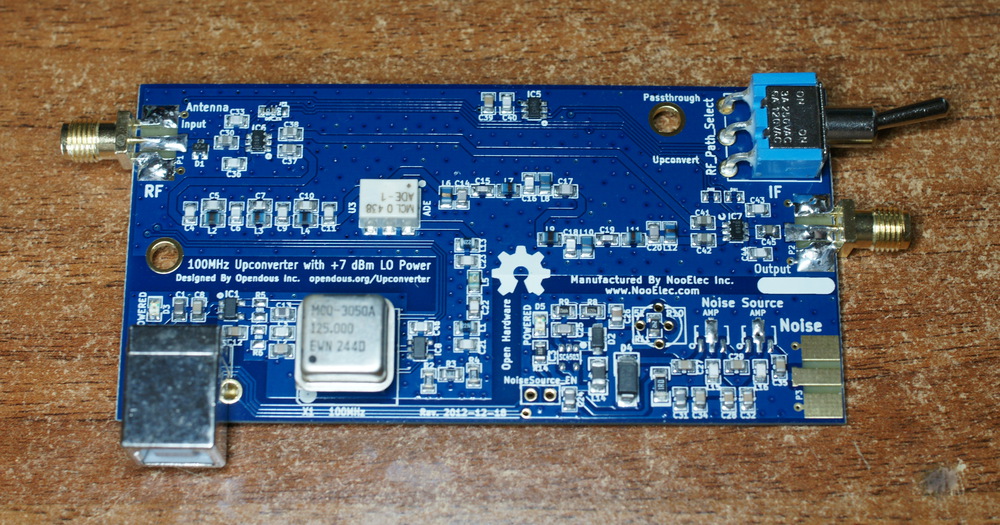
The principle of operation is that we cut off everything above 50 MHz from the incoming signal from the antenna, mix it with a 125 MHz frequency obtained from a crystal oscillator, filter out the excess from the signal again, and we get our signal shifted upward by 125 MHz. Those. what came from the antenna at 10 MHz - in the receiver we will receive at a frequency of 135 MHz.
The choice of quartz at 125 MHz is very important, many converters use quartz at 100 MHz and the received signal is obtained just in the region of powerful FM stations, which can be a serious problem and you have to fence very neat shielding of absolutely everything.
This converter does not have a built-in amplifier, and the conversion loss is about 10dB (i.e. the signal becomes 10 times weaker). However, as it turned out, this is not a problem - there is so much noise on the air that the amplifier inside the RTL2832 never had to be twisted to the maximum.
Trivial Tricks
I suffered for a long time because of the poor quality of reception. As it turned out, many poorly made electronic devices crap on the air and the power grid just in the range we are interested in (0-50 MHz). In my case, the wildest noise (~ 30-100 times the background) was from a LED desk lamp and an old LCD monitor (backlighting on lamps with a cold cathode). Also, do not keep the computer with an open case - it will also shine interference.The computer should be grounded, some spoke well about using laptops with battery power (to exclude interference from the network)
An antenna for low frequencies needs much larger dimensions than for ~ 433 MHz. I did just that - I lowered 15m of copper wire from the balcony (a rough formula for estimating the required optimal length for a quarter-wave antenna-monopole is 71250mm / frequency in MHz (for a 22AWG cable)).
And finally - much more is heard at night than during the day - due to a change in the state of the ionosphere.
Listening
Mostly HF radio stations are heard - at night we managed to listen to radio stations from France, Italy, Germany, Bulgaria, Great Britain and China (somewhere from 7 to 13 MHz). Amateur transmitters - managed to be found only in Morse code. After a long search for the best settings, I also managed to hear the Doomsday radio station - UVB-76 : I had no luck with the balcony facing south, and the station in the north-west of Moscow.At 27 MHz, less is heard than I expected - only radios that are relatively close to me (that is, in dialogs I often hear only one person). Apparently, a more thorough approach to the design and coordination of the antenna is needed.
Making the volume lower:
Good luck with your ether research :-)