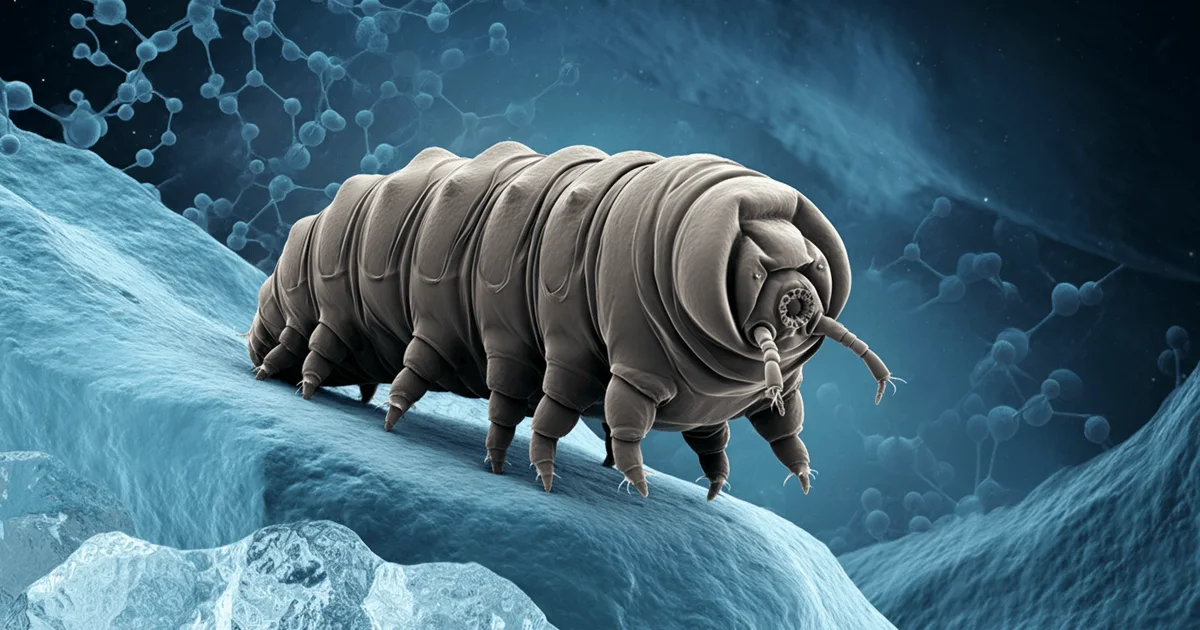
Tardigrades: Nature's Ultimate Survivors and Their Biotech Implications
Tardigrades, also known as 'water bears,' are renowned for their phenomenal resilience to extreme conditions, from the vacuum of deep space to temperatures near absolute zero. These microscopic invertebrates thrive where life is unimaginable for most organisms, employing unique molecular mechanisms that challenge standard evolutionary models and open new frontiers in biotechnology.
Unveiling the World of Tardigrades
Tardigrades are eight-legged microscopic invertebrates, rarely exceeding 1.5 mm in size. Despite their diminutive stature, they are among the most resilient creatures on Earth. Their name derives from the Latin _tardigradus_ ('slow-stepper'), reflecting their unhurried gait. These organisms are ubiquitous: they can be found in garden moss, Arctic ice, the Mariana Trench's abyssal depths, and scorching hot springs. Over 1,300 species of tardigrades have been described to date, each possessing unique adaptations for survival. Discovered in 1773, these 'little water bears' continue to astound scientists with their ability to enter a state of cryptobiosis, allowing them to endure conditions lethal to other life forms.
Phenomenal Resilience: The Technical Specifications of Survival
Tardigrades' resistance to external stressors is truly astonishing. Their biological 'specifications' appear to be the result of engineering an ultra-reliable system capable of functioning under any circumstances. Let's examine the key parameters of their survival:
- Temperature: Tardigrades can withstand extreme temperature fluctuations: from −272 °C (just one degree above absolute zero, where helium is still liquid) to brief heating up to +150 °C.
- Pressure: These microorganisms survive pressures up to 600 MPa (equivalent to approximately 6,000 atmospheres). For comparison, the maximum pressure at the bottom of the Mariana Trench is about 1,100 atmospheres. Such excessive pressure resistance is unparalleled in known terrestrial conditions.
- Radiation: The lethal dose of radiation for humans is about 5 Gy. Tardigrades, however, can tolerate up to 5,000 Gy of gamma radiation, which is 1,000 times the lethal dose for most multicellular organisms. Some species demonstrate resistance up to 6,200 Gy.
- Vacuum: In 2007, the European Space Agency (ESA) sent tardigrades into orbit aboard the FOTON-M3 satellite. After ten days in open space, exposed to vacuum, ultraviolet radiation, and cosmic rays, some tardigrades returned alive and even reproduced.
- Dehydration (Anhydrobiosis): Tardigrades can lose up to 97% of their body water, entering a dehydrated 'tun' state. In this condition, their metabolism drops to 0.01% of normal. This is essentially equivalent to a
SIGSTOPcommand for a multicellular organism. After rehydration, they resume vital activities within half an hour.
Molecular Mechanisms of Survival: Biological Hacks
Such remarkable resilience is underpinned by complex and unique molecular mechanisms, which can truly be described as biological 'hacks':
Trehalose and Vitrification. When dehydrated, many tardigrade species synthesize trehalose — a disaccharide that forms a glassy matrix upon drying. This 'biological glass' fixes cell membranes and proteins in their functional positions, preventing degradation. This process is analogous to vitrification used in cryobiology for preserving embryos, but tardigrades achieve it autonomously and without external reagents. Notably, some tardigrade species use other, not yet fully understood, mechanisms to achieve a similar effect without resorting to trehalose.
Dsup Protein (Damage Suppressor). In 2016, researchers from the University of Tokyo discovered a unique protein in the genome of the tardigrade _Ramazzottius varieornatus_, named Dsup (Damage Suppressor). This protein physically envelops DNA, much like a protective film, and reduces radiation damage by approximately 40%. Dsup is unique to tardigrades and is not found in other known organisms on Earth. Experiments have shown that introducing the Dsup gene into human cell cultures (HEK293) significantly increases their resistance to X-ray radiation, making them twice as resistant. This discovery holds immense significance for genetic engineering and space medicine.
Intrinsically Disordered Proteins (IDPs). Another key element in the tardigrade's arsenal is intrinsically disordered proteins (IDPs). Unlike most proteins, which have a distinct tertiary structure, tardigrade IDPs are unstructured under normal conditions. However, when extreme conditions arise, such as dehydration, these proteins form a rigid glassy matrix that stabilizes and protects cellular structures. Thus, tardigrades utilize proteins that activate and perform a protective function only under stress, remaining 'dormant' in ordinary conditions.
Horizontal Gene Transfer. In 2015, an article was published suggesting that up to 17% of the _Hypsibius dujardini_ tardigrade genome consisted of borrowings from bacteria, archaea, fungi, and plants. Although subsequent studies adjusted this figure to 6–8% (some turned out to be contamination), even 6% is an abnormally high amount for an animal. For comparison, in humans, the proportion of horizontally transferred genes is less than 1%. This indicates that tardigrades literally 'assemble' their genome from 'open-source libraries' of various organisms, integrating useful adaptations.
The Evolutionary Paradox: Redundant Resilience
Tardigrades' phenomenal resilience to conditions rarely encountered on Earth poses serious questions for evolutionary biologists. For instance, why would an organism need to withstand 6,000 atmospheres if the planet's maximum pressure doesn't exceed 1,100 atmospheres? Or radiation 1,000 times higher than Earth's background levels? And why would evolution invest resources in vacuum protection if tardigrades don't inhabit space?
The standard explanation is 'cross-tolerance': adaptation to one stress factor (e.g., dehydration, which regularly occurs in moss) can 'for free' confer resistance to others, as many damaging mechanisms (oxidative stress, DNA breaks) are similar. However, this hypothesis does not fully explain all phenomena. For example, resistance to 6,000 atmospheres of pressure does not correlate well with dehydration, and some tardigrade species that do not enter anhydrobiosis still demonstrate high radiation resistance. Molecular clocks place the origin of tardigrades in the Cambrian period, approximately 500 million years ago. During this time, they survived five mass extinctions, including the Permian, which wiped out 96% of marine species. Their 'excessive' resilience to conditions that never existed or do not exist on Earth is a true evolutionary paradox.
Tardigrades and the Panspermia Hypothesis
The idea of panspermia – the hypothesis that life (or its precursors) was brought to Earth from space – was long considered marginal. However, tardigrades provide compelling 'proof of concept' for this theory. They are living evidence that a multicellular organism _can_ survive interplanetary travel, enduring vacuum, radiation, and extreme temperatures. But what about impact upon landing?
A study published in 2021 in the journal _Astrobiology_ showed that tardigrades in their tun state (dehydrated 'barrels') survived impacts with a sand target at speeds up to 728 m/s. At 901 m/s, there were no survivors. The impact pressure reached 1.14 GPa, which is within the range of shock loads experienced when rock is ejected from a planet's surface due to a meteorite impact. Thus, theoretically, a meteorite impact could eject rock fragments containing tardigrades into space, which could then drift for millions of years, land on another planet, and 'wake up.'
This hypothesis received practical confirmation in 2019 when the Israeli lunar lander 'Beresheet' crashed upon landing on the Moon. A capsule from the Arch Mission Foundation was on board, containing thousands of dehydrated tardigrades encased in epoxy resin. The foundation's founder, Nova Spivack, stated that the tardigrades were "likely scattered across the lunar surface." Given their incredible resilience and capacity for long-term cryptobiosis (some studies suggest revival after 30 years of freezing, and disputed data after 120 years), it is quite plausible that they are still there intact, awaiting water for rehydration.
Practical Applications: Biotechnology of the Future
The unique adaptations of tardigrades unlock immense potential for the development of modern technologies, particularly in IT and biotechnology:
- Dsup in Gene Therapy and Space Medicine. Research into the Dsup protein is already actively underway as a potential tool for protecting human cells. If introducing a single gene can double the resistance of cells to radiation, this could revolutionize space medicine. Astronauts embarking on long-duration missions, such as to Mars, are exposed to significant radiation, and Dsup could solve part of this problem by providing protection at the cellular level.
- Dry Storage of Biomaterials. The principle of trehalose vitrification, used by tardigrades, could be adapted for the dry storage of vaccines, blood, enzymes, and other biological preparations. Today, most such materials require strict adherence to the 'cold chain,' making logistics extremely expensive and complex. Creating stable biopreparations that can be stored at room temperature for years could fundamentally change the pharmaceutical industry and the accessibility of medicines worldwide.
- Radiation-Resistant Cell Lines. Using Dsup to create radiation-resistant human cell lines would allow for more efficient research into radiation effects. This would eliminate the need for frequent sample replacement due to cell death, accelerating scientific discoveries in oncology and radiology.
- Inspiration for Engineering. The principles underlying tardigrade resilience can inspire engineers to create new materials and fault-tolerant systems capable of functioning in extreme conditions, mimicking biological protection mechanisms.
Extraterrestrial Origin?
The question of tardigrade origin remains open. On one hand, their genome fits well within Earth's tree of life, and fossil discoveries in Cretaceous amber (around 80 million years ago), along with molecular clock data, confirm their ancient terrestrial origin, tracing back to the Cambrian period. On the other hand, their excessive resilience to conditions simply not found on Earth raises questions. Evolution typically doesn't create such robust safety margins without corresponding selective pressure. Tardigrades, however, possess a 'storehouse of resistances for all occasions,' most of which have never been necessary under Earth's conditions.
This redundancy is the main argument for those who consider the hypothesis of an extraterrestrial origin for tardigrades. While certainly not direct proof of alien provenance, it is an intriguing evolutionary phenomenon that challenges our understanding of life's capabilities and its distribution throughout the universe.
Key Takeaways:
- Tardigrades possess unprecedented resilience to temperatures from -272 to +150 °C, pressures up to 600 MPa, radiation up to 5,000 Gy, and vacuum.
- Their survival is ensured by unique molecular mechanisms: trehalose synthesis (vitrification), the protective Dsup protein for DNA, and intrinsically disordered proteins (IDPs).
- A significant portion of the tardigrade genome is acquired through horizontal gene transfer, making them 'biological constructors' capable of integrating useful adaptations.
- The excessive resilience of tardigrades to conditions not found on Earth raises questions about evolutionary pressure and makes them a key 'proof of concept' for the panspermia hypothesis.
- Tardigrade research opens prospects for biotechnology: from increasing cellular radiation resistance for space medicine to creating stable biopreparations that do not require a cold chain.
— Editorial Team










No comments yet.