Rock and roll is dead and mud is not there yet
Hi% habrauser%!
In this topic, I would like to talk about such a genre of games as MUD
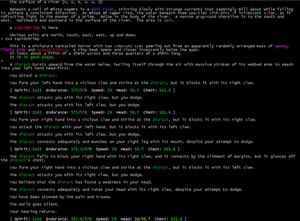 (Multi User Dungeon). These are fully textual MMORPGs with role-playing elements, hack and slash elements and interactive quests.
Back in 1975, when ordinary people could not afford to buy a computer, no one Richard Bartle delivered a teletype to the school - a system with a time sharing mode, where each subscriber answered in turn, and the entire "conversation" was printed on a wide paper tape. Question-answer had to be typed on the keyboard. It was such an ancient prototype of ICQ. The very chip of this teletype was that its operation algorithm could be changed. Here, I must add that Richard was an avid desktop RPG player and even published a small game magazine at school.
Due to the fact that Bartle studied well at school, he managed to gain access to this technique and learn how to program it. It was not difficult to guess what his efforts were directed at. First of all, Richard wrote a simple text quest, where a specific team was responsible for each action. It looked something like this: "Before you stand a huge dragon, if you want to kill him, dial 20R, if you want to escape, dial 19R."
In 1978, Richard enters the University of Essex and meets there with the same complete gamer as he is. Roy Trabshaw was a year older, but already had programming experience and dreamed of his own fantasy-style game. Roy's text quest interested Roy, but he wanted multiplayer. It was Trabshaw who named his first online project MUD. When creating the mad, Richard was responsible for the game world, thought out ways of interaction between the players, and Roy put his ideas into the game. By the end of the training, they were already working on the third version of MUD. When Roy left the university, Richard had to finish the game alone. By the way, Bartle made this game his thesis.
In Europe, MUDs have become especially popular on university networks, where they are played by a lot of people, both from the university and outside it. Because of this, such games even began to be called “Multi-Undergrad Destroyer” (Multi-Student Fighter) due to the fact that students spent a huge amount of time playing, forgetting about classes. The MMMs were mainly inspired by board role-playing games such as Dungeons & Dragons, which at that time reached their peak of popularity, especially after the release of Advanced Dungeons & Dragons (AD&D) in 1977.
In the early eighties, Alan Klets wrote a game called Milieu on CDC Cyber. In 1983, he ported it to IBM XT under the name Scepter of Goth. The game supported simultaneous connection from 10 to 16 players. This was the first commercial MPM. The author sold the right to use the game, and several companies even bought it. In 1989, TinyMUD appeared, in which players got the opportunity not only to participate in the game, but also to create a world in which they play.
In 1991, DikuMUD appeared, which led to the emergence of a huge number of hack-n-slash MPMs based on its source code. Also, several codebases based on it appeared (CircleMUD, Merc, ROM, NiMUD, SMAUG, Anatolia), which are still the basis for writing MTMs all over the world (and this is very bad).
In Russia, Mads were not very popular. Since our Internet was developing late with respect to the West, the peak of popularity was observed in the late 1990s and early 2000s, while in the most visited worlds the number of simultaneously playing participants usually did not exceed two to three hundred (in Western worlds but time could be observed up to a thousand people playing at the same time).
Players interact with the virtual world using commands sent via the telnet protocol. In response, they are sent descriptions of rooms, objects, events, characters of other players, NPCs and various other elements of the virtual world. Due to the peculiarities of the Russian language, nouns have to be used in the nominative case, and verbs in indefinite form. For example, to kill a golden dragon, you need to write this command: "kill the golden dragon."
Typically, actions in a game take place in a fantasy world, with battles and witchcraft populated by elves, goblins, orcs, and other fictional creatures. But there are MUDs with an entourage of techno-fantasy, cyberpunk, science fiction, post-apocalypse, even there are adult-oriented madas! As in any RPG, there are points of strength, agility, intelligence, wisdom, there are hp and mana, there are things that give certain characteristics.
The game space in madas is divided into cells (rooms) that have the appropriate properties ((for example: you can drown in the river, disguise yourself in the forest, weather phenomena do not affect you in the room). A group of locations united by one concept is reduced to the game zone - a whole region of a fictional world (castle, city, highway, dungeons).
The time in such games is divided into rounds, approximately equal to one second (round - the minimum period of time during which one event can happen - moving one cell, exchanging blows or spells during a battle, processing one team), and ticks, approximately equal to a minute (each of one or several ticks can lead to regeneration of character’s hit points, restoration of killed NPCs, and so on).
The gameplay in the MMM is exactly the same as in the rest mmorpg: exploring the world of the game, developing the game character and interacting with other players, so there is no point in describing it. I would also like to add that there are immortals in the game - a special class of players who manage the multi-player world. They conduct quests, maintain a fantasy atmosphere, monitor the order, identify bugs, create new zones, the game code.
I would like to note that there are a fairly large number of open source MUDs. In Russia, unfortunately, at the moment there is only one . But there are many foreign ones .
For those who want to play, here is a list of Russian-language madas , for those who know the English list of foreign MUDs well ..
In this topic, I would like to talk about such a genre of games as MUD
(Multi User Dungeon). These are fully textual MMORPGs with role-playing elements, hack and slash elements and interactive quests.Story
Back in 1975, when ordinary people could not afford to buy a computer, no one Richard Bartle delivered a teletype to the school - a system with a time sharing mode, where each subscriber answered in turn, and the entire "conversation" was printed on a wide paper tape. Question-answer had to be typed on the keyboard. It was such an ancient prototype of ICQ. The very chip of this teletype was that its operation algorithm could be changed. Here, I must add that Richard was an avid desktop RPG player and even published a small game magazine at school.
Due to the fact that Bartle studied well at school, he managed to gain access to this technique and learn how to program it. It was not difficult to guess what his efforts were directed at. First of all, Richard wrote a simple text quest, where a specific team was responsible for each action. It looked something like this: "Before you stand a huge dragon, if you want to kill him, dial 20R, if you want to escape, dial 19R."
In 1978, Richard enters the University of Essex and meets there with the same complete gamer as he is. Roy Trabshaw was a year older, but already had programming experience and dreamed of his own fantasy-style game. Roy's text quest interested Roy, but he wanted multiplayer. It was Trabshaw who named his first online project MUD. When creating the mad, Richard was responsible for the game world, thought out ways of interaction between the players, and Roy put his ideas into the game. By the end of the training, they were already working on the third version of MUD. When Roy left the university, Richard had to finish the game alone. By the way, Bartle made this game his thesis.
In Europe, MUDs have become especially popular on university networks, where they are played by a lot of people, both from the university and outside it. Because of this, such games even began to be called “Multi-Undergrad Destroyer” (Multi-Student Fighter) due to the fact that students spent a huge amount of time playing, forgetting about classes. The MMMs were mainly inspired by board role-playing games such as Dungeons & Dragons, which at that time reached their peak of popularity, especially after the release of Advanced Dungeons & Dragons (AD&D) in 1977.
In the early eighties, Alan Klets wrote a game called Milieu on CDC Cyber. In 1983, he ported it to IBM XT under the name Scepter of Goth. The game supported simultaneous connection from 10 to 16 players. This was the first commercial MPM. The author sold the right to use the game, and several companies even bought it. In 1989, TinyMUD appeared, in which players got the opportunity not only to participate in the game, but also to create a world in which they play.
In 1991, DikuMUD appeared, which led to the emergence of a huge number of hack-n-slash MPMs based on its source code. Also, several codebases based on it appeared (CircleMUD, Merc, ROM, NiMUD, SMAUG, Anatolia), which are still the basis for writing MTMs all over the world (and this is very bad).
In Russia, Mads were not very popular. Since our Internet was developing late with respect to the West, the peak of popularity was observed in the late 1990s and early 2000s, while in the most visited worlds the number of simultaneously playing participants usually did not exceed two to three hundred (in Western worlds but time could be observed up to a thousand people playing at the same time).
General
Players interact with the virtual world using commands sent via the telnet protocol. In response, they are sent descriptions of rooms, objects, events, characters of other players, NPCs and various other elements of the virtual world. Due to the peculiarities of the Russian language, nouns have to be used in the nominative case, and verbs in indefinite form. For example, to kill a golden dragon, you need to write this command: "kill the golden dragon."
Typically, actions in a game take place in a fantasy world, with battles and witchcraft populated by elves, goblins, orcs, and other fictional creatures. But there are MUDs with an entourage of techno-fantasy, cyberpunk, science fiction, post-apocalypse, even there are adult-oriented madas! As in any RPG, there are points of strength, agility, intelligence, wisdom, there are hp and mana, there are things that give certain characteristics.
The game space in madas is divided into cells (rooms) that have the appropriate properties ((for example: you can drown in the river, disguise yourself in the forest, weather phenomena do not affect you in the room). A group of locations united by one concept is reduced to the game zone - a whole region of a fictional world (castle, city, highway, dungeons).
The time in such games is divided into rounds, approximately equal to one second (round - the minimum period of time during which one event can happen - moving one cell, exchanging blows or spells during a battle, processing one team), and ticks, approximately equal to a minute (each of one or several ticks can lead to regeneration of character’s hit points, restoration of killed NPCs, and so on).
The gameplay in the MMM is exactly the same as in the rest mmorpg: exploring the world of the game, developing the game character and interacting with other players, so there is no point in describing it. I would also like to add that there are immortals in the game - a special class of players who manage the multi-player world. They conduct quests, maintain a fantasy atmosphere, monitor the order, identify bugs, create new zones, the game code.
Conclusion
I would like to note that there are a fairly large number of open source MUDs. In Russia, unfortunately, at the moment there is only one . But there are many foreign ones .
For those who want to play, here is a list of Russian-language madas , for those who know the English list of foreign MUDs well ..