Minnowboard - mini-computer on Intel Atom

At the “Automotive Linux Summit” conference held in late May, Intel introduced a robotic arm - a “fisherman,” which detected objects similar to fish and placed them in an aquarium. The brain of the robot was a Minnowboard mini computer , an analog of the Raspberry Pi on the Intel Atom processor . The Minnowboard project is currently at the stage of final preparations for entering the market, so I think the information about it will be of interest to the habr community, especially since this topic is being raised here for the first time.
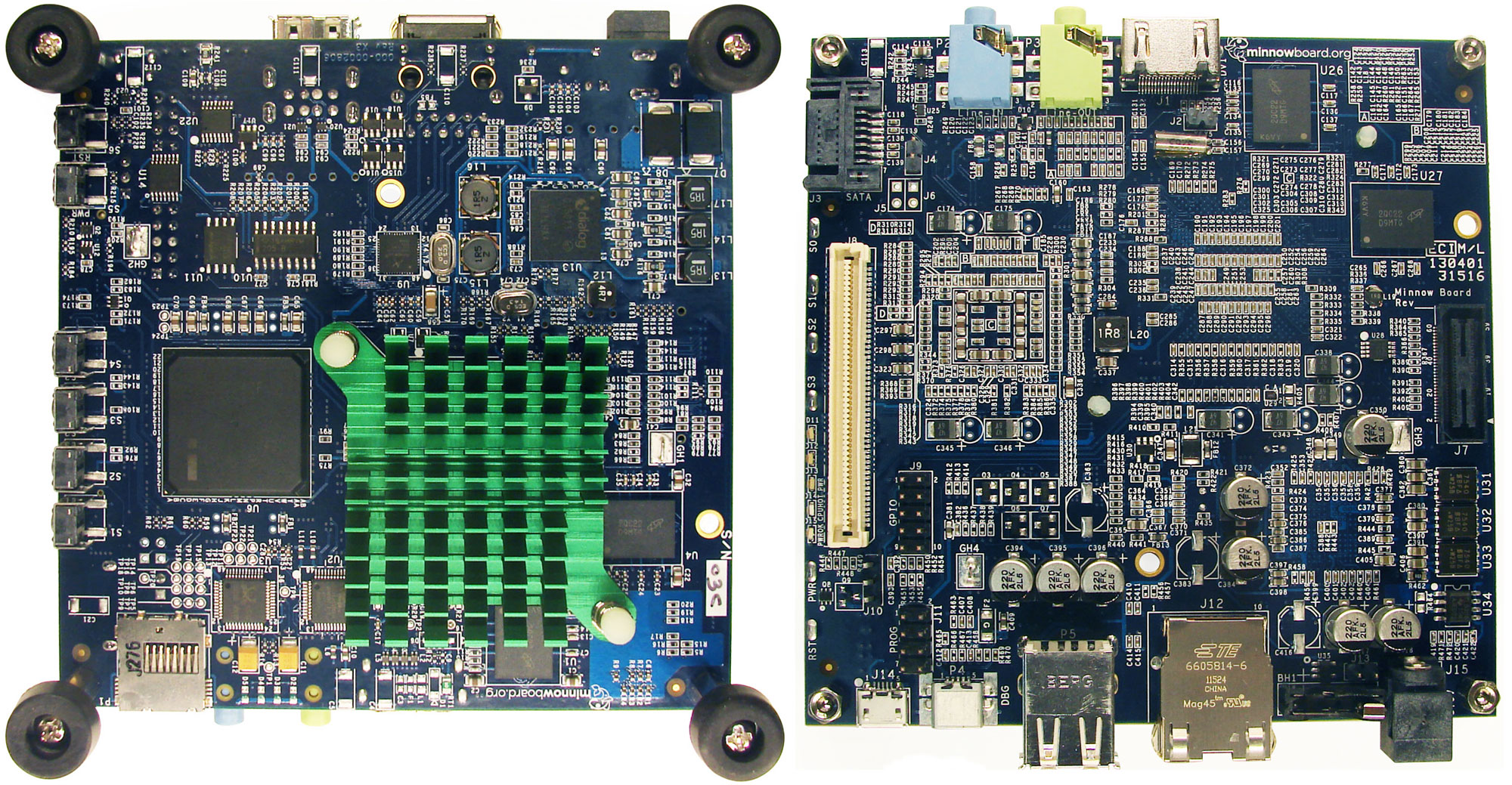
Appearance of the Minnowboard. Clickable.
Minnowboard is a full-fledged x86 architecture computer, equipped with all the necessary interfaces for connecting hard drives and peripherals (PCI Express, SATA, USB), as well as specialized interfaces for receiving information from sensors, sensors or other digital devices (SPI, I2C, CAN, GPIO ) The Minnowboard has a special 100-pin connector through which all kinds of expansion cards are connected - but more on them later. To get started, here's the Minnowboard specification.
| CPU | Intel Atom E640 (1 GHz, 32 bit) EG20T Intel Platform Controller Hub Integrated Intel Graphics Media Accelerator (GMA) 600 |
| Memory | 1 GB DDR2 RAM |
| System microcode memory | 4 MB SPI Flash |
| Video | DVI over HDMI |
| Audio | Analog |
| Input Output | 1 micro SD SATA2 3 Gb / s 2 USB hosts 1 USB device (micro USB-B port) 1 debug port (mini USB-B port) 10/100/1000 Ethernet |
| Functions for the experimenter | 8 buffered GPIO feet 2 controlled GPIO LEDs 4 GPIO switches |
| Software | All software will be provided in the form of images and free source code. |
| operating system | Angstrom Linux Distribution (compatible with Yocto Project v 1.3) |
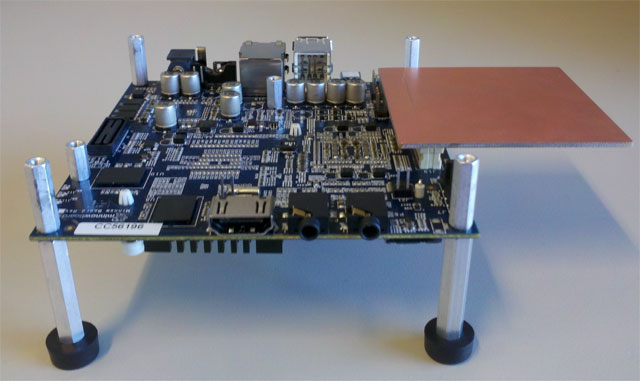
Minnowboard with dummy expansion cards type 3.
Thus, Minnowboard can be used as a self-contained miniature PC for user needs (and for the same Raspberry Pi have already come up with almost hundreds of different applications) or as a “brain” component of intelligent and robotic systems. The latter, I think, will interest DIY lovers, of whom there are plenty.
Minnowboard video presentation The
manufacturer provides 3 form factors for expansion cards that are connected through the aforementioned 100-pin connector (the pinout of the connector can be viewed here ) or GPIO pins; form factors vary in size and method of attachment to the motherboard. Already, several types of reference cards have been developed for various purposes, from the simplest, carrying a 7-section display or miniPCIe / mSATA connectors to the promising Arduino-compatible, which themselves have a wide range of applications. The maximum number of stackable cards is 4 pieces.
At the moment, Minnowboard is undergoing final test tests, the start of sales is scheduled for the very near future. Interested parties are encouraged to check back often on the Minnowboard community pages, for example on Facebook for news - they will probably be there soon.