Game mechanics: let's analyze the core of the game on the bones
The term “game mechanics” has many meanings, but today I will talk about game mechanics as an abstraction that determines the state of a game. It looks very simplistic like this:
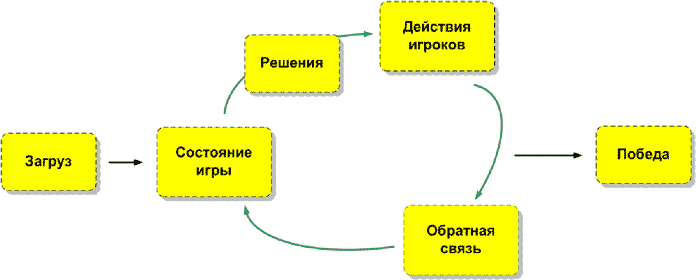
There are only two factors that determine any current state of the game: mechanics (rules) and players with their actions.
Step 1: state determination
There is always a certain current state of the system (for example, the beginning of a move). It is determined on the first bar by the initializing sequence, when the players “load” the game, expanding the field, selecting chips, allocating initial resources, and so on. Then it changes depending on what is happening in the game.
Step 2: Players evaluate the state for making decisions.
After updating the state of the game, there is a tact during which players make decisions based on new information.
Tact 3: players perform actions
At this step, players change the state of the game, doing something in accordance with the rules, for example, moving a piece.
Step 4: the game itself gives feedback.
In chess this is not, but, for example, if we were playing dice, the game would generate several random numbers on the dice for us for a new state.
The exit from the cycle is done according to one of the criteria for the end of the algorithm, that is, for example, your victory.
Once again: on the basis of state analysis, players make a decision about their actions, perform these actions, interact with other players and rules, and then set the game in a new state. The game can do part of the work itself, regardless of the actions of the players. For example, in Startup, each turn opens a card with a random event.
Game mechanics consists of a kind of genes - known sequences of actions, which are not very many. New genes appear in the desktop world only a couple of times a year, and not all take root. This is how the current list according to the BGG version looks like (this is a rather conditional separation, since the classification is not very clear):
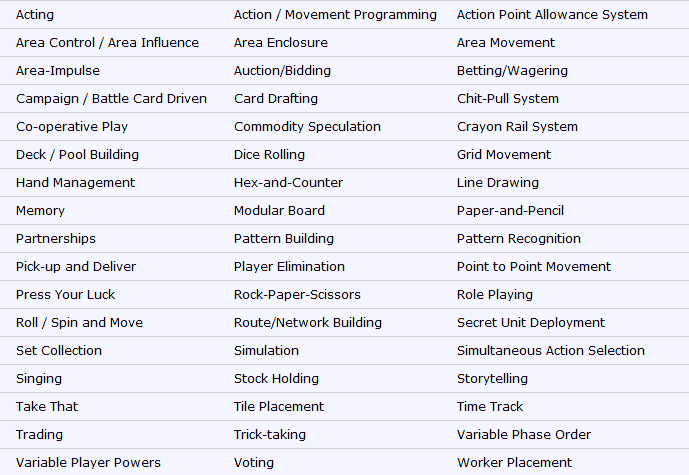
For example, Monopoly is a combination of betting mechanics, “roll a die and move”, collection collection and bidding. At the level of setting, you buy real estate and compete, at the level of mechanics - move around the field, collect sets of cards and make bets with chips.
Without mechanics, it would be unclear how to trade real estate - mechanics reduced this to the manipulation of bets and cards, and the players presented everything else already at different levels.
Mechanics are almost always an abstraction, in no way connected with the game setting and plot. For example, in the board game "Game of Thrones" it does not matter who walks and what. You can completely calmly make a game about the Great Patriotic War from the “Game of Thrones”.
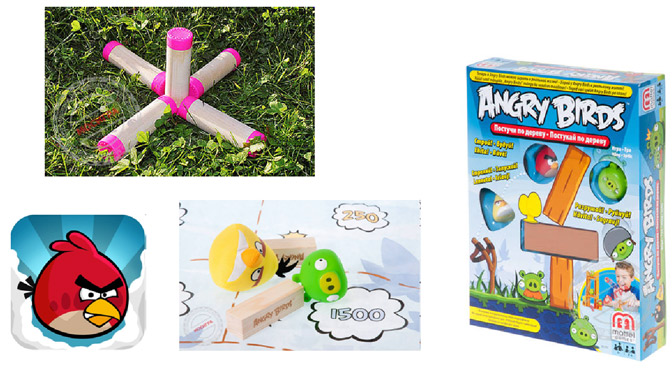
Tabletop Angry Birds is an evolution of Townships. General mechanics - throwing objects. Excellent mechanics just for this setting. In the first case, you need a bat for chocks, in the second - for birds for pigs. The first game costs 350 rubles, the second is more than 1000. The mechanics are the same, but the setting is different - and guess what sells better.
When mechanics combine with setting, it works much better. For example, in “Space Truckers,” a meteorite that hits the open gateway on the left is the destruction of the module. It is easy to imagine and easy to do without looking at the rules.
Therefore, an important principle of good mechanics is the correspondence of the actions that it dictates to what the players expect about this.
Obviously, the setting is very helpful in explaining the mechanics and its natural interaction with the user. For example, “Jackal” is actually a game about a weighted count, but players walk around the island and look for treasures. From the point of view of mechanics, the coincidence of the coordinates of the figures leads to the destruction of one of them and the creation of a new object at a given point, and from the point of view of the player, one pirate hits another, and the victim returns to his ship. If the mechanics at the same time created two pirates on the ship, it would be extremely difficult to explain in the setting why this is so - and some other interface would be required.
Yes, you understood correctly: the realism of actions within the setting depends on the mechanics.For example, you can play the economic simulator of the exchange with all the difficulties, or you can publish the same game about the exchange in the form of “throw a dice and move a chip” mechanics. It is clear that the second option is not what you expect from an economic simulator.
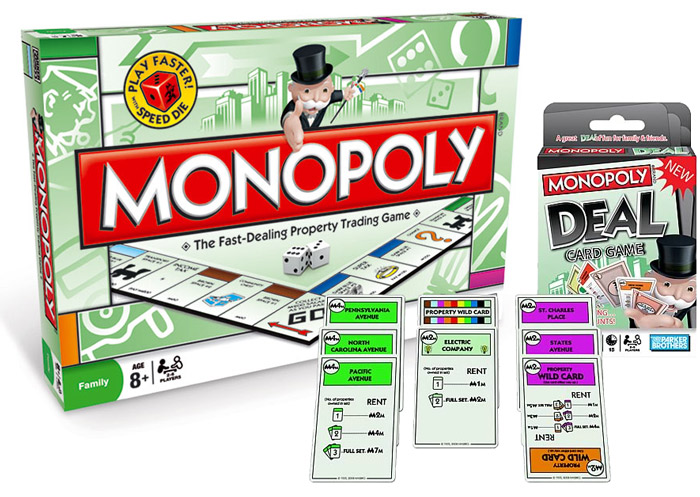
The same setting for different mechanics: playing with a field and another game on maps
Another important thing - mechanics creates a common language of rules to which game events obey. However, it introduces limitations to the model, which are not always good.
We play to have fun. It can be obtained from the game itself, decisions in its process, communication with other players, contemplation of art (as in the Imaginarium), victory and a bunch of other things. Here are some details .
The most important thing in mechanics is the definition of a “high point” . Roughly speaking, these are the actions that cause the player to react chemically. Simply put - that the player will be happy to repeat and repeat again (this is the essence of the game - have fun). Obviously, any point of the buzz should lie outside the game - otherwise in this game there would simply be no point.
Some children's games are boring and incomprehensible to adults. The fact is that young children can be savagely wild just from the process of searching for pictures in a heap, moving and moving objects, and so on. Their pleasure can even lie in motor skills: the child really likes to do something small, which immediately seriously changes the state of the game (as he understands that he can affect the world around him). For example, the fall of a wooden tower from the bars in Jenga is a real miracle, causing a bunch of screeching.
The average player likes to see their impact on the game. In cooperative board games, players are cut against the "playing field", for example, trying to fill up the boss for a limited number of moves.
If there are three players, then one of them can easily fall out of the decision-making process: in fact, a strong leader will steer his chip. This is important for family games, where mom does not really want to understand the game, but just wants to see her son at the table, next to him, with burning eyes and without a computer. But this is bad for games that are designed specifically for normal players. Therefore, it is good if each of the players at least once per game can make a decision that will affect the situation as a whole.
Players do not always like to play hardcore and seriously, so if such a decision point is too early, for example, in the first moves, then an error will lead to lost time and frustration. If the decision point lies at the end of the game, for example, on the last move, then you can safely throw out all the previous ones. Therefore, usually there are several solutions, say, 2-3-7 per game, and each of them advances to victory. And it also helps forgive some player mistakes.
Quite often, we test games, and one of the most common mistakes for almost all novice authors (like ourselves once) is an unnecessary complication, and in most cases, for the sake of detailing the world and setting.
As I said before, in Half-Life you’re unlikely to ever untie your shoelaces, take off your shoes and move your fingers to rest. But a person (and we think that we play for a person!) Can do this. And developers may decide to add this feature. And a hundred others just in case. How it ends is easy to imagine. Therefore, the task is to determine the moments that bring players this or that pleasure, and then mercilessly cut out the rest, not leading directly to the high points.
Now back to the issue of the load on the player’s resources (time and attention). From the point of view of attention, there should be a fairly clear locus: the main sequence that needs to be monitored.
When mechanics help intuitively do basic actions, the locus moves not to implement rules, but to make decisions. And even later - to think about the strategy as a whole. It's like driving: first, a manual gearbox will be your main enemy, and later you will learn how to drive it on autopilot and will look at the road.
The simplest question of analyzing the attention resource is “How many times to think and how many times to solve?”. For example, seeing three moves of opponents, you have to think three times about what each of them has in mind. You have to decide only once - where to send your army, for example.
It is also useful to consider uptime , that is, the time when the player does something. A common mistake is a strategy with long moves, when another player sits and looks (that is, nothing changes in his picture of the world). There are examples of working games with wild downtime - large-scale strategies such as “Twilight of the Empire”, where the expectation of the end of the course of other players is brightened up by the opportunity to negotiate alliances. Another example is the same “Game of Thrones”, where players make moves at the same time, and then simply resolve the stack of orders: instead of N-1 downtime periods for N players, the game designer made only one, but a little longer than the standard one. Damn pretty.
The next question is how mechanics relate to the player’s experience. For example, in chess only the player’s experience decides. In Russian roulette, experience does not solve at all.
If the game is aimed at the middle segment, you can do this:
The success or failure of a game is largely determined by how much it draws players in. Let's look at 3 computer games:
The most important thing for the success of the game (i.e., sales) is tuning to the audience.
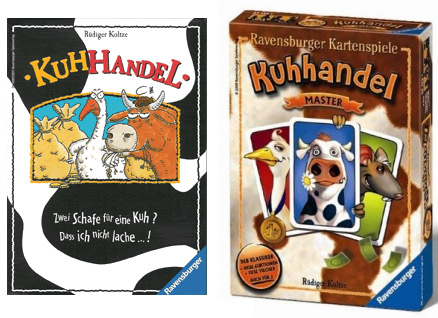
The same setting and almost the same mechanics with different art (setting for adults with drawn art and children-players with 3D):
Here are the questions, the answers to which you need to understand before the final sharpening:
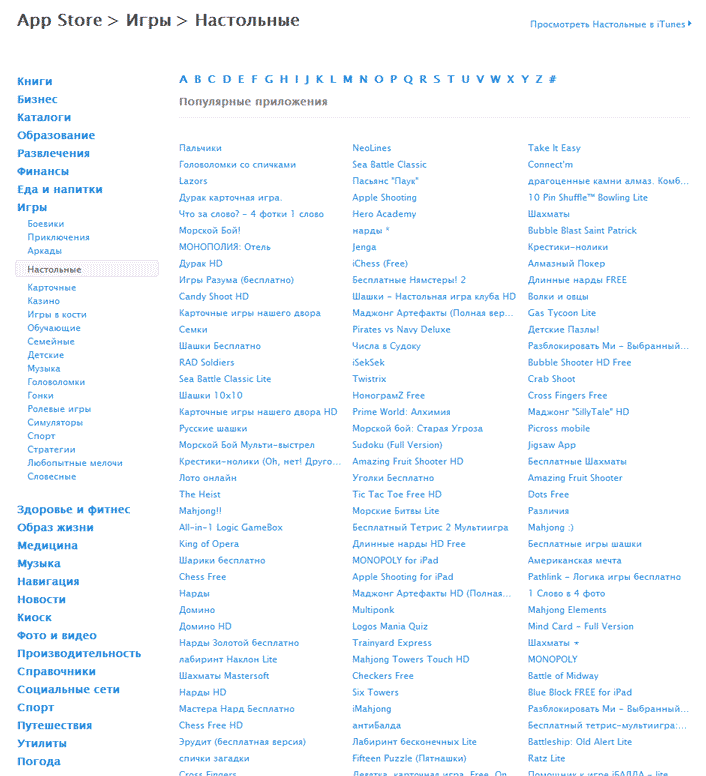
Most mechanics have direct counterparts in platform games. Moreover, as a rule, the “buzz points” of board games are so accentuated that even a simple porting of the game allows it to break into hits. In Appstore, for example, there are an incredible amount of desktops:
As was shown by the example of Angry Birds, some computer games and applications for tablet phones are also transferred to the desktop format. For example, there are “ports” of Starcraft, MOO, Warcraft, Civilization, Doom, and so on.
Players at the end of the game evaluate for themselves: "Was it cool?" If so, then you can continue to play and you can tell others about this desktop.
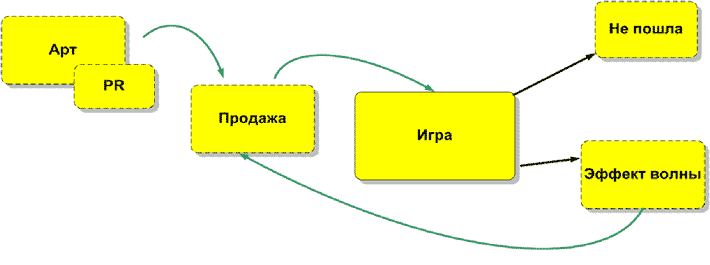
Accordingly, the mechanics become important not for sale in the store and not for the stage of the announcement of the game (art and marketing decide more here), but for sales after the first thousand copies, when the people who play will already come to stores for new boxes.
The mechanics determine the “virality” of a game more than art, plot, atmosphere, setting details, and so on, and this is what is important for experienced players.
Phew If you read, thanks. I didn’t really want to write such a long topic, but promised.
There are only two factors that determine any current state of the game: mechanics (rules) and players with their actions.
Core level
Step 1: state determination
There is always a certain current state of the system (for example, the beginning of a move). It is determined on the first bar by the initializing sequence, when the players “load” the game, expanding the field, selecting chips, allocating initial resources, and so on. Then it changes depending on what is happening in the game.
Chess Game Status
В шахматах у нас всегда есть положение фигур на доске и всегда известно, чей сейчас ход. Начальная расстановка фигур определяется правилами игры, все остальные состояния – тем, как игроки будут двигать свои фигуры. Возможны только те состояния, которые достижимы при соблюдении правил. Пример ошибки – 5 королей на доске.
Step 2: Players evaluate the state for making decisions.
After updating the state of the game, there is a tact during which players make decisions based on new information.
Tact 3: players perform actions
At this step, players change the state of the game, doing something in accordance with the rules, for example, moving a piece.
Step 4: the game itself gives feedback.
In chess this is not, but, for example, if we were playing dice, the game would generate several random numbers on the dice for us for a new state.
The exit from the cycle is done according to one of the criteria for the end of the algorithm, that is, for example, your victory.
Once again: on the basis of state analysis, players make a decision about their actions, perform these actions, interact with other players and rules, and then set the game in a new state. The game can do part of the work itself, regardless of the actions of the players. For example, in Startup, each turn opens a card with a random event.
"SDK"
Game mechanics consists of a kind of genes - known sequences of actions, which are not very many. New genes appear in the desktop world only a couple of times a year, and not all take root. This is how the current list according to the BGG version looks like (this is a rather conditional separation, since the classification is not very clear):
For example, Monopoly is a combination of betting mechanics, “roll a die and move”, collection collection and bidding. At the level of setting, you buy real estate and compete, at the level of mechanics - move around the field, collect sets of cards and make bets with chips.
Without mechanics, it would be unclear how to trade real estate - mechanics reduced this to the manipulation of bets and cards, and the players presented everything else already at different levels.
Mechanics are almost always an abstraction, in no way connected with the game setting and plot. For example, in the board game "Game of Thrones" it does not matter who walks and what. You can completely calmly make a game about the Great Patriotic War from the “Game of Thrones”.
Tabletop Angry Birds is an evolution of Townships. General mechanics - throwing objects. Excellent mechanics just for this setting. In the first case, you need a bat for chocks, in the second - for birds for pigs. The first game costs 350 rubles, the second is more than 1000. The mechanics are the same, but the setting is different - and guess what sells better.
"GUI"
When mechanics combine with setting, it works much better. For example, in “Space Truckers,” a meteorite that hits the open gateway on the left is the destruction of the module. It is easy to imagine and easy to do without looking at the rules.
Therefore, an important principle of good mechanics is the correspondence of the actions that it dictates to what the players expect about this.
Example
В MTG есть система стека действий, и до определённой редакции боевые повреждения заносились в стек, а потом резолвились. Если поверх повреждений в стеке окажется, например, заклинание отзыва в руку, то игроки увидят странную с точки зрения реалистичности ситуацию:
1. Два существа встретились в бою (в стек ушли повреждения).
2. Игрок А сыграл отзыв (в стек ушло заклинание отзыва).
3. Игрок Б спасовал.
4. Из стека отрезолвился первый объект (существо игрока А вернулось в руку).
5. Из стека отрезолвился второй объект (повреждения по существам, но поскольку первого на столе уже нет – только по существу игрока Б).
Получилось, что несуществующее уже существо убило кого-то. Повреждения в стеке были крайне элегантны с точки зрения общей механики игры, но было сложно объяснить начинающим игрокам, почему их существо ушло на кладбище в такой ситуации. Поэтому разработчики в какой-то момент были вынуждены резолвить повреждения в бою мимо стека, чем срезали часть глубины тактики, но улучшили «интерфейс» игры.
1. Два существа встретились в бою (в стек ушли повреждения).
2. Игрок А сыграл отзыв (в стек ушло заклинание отзыва).
3. Игрок Б спасовал.
4. Из стека отрезолвился первый объект (существо игрока А вернулось в руку).
5. Из стека отрезолвился второй объект (повреждения по существам, но поскольку первого на столе уже нет – только по существу игрока Б).
Получилось, что несуществующее уже существо убило кого-то. Повреждения в стеке были крайне элегантны с точки зрения общей механики игры, но было сложно объяснить начинающим игрокам, почему их существо ушло на кладбище в такой ситуации. Поэтому разработчики в какой-то момент были вынуждены резолвить повреждения в бою мимо стека, чем срезали часть глубины тактики, но улучшили «интерфейс» игры.
Obviously, the setting is very helpful in explaining the mechanics and its natural interaction with the user. For example, “Jackal” is actually a game about a weighted count, but players walk around the island and look for treasures. From the point of view of mechanics, the coincidence of the coordinates of the figures leads to the destruction of one of them and the creation of a new object at a given point, and from the point of view of the player, one pirate hits another, and the victim returns to his ship. If the mechanics at the same time created two pirates on the ship, it would be extremely difficult to explain in the setting why this is so - and some other interface would be required.
Yes, you understood correctly: the realism of actions within the setting depends on the mechanics.For example, you can play the economic simulator of the exchange with all the difficulties, or you can publish the same game about the exchange in the form of “throw a dice and move a chip” mechanics. It is clear that the second option is not what you expect from an economic simulator.
The same setting for different mechanics: playing with a field and another game on maps
Another important thing - mechanics creates a common language of rules to which game events obey. However, it introduces limitations to the model, which are not always good.
What results in an unexpected model restriction
Первый раз, когда я начал играть в «S.T.A.L.K.E.R», полчаса бродил по деревне, слушал музыку у костра, говорил с Сидоровичем и другими персонажами. До этого я читал про мегареализм — и он действительно потрясал. А потом я вышел из первой «мирной» локации и нашел труп сталкера. И естественным образом понёс его в деревню, чтобы похоронить по-человечески. А он там никому нафиг не сдался – и я как дурак ходил с телом и приставал к NPC, которые просто не меняли реакции. При этом в игре была механика переноски тела, которая и сформировала ожидание того, что с ним что-то можно сделать. Если бы тело нельзя было поднять — разочарования не было бы, это ведь уже принятая условность.
Optimization
We play to have fun. It can be obtained from the game itself, decisions in its process, communication with other players, contemplation of art (as in the Imaginarium), victory and a bunch of other things. Here are some details .
The most important thing in mechanics is the definition of a “high point” . Roughly speaking, these are the actions that cause the player to react chemically. Simply put - that the player will be happy to repeat and repeat again (this is the essence of the game - have fun). Obviously, any point of the buzz should lie outside the game - otherwise in this game there would simply be no point.
Chess Points in Chess
В шахматах самая яркая такая точка – понимание замысла противника и принятие контрмер. Удовольствие вы получаете от того, что разгадали план оппонента и оказались умнее его. Следующая по важности там же точка – это получение преимущества на поле, например, взятие фигуры. Важно, что профессиональные игроки радуются не именно взятию фигуры, а некоему сочетанию параметров на поле. Но для начинающих важно именно снять слона соперника с доски: тут включается и физическое действие, и мини-ритуал, и на глаз видно прогресс: у меня слонов два, а у тебя – уже один.
Когда мастер игры неожиданно встретит равного, это тоже будет точкой кайфа – и это тоже лежит за пределами самой игры и механики. И всё же главное удовольствие в шахматах, как и во всех настольных играх – это просто общение между двумя людьми. Игра – это что-то вроде протокола такого общения.
Когда мастер игры неожиданно встретит равного, это тоже будет точкой кайфа – и это тоже лежит за пределами самой игры и механики. И всё же главное удовольствие в шахматах, как и во всех настольных играх – это просто общение между двумя людьми. Игра – это что-то вроде протокола такого общения.
Some children's games are boring and incomprehensible to adults. The fact is that young children can be savagely wild just from the process of searching for pictures in a heap, moving and moving objects, and so on. Their pleasure can even lie in motor skills: the child really likes to do something small, which immediately seriously changes the state of the game (as he understands that he can affect the world around him). For example, the fall of a wooden tower from the bars in Jenga is a real miracle, causing a bunch of screeching.
Cooperative game
The average player likes to see their impact on the game. In cooperative board games, players are cut against the "playing field", for example, trying to fill up the boss for a limited number of moves.
If there are three players, then one of them can easily fall out of the decision-making process: in fact, a strong leader will steer his chip. This is important for family games, where mom does not really want to understand the game, but just wants to see her son at the table, next to him, with burning eyes and without a computer. But this is bad for games that are designed specifically for normal players. Therefore, it is good if each of the players at least once per game can make a decision that will affect the situation as a whole.
Thin moment with balance
Players do not always like to play hardcore and seriously, so if such a decision point is too early, for example, in the first moves, then an error will lead to lost time and frustration. If the decision point lies at the end of the game, for example, on the last move, then you can safely throw out all the previous ones. Therefore, usually there are several solutions, say, 2-3-7 per game, and each of them advances to victory. And it also helps forgive some player mistakes.
Realism versus Convenience
Quite often, we test games, and one of the most common mistakes for almost all novice authors (like ourselves once) is an unnecessary complication, and in most cases, for the sake of detailing the world and setting.
As I said before, in Half-Life you’re unlikely to ever untie your shoelaces, take off your shoes and move your fingers to rest. But a person (and we think that we play for a person!) Can do this. And developers may decide to add this feature. And a hundred others just in case. How it ends is easy to imagine. Therefore, the task is to determine the moments that bring players this or that pleasure, and then mercilessly cut out the rest, not leading directly to the high points.
Example
В первой версии Стартапа у нас была оплата офиса. Позже при перерасчёте ресурсов времени и внимания после турниров выяснилось, что это рутина, от которой можно смело отказаться: и мы сэкономили немного внимания игроков, плюс сократили ход на 10-12 секунд.
Now back to the issue of the load on the player’s resources (time and attention). From the point of view of attention, there should be a fairly clear locus: the main sequence that needs to be monitored.
When mechanics help intuitively do basic actions, the locus moves not to implement rules, but to make decisions. And even later - to think about the strategy as a whole. It's like driving: first, a manual gearbox will be your main enemy, and later you will learn how to drive it on autopilot and will look at the road.
The simplest question of analyzing the attention resource is “How many times to think and how many times to solve?”. For example, seeing three moves of opponents, you have to think three times about what each of them has in mind. You have to decide only once - where to send your army, for example.
It is also useful to consider uptime , that is, the time when the player does something. A common mistake is a strategy with long moves, when another player sits and looks (that is, nothing changes in his picture of the world). There are examples of working games with wild downtime - large-scale strategies such as “Twilight of the Empire”, where the expectation of the end of the course of other players is brightened up by the opportunity to negotiate alliances. Another example is the same “Game of Thrones”, where players make moves at the same time, and then simply resolve the stack of orders: instead of N-1 downtime periods for N players, the game designer made only one, but a little longer than the standard one. Damn pretty.
XCOM fighter control mechanics
Я уже сравнивал в одном из прошлых топиков модель движения бойцов в компьютерном первом XCOM и новом UFO. Напомню: в первой игре вам надо учитывать время (разбитое на единицы), энергию, примерно прикидывать траекторию движения и считать клетки, делать оценку того, сколько времени останется после движения на выстрел и так далее. В новом модель упрощена – теперь вы сразу видите зону, куда боец может добежать до выстрела, не нужно делать никаких расчётов. Можно просто взять и побежать. Первая модель более хардкорна и реалистична (и доставляет кайф любителям сложных игр), вторая позволяет сосредоточиться именно на тактике истребления пришельцев. Обе, разумеется, имеют свои недостатки. Задача гейм-дизайнера – сделать так, чтобы неизбежные недостатки моделирования в рамках настольной игры не влияли на удовольствие от игрового процесса.
Skill in the game
The next question is how mechanics relate to the player’s experience. For example, in chess only the player’s experience decides. In Russian roulette, experience does not solve at all.
If the game is aimed at the middle segment, you can do this:
- Give a beginner a ghostly chance to defeat an experienced friend . For example, in the desktop MTG, this is solved by the “stone-scissors-paper” system: there are three archetypes of strategy, and the “aggression” that met the “control” will win with a very high probability. As in Starcraft: early zergrash without hesitation “what will happen if it doesn’t work out” may allow defeating a more experienced friend.
- At the same time, there must be a balance so that experienced players are interested in playing with each other . Returning to MTG - there is a sideboard system, that is, modifications to the deck for the opponent between rounds.
- The big question of balancing is the role of chance . When it turns into statistics (like in card games) - that's good. When it becomes the basis of action, as in Russian roulette, it does not cause joy from the mechanics themselves already from the second installment. Other layers of the game can cause joy - but not the ability to influence its state, since feedback will be random.
- Well, if the game is replayable with the same people . For example, chess has an almost infinite margin of regislability, but Danetki has practically none, because the cards will end soon. But at the same time Danetki sells better than chess, because they provide faster emotions and do not have an entry threshold.
Player Development Curve
The success or failure of a game is largely determined by how much it draws players in. Let's look at 3 computer games:
- "The snake . " The entry here is very simple - you have only two buttons, intuitively what to do. First you master the movement of the snake, then learn the general rules (yeah, the collected points lengthen my snake!), Then increase your skill (more precisely, control the snake and you can allow yourself to make 180-degree turns), then try to get the maximum score. Everything is simple and clear. If there are other games - this will get tired quickly.
- Jagged Alliance 2 . Here you first get into the atmosphere of the game (read about the mercenaries, leaf through the intelligence report), and then go through a series of battles. The difficulty increases gradually: the first city meets you with shells with pistols. The number of trunks, people in the detachment, functions and, as a result, available tactics grows with training and passing. In the end, the most difficult battle awaits you. The most difficult thing is sometimes to break away from the game and do not forget to eat. The whole process is designed so that you constantly have new opportunities (barrels, mercenaries) that you want to try out in battle, new plot twists, new incentives to move on. The game provides excellent feedback. The player’s path in Fallout 2 is very similar (training, complication, gradual disclosure of opportunities and plot).
- Vanger . This game immediately blows your brain and immerses you in a new world. Lipky’s incomprehensible words, some kind of acid hell on the surface, crazy movement of everything, mastering the properties of his mehos ... In general, only after a couple of hours will you have a picture of the world. Which you immediately flipped over, and then flipped over and over again - in general, until the second passage you will be in constant cognitive dissonance. Madly cool, but it creates a huge threshold for entry.
Customization for players
The most important thing for the success of the game (i.e., sales) is tuning to the audience.
The same setting and almost the same mechanics with different art (setting for adults with drawn art and children-players with 3D):
Here are the questions, the answers to which you need to understand before the final sharpening:
- Who will play? Boy or girl, married couple or friends, colleagues or hardcore geeks? How many people will play? What do they like, what not?
- Where will he play? On the train, on the plane, in a relaxed atmosphere at the table, on a picnic? Will they have 2-3 hours without phone calls, for example?
- How will it play and with whom? How often can a buyer buy a game for her? Is it possible that there will be only 10 people in the city who can play at the right level?
- How will tournaments go? What will change? Will it be necessary to get rid of some of the accidents in order not to fall into the category of gambling in different countries?
- What do we have for geeks? Is there something you can enjoy for years?
- Will there be sequels? How do they integrate with the game? What will happen to the balance in this case?
- How to teach the game? Is it possible to understand the rules or need someone who played?
- Is it possible in the store to explain the basic things about the game in 30 seconds - or will it take a long time to dig on the site to make a choice?
Transfer mechanic
Most mechanics have direct counterparts in platform games. Moreover, as a rule, the “buzz points” of board games are so accentuated that even a simple porting of the game allows it to break into hits. In Appstore, for example, there are an incredible amount of desktops:
As was shown by the example of Angry Birds, some computer games and applications for tablet phones are also transferred to the desktop format. For example, there are “ports” of Starcraft, MOO, Warcraft, Civilization, Doom, and so on.
The importance of mechanics
Players at the end of the game evaluate for themselves: "Was it cool?" If so, then you can continue to play and you can tell others about this desktop.
Accordingly, the mechanics become important not for sale in the store and not for the stage of the announcement of the game (art and marketing decide more here), but for sales after the first thousand copies, when the people who play will already come to stores for new boxes.
The mechanics determine the “virality” of a game more than art, plot, atmosphere, setting details, and so on, and this is what is important for experienced players.
Phew If you read, thanks. I didn’t really want to write such a long topic, but promised.