April 9, 2013 at 17:15
Road to the clouds: SaaS vs desktop
At the end of 2012, a small survey flashed across Habré: “Why aren’t you using cloud infrastructure / services in your company?” Its results are very revealing for the Russian SaaS market as a whole: the majority of respondents consider cloud services either expensive or unsafe for storing commercial information. Nevertheless, the number of players in the cloud services market is growing and now even “conservative” and, at first glance, desktop services such as 1C are offered as a service.
Despite the existing prejudices and fear of users, cloud services are increasing their market share, are actively developing and are offering new solutions and services to private clients and businesses: creating and storing notes, complete documents, storing links, organizing corporate portals, real CRM in cloud, etc ...
Before we try to answer the question, what is the reason for the growing success, we will understand the concepts of "cloud" and "SaaS". Today in Russia, cloud services are subject to two main trends:

Image source: www.computerra.ru
Let's start with the first paragraph. Often, users by the terms SaaS and "cloud" understand cloudy virtual PBXs implemented through IP-telephony. However, such an understanding significantly limits the functionality and reduces the essence of the concept itself. In fact, cloud technology is both Yandex or Google email, and popular file storage, and Google Docs.
Wikipediagives a rather confusing explanation of what is SaaS, understandable mainly to technical specialists. Meanwhile, the decision to implement cloud infrastructure is often made by commercial specialists. It is for them that I want to explain from the point of view of the conceptual apparatus of the manager. In principle, the whole essence of the cloud (SaaS) lies in the name itself - software as a service - software as a service. That is, a person receives not a program installed on his computer, but some service, which for him is a utility for work / study / other purposes and at the same time “lives” in a browser, that is, is virtual. Such software does not need its own server, it does not require any special configuration of hardware and operating system. The user opens the browser, logs into the application, logs in and works.
The choice of solutions for working in the clouds is really worthy and is represented by a number of eminent companies. By the spring of 2013, several major players offering corporate cloud solutions were identified on the market. Let's try to figure out who is who and what developers are ready to offer the business.
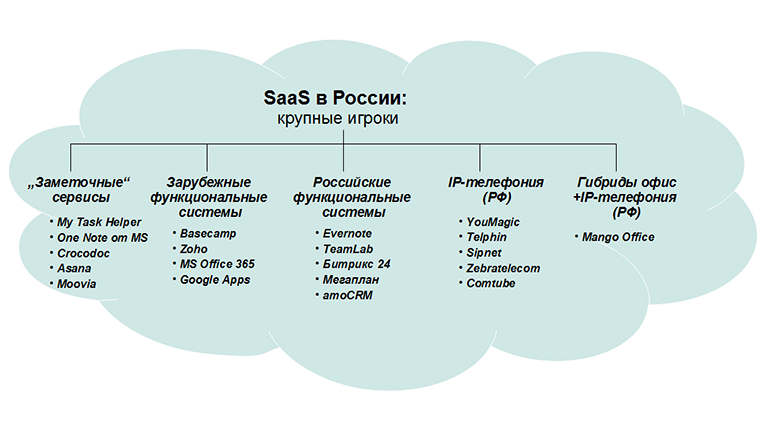
First of all, as a whole class of tools working in the cloud, you can select small online applications that allow you to save user data on an external server (for a user, on a virtual disk). Of the most interesting, for example:
Today, in the Russian market for cloud solutions for project and document management, several powerful applications are presented that allow you to manage processes and even workflow. Conventionally, they can be divided into two large groups. The first is well-known Western services, some of which do not even have full Russian localization:
However, not only foreign developers are ready to offer SaaS solutions. Recently, there has been an active growth in cloud services in Russia and this has allowed obvious leaders to stand out on the market, some of whom have successfully begun expansion into Western Europe and the USA, creating a viable and relevant product for any market:
1. 1C will not go to the development of “alien” CRM in spite of its already developed, therefore, rather all in all, you don’t have to wait for a good cloud CRM;
2. If there are two task managers, it is obvious that they will soon merge into one, convenient, functional and strong. So, perhaps, another interesting cloud solution will soon appear on the market, combining a corporate portal and a project management system.
In principle, one more group of cloud solutions can be distinguished - these are IP-telephony operators that have already announced the creation of full-fledged virtual offices. Among the Russian ones, Mango Office can be distinguished , which offers along with a cloud-based PBX and a call center integrated with CRM Mango-Office. CRM has the usual functionality: a customer and sales management tool, setting tasks for managers, conducting transactions.
Pros for the client:
Pros for the developer:
It is worth recognizing that any modern company cannot exist without a specific set of general-purpose software and a specific type of activity. Licensed software is quite expensive, it requires a certain level of hardware, an employee (s) servicing the user's computer park and software installed on them, paid implementation, training, and often paid support. Thus, the construction of the optimal software infrastructure of the company requires significant both one-time and fixed costs.
Turning to the cloud, the company receives obvious financial advantages:
However, it should be borne in mind that often when introducing cloud technologies the client is faced with high price tags for refinement for their business or simply the impossibility of refinement. At the same time, this problem is easily solved - the market is not monopolistic and decent alternative solutions can always be found.
Each company, when deciding on the implementation of cloud software, finds its additional benefits. But one thing remains clear: when using this type of software, ROI is significantly increased - an indicator of the return on investment in a business, which, of course, includes IT infrastructure.
Any coin has two sides. When it comes to innovations in the IT sphere, both sides of the coin are very pronounced: the front one is shiny and attractive, the other side scares the unknown and leaves many questions open. So with SaaS - at the end of the article it is worth talking about criticism of such decisions.
Probably the most ardent critic of the cloud is Richard Stallman. He talks amusingly about espionage, data insecurity, and the inability to monitor all program operations. If in the case of corporate software there is a copy of the program that is difficult and illegal to modify, then "in the case of service programs ... you use a copy that you do not have". Stallman argues that the clouds are a “nonsense” approach to client computing and traditionally in conclusion they offer to use free software, create an alternative to servers, etc. ... In principle, he criticizes from the point of view of his philosophy and his arguments are little weighty for the Russian small and medium-sized businesses, but professionals will be interested and useful to read his articles.
So, despite the obvious advantages, cloud technologies have a number of aspects, if not negative, then significantly hinder the growth of the popularity trend. They are not as global as Stallman’s criticism, but more practically directed.
The following two negative points are more relevant for Russia, Belarus and Ukraine:
According to a Gartner campaign study , the global expansion of cloud technology in the enterprise software sector will continue and grow in gross volumes from $ 12 million in 2011 to $ 21 million in 2015, thus reaching 16.3% CARG (average annual growth rate) annually.
It is difficult to say that cloud technologies in Russia will blow up the market and completely displace desktop solutions. However, they already influence and will have an even greater impact on the development of user applications. This is due to the fact that a private user feels like a master in the cloud, while a corporate user seeks to save; and both of them are just comfortable working in cloud applications. That is why such technologies will definitely not be left without attention and will develop further in the following possible directions:
Clouds will be chosen by small and medium-sized businesses, small groups of freelancers and serious advertising agencies. The clouds will work, grow, and generate new forms of existence of the IT infrastructure of the campaigns. They will be competitors for the desktop, but in the near future they will not take its place. It cannot be said that the future is in the clouds, but the future without them is also difficult to imagine.
Terminology difficulties
Despite the existing prejudices and fear of users, cloud services are increasing their market share, are actively developing and are offering new solutions and services to private clients and businesses: creating and storing notes, complete documents, storing links, organizing corporate portals, real CRM in cloud, etc ...
Before we try to answer the question, what is the reason for the growing success, we will understand the concepts of "cloud" and "SaaS". Today in Russia, cloud services are subject to two main trends:
- Inadequate understanding of the essence of cloud services
- numerous myths about the cost, danger, instability of services.
Image source: www.computerra.ru
Let's start with the first paragraph. Often, users by the terms SaaS and "cloud" understand cloudy virtual PBXs implemented through IP-telephony. However, such an understanding significantly limits the functionality and reduces the essence of the concept itself. In fact, cloud technology is both Yandex or Google email, and popular file storage, and Google Docs.
Wikipediagives a rather confusing explanation of what is SaaS, understandable mainly to technical specialists. Meanwhile, the decision to implement cloud infrastructure is often made by commercial specialists. It is for them that I want to explain from the point of view of the conceptual apparatus of the manager. In principle, the whole essence of the cloud (SaaS) lies in the name itself - software as a service - software as a service. That is, a person receives not a program installed on his computer, but some service, which for him is a utility for work / study / other purposes and at the same time “lives” in a browser, that is, is virtual. Such software does not need its own server, it does not require any special configuration of hardware and operating system. The user opens the browser, logs into the application, logs in and works.
The choice of solutions for working in the clouds is really worthy and is represented by a number of eminent companies. By the spring of 2013, several major players offering corporate cloud solutions were identified on the market. Let's try to figure out who is who and what developers are ready to offer the business.
Clouds in faces: comfortable and simple
First of all, as a whole class of tools working in the cloud, you can select small online applications that allow you to save user data on an external server (for a user, on a virtual disk). Of the most interesting, for example:
- My Task Helper - a set of ready-made templates for orders, invitations, surveys, and even for a bugtracker
- Microsoft's One Note is a handy notepad that lets you post notes to large-scale Share Point or Sky Drive
- many online applications, such as Crocodoc (viewing and commenting documents, disk space), Asana (system for setting and managing tasks), Moovia (tool for collaboration on projects).
Clouds in faces: strong and functional, but alien
Today, in the Russian market for cloud solutions for project and document management, several powerful applications are presented that allow you to manage processes and even workflow. Conventionally, they can be divided into two large groups. The first is well-known Western services, some of which do not even have full Russian localization:
- Basecamp , a product of 37 Signals, is a popular SaaS system. It allows you to manage files and delimit access rights, conduct discussions and discussions on blogs, includes calendars and CRM, makes it possible to set tasks and deadlines for these tasks. There is no built-in document editor. Basecamp can integrate with Google Drive, Dropbox, Evernote, and some other services.
- Zoho is another popular cloud solution, unlike the previous ones, which has a built-in editor of documents, tables, presentations. Zoho offers users the widest functionality: collaboration, project and task management, instant messaging, internal communications, file storage. Zoho products integrate with Google Apps and Microsoft Projects.
- MS Office 365 . The name speaks for itself - this is, first of all, the ability to create and jointly edit documents in the cloud directly from the browser, save prepared files and assign access rights. In addition, Office 365 offers the ability to create a corporate site, email, calendars, video conferencing user groups. Project management as such is not implemented, there is no possibility of integration with other services.
- Google Apps is a suite of business web applications from Google. This is e-mail, the ability to create a corporate portal according to ready-made templates, a calendar with the function of creating tasks, Google Drive, document archiving. Google Apps implements Google Docs, which is already familiar to many online editor of documents, spreadsheets and presentations.
Clouds in faces: strong, functional and
However, not only foreign developers are ready to offer SaaS solutions. Recently, there has been an active growth in cloud services in Russia and this has allowed obvious leaders to stand out on the market, some of whom have successfully begun expansion into Western Europe and the USA, creating a viable and relevant product for any market:
- Megaplan . An application with rich functionality: maintaining a base of employees, monitoring the work of employees and evaluating labor efficiency, CRM, project management, collaboration, a file storage system, maintaining operational records. There is no built-in document editor. Integration with other services (1C, client-bank), Google calendar, social networks, online store, with a site via API.
- Bitrix 24 . Announces the creation of a single workspace within the company, and successfully and copes with it: tasks, calendar, tape, files, instant messages, alerts. It’s quite a worthy corporate portal. Clients may well be satisfied with the proposed operational CRM and a task and project management system with reports and a Gantt chart.
1. 1C will not go to the development of “alien” CRM in spite of its already developed, therefore, rather all in all, you don’t have to wait for a good cloud CRM;
2. If there are two task managers, it is obvious that they will soon merge into one, convenient, functional and strong. So, perhaps, another interesting cloud solution will soon appear on the market, combining a corporate portal and a project management system.
- amoCRM . A system of customer accounting and transactions with task management and sales analysis elements. In amoCRM, it is possible to separate access rights to transactions and clients - each manager is only responsible for his part. The system in the standard package integrates with Google Apps, integration with accounting and IP-telephony is an optional service.
- Evernote is a notebook for notes for private users and a knowledge base for corporate users. It has a nice interface, allows you to exchange records in the cloud, delimits access rights. One business notebook (notes) is actually a form of organizing work with projects in a business group. Such notebooks are combined into an internal corporate knowledge system. Evernote is interested in the possibilities of working with handwritten and printed notes, it is a great tool for a manager, merchandiser, creative person, photographer - those who need constant small notes.
- TeamLab . We can say that this is a universal solution combining a set of the most necessary tools for business: project management, simple and convenient CRM, file and document collaboration, corporate Wiki, blogs, polls. The key advantage of TeamLab is its unique online document editor implemented in HTML5 and as close as possible to desktop analogs in functionality. TeamLab integrates with Google Drive, Dropbox, Box, SkyDrive.
In principle, one more group of cloud solutions can be distinguished - these are IP-telephony operators that have already announced the creation of full-fledged virtual offices. Among the Russian ones, Mango Office can be distinguished , which offers along with a cloud-based PBX and a call center integrated with CRM Mango-Office. CRM has the usual functionality: a customer and sales management tool, setting tasks for managers, conducting transactions.
Clouds - pluses for the developer and for the client
Pros for the client:
- no cost to install updates, ease of deployment. However, hardware hardware with preinstalled software, hardware platforms is not always guaranteed, some services do not work with mobile browsers
- speed of implementation (implementation period is practically absent), which is valuable for both small and large teams. Small ones will be able to quickly expand their activities using high-quality software, and large-scale ones will not lose work time for installing and configuring applications for each workplace
- Communality of the application - a complete multi-user solution, ample opportunities for joint work on projects and / or joint editing of documents
- often there is a divisibility of software and the ability to purchase on separate modules
- flexible payment decisions: a scale depending on the number of users, the required functionality, and the amount of virtual disk space. It’s as convenient as paying a cellular subscription fee.
- access via network channels via a web interface from almost anywhere in the world, from various types of devices
- simple, familiar interface for users - everyone is used to their browser and just continues to work in it
- simple, quick and frequent updates, the latest version of the system is always available
- a single software core - less resources and financial costs.
Pros for the developer:
- ease of deployment on the client side
- continuous receipt of service charges, reliable payment flow
- easy market intervention - the user can start using the free demo version and evaluate the product in a few clicks
- Continuous product development following the web and end user terminals.
Cloud economy
It is worth recognizing that any modern company cannot exist without a specific set of general-purpose software and a specific type of activity. Licensed software is quite expensive, it requires a certain level of hardware, an employee (s) servicing the user's computer park and software installed on them, paid implementation, training, and often paid support. Thus, the construction of the optimal software infrastructure of the company requires significant both one-time and fixed costs.
Turning to the cloud, the company receives obvious financial advantages:
- Pre-known and stable cloud infrastructure maintenance costs
- Savings on server maintenance, starting from the equipment itself and ending with the remuneration of specialists in whose competence is the service
- Savings on installation, implementation, deployment
- Flexible payment system depending on real needs (the amount of required disk space, the number of users, and sometimes even a set of modules)
- Licenses for "cloud" software do not need to put on balance
However, it should be borne in mind that often when introducing cloud technologies the client is faced with high price tags for refinement for their business or simply the impossibility of refinement. At the same time, this problem is easily solved - the market is not monopolistic and decent alternative solutions can always be found.
Each company, when deciding on the implementation of cloud software, finds its additional benefits. But one thing remains clear: when using this type of software, ROI is significantly increased - an indicator of the return on investment in a business, which, of course, includes IT infrastructure.
Criticism of the cloud
Any coin has two sides. When it comes to innovations in the IT sphere, both sides of the coin are very pronounced: the front one is shiny and attractive, the other side scares the unknown and leaves many questions open. So with SaaS - at the end of the article it is worth talking about criticism of such decisions.
Probably the most ardent critic of the cloud is Richard Stallman. He talks amusingly about espionage, data insecurity, and the inability to monitor all program operations. If in the case of corporate software there is a copy of the program that is difficult and illegal to modify, then "in the case of service programs ... you use a copy that you do not have". Stallman argues that the clouds are a “nonsense” approach to client computing and traditionally in conclusion they offer to use free software, create an alternative to servers, etc. ... In principle, he criticizes from the point of view of his philosophy and his arguments are little weighty for the Russian small and medium-sized businesses, but professionals will be interested and useful to read his articles.
So, despite the obvious advantages, cloud technologies have a number of aspects, if not negative, then significantly hinder the growth of the popularity trend. They are not as global as Stallman’s criticism, but more practically directed.
- The issue of service security remains open. On the one hand, vendors and server holders give certain security guarantees, on the other hand, information falls into too many "hands", even if they are not interested. In addition, software in the clouds is dangerous because employees can easily enter programs and document stores from other terminals, including their own, which can fall into the wrong hands.
- The risk of the developer refusing to further develop the product. If the software vendor considers its product unprofitable, it may refuse to support the software and after some time access to the corporate system will be quite problematic.
The following two negative points are more relevant for Russia, Belarus and Ukraine:
- Rigid binding of cloud software to the Internet. The quality and speed of work, as well as access to the corporate system as a whole, depends on the speed of the Internet and the stability of the connection, which often leave much to be desired.
- Distrust in IT outsourcing and the general technical backwardness of enterprises where software is implemented. Opponents of the introduction of cloud technologies can be both conservative owners and directors of companies, and personnel who avoid any kind of automation and virtualization due to general technical “lack of knowledge” or age.
Cloud Prospects in Russia
According to a Gartner campaign study , the global expansion of cloud technology in the enterprise software sector will continue and grow in gross volumes from $ 12 million in 2011 to $ 21 million in 2015, thus reaching 16.3% CARG (average annual growth rate) annually.
It is difficult to say that cloud technologies in Russia will blow up the market and completely displace desktop solutions. However, they already influence and will have an even greater impact on the development of user applications. This is due to the fact that a private user feels like a master in the cloud, while a corporate user seeks to save; and both of them are just comfortable working in cloud applications. That is why such technologies will definitely not be left without attention and will develop further in the following possible directions:
- Splicing various applications into a single “office”: editors, repositories, IP-telephony, accounting, CRM. However, it is the bookkeeping and warehouse that will sharply inhibit cloud expansion. It is the warehouse that is most critical from the point of view of software security and fault tolerance, therefore, for a very long time, the preference for trading companies with a serious warehouse scale will be given to desktop solutions.
- Creation of new editors (notes, photos, etc.) and the active development of existing ones - up to erasing the edges between the desktop and the cloud
- Actively building collaborative editing capabilities
- The desire to reduce the cost of implementing SaaS and the transition of the cloud economy completely to the subscriber system
Clouds will be chosen by small and medium-sized businesses, small groups of freelancers and serious advertising agencies. The clouds will work, grow, and generate new forms of existence of the IT infrastructure of the campaigns. They will be competitors for the desktop, but in the near future they will not take its place. It cannot be said that the future is in the clouds, but the future without them is also difficult to imagine.