March 4, 2013 at 14:45
Secrets of successful design of a children's application - an interview with the developer
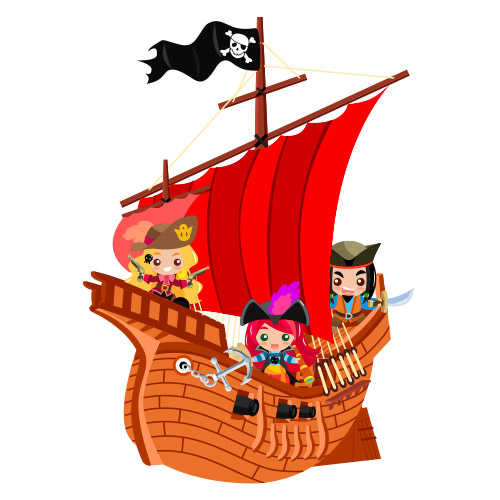
The Little Beetle work in full swing. Employees are passionate about creating a new application that will be something special, such as we have not yet created. One of the most striking features of the new children's application from Little Beetle is a catchy and original design. The theme of the future application is the adventure of pirates.
We present to your attention an interview with the leading designer of the company - Azamat “Keetano” . In this interview, we will try to reveal important topics and get answers to many questions regarding the design of children's mobile applications and the place of the designer in the development process.
Little Beetle: Where does the work begin?
Keetano:Work usually starts with an idea. We are set the task in the spirit of “come up with a new children's application,” and so far we have not come up with anything, we are not working. Sometimes we already have some ideas, because they appeared before the opportunity arose to implement them. Due to the fact that the resources are not unlimited, each employee cannot make several applications at once, so they are in the head “on the shelf”, and the team remembers them when the question arises about a new application.
Having decided on an idea, we must develop and justify it. For example, to explain the essence of the application, why it will be interesting for children, and how it will be possible to develop this application further. If this is a game, then you need to decide how to complicate the levels or how to add new tasks, is it possible within the framework of this idea.
After the specific developers of this application are selected from the team, we get together to discuss what we have to do and what the application will be like. It creates something like a design document, which is a kalyak-malyaki in a notebook.

At the first stage, this is enough to figure out where to move. The designer and programmer get their tasks, and the project manager oversees the processes and helps to solve problems that may arise during the work.

"Pirates of the Milk Sea"I suggested at the next meeting when we were discussing new applications. I always liked the pirate theme, and I am sure that children also love sea adventures and fearless pirates. In addition, the plan with the islands made it possible not to make a small application, but to collect many others in one game so that the adventures were long. Also, the game with the islands is easy to update by adding new islands to the map with new tasks.
Before starting the design, I read a couple of books about pirates, watched several films and rummaged on the Internet in search of illustrations on a pirate theme, portraits of the pirates themselves, images of treasures, sea monsters, islands, ships and other paraphernalia. This does not happen with all applications, but the fertile topic of pirate life required a more thorough approach to it. All this allowed me to come up with what kind of islands we will have, what will happen to the heroes of the game, and what they will do.
After the work done, having gathered my thoughts, I sat down to draw on the island's notebook and come up with names and characters. At the very beginning, we had a slightly different concept and other heroes. Perhaps we will return them to some of the islands, because they are great guys, but it would be difficult to start with them.


Having finished with the islands on paper, I scanned them and began to digitize them in Illustrator. After that, the main work related directly to the application began.

You see the most terrible island, the Southern Cross, where travelers will be greeted by cemetery horrors. Pirate stories must thoroughly tickle the nerves, otherwise they will not have all the charm.

Little Beetle: What do you focus on in your work, what inspires you?
Keetano: I focus primarily on other similar applications that are already on the App Store. You need to study what is on the market in order to figure out how to do better.
For the "Pirates of the Milk Sea" the opportunity to find inspiration was a whole ocean, because all these stories about sea adventures are very developed in a variety of directions. There were no problems.
As for our other applications, for example, "ABC ABDWiki" or "Fun Accounts" , often ideas come in the process of testing preliminary versions of the application. While you mess with him and run into some kind of problems, ideas arise how to do better or add something new.
In addition, we receive dozens of emails from our customers with suggestions for updates and many ideas for creating new applications. Thanks to the feedback, we can interact directly with parents who purchase our products for their children. We can and try to fulfill their wishes, realize their ideas - this is just fine.
Little Beetle: How do you define style? First comes the idea of the application, and then you come up with images, or vice versa?
Keetano:As a rule, a general idea is first formed, and then details like characters are formed. In Pirates of the Milk Sea, the main concept is simple: it is a game with educational and developing elements of pirates, designed for children. Who will be in the game and where they will swim is decided later. It's not like in comics, where the protagonist is born first, and only then his past and character are invented.

With style, everything is simpler. Since we make applications for children, everything should be so that they like it.
In general, I am against the generally accepted children's standards when design for children is done “in a childish way”: all the colors of the rainbow, cartoon characters, voice acting in stupid voices and other things that can be seen on the street and on TV - I mean all kinds of “telepuziks” , "Winx" and other evil spirits. However, practice shows that it is possible to convince parents for a very long time that children can be instilled higher standards, and done for children, first of all, as for people, and not “childish”. But this, as a rule, will not lead to anything, because this process takes a lot of time.

In other words, if you want your application to be sold, you need to make it in such a style that your parents define it as “childish,” and the children respond to an attractive icon that stands out from the crowd with some funny character that radiates joy and happiness. Children can distinguish game application icons from icons of other programs, even if they have never seen them before.

Little Beetle: What do you use at work? For example, do you use ready-made images from stocks, etc.
Keetano:Since I am not an illustrator, it’s quite difficult, and sometimes impossible, to draw an entire application from scratch — all backgrounds, objects, heroes, and more. I usually draw the interface myself, but for more complex images I resort to the services of photo stocks. Unfortunately, sometimes it is more difficult to find what is needed than to draw it yourself. Also, you often have to redo the purchased image to fit your needs. In such cases, the file is opened in a vector editor, and one can only hope for the best.
The notebook in which I take pen samples also helps me, because it is not always easy to imagine a picture in my head - sometimes you need to try options on paper to decide what will look better and how best to draw it before you start working on a computer . Sketch a pirate ship faster on paper. Immediately, the result can be shown to colleagues to find out their opinion. This helps not only to simplify the process, but also a little distract from working at the computer.

Little Beetle: Have you had any failures, failed projects that failed only because of the design and graphics?
Keetano:So that just because of the design they closed the development of the application - this has not happened before. Sometimes in the App Store there are comments like “fire your designer”, but this happens rarely, and, as a rule, only in the Russian App Store. The audience here is very critical, and for one mistake they can put the lowest rating, although this is undeserved. I will not argue that we make divine applications for children, but criticizing us for an ugly design is in no way possible - this would be biased, because there are never serious problems with design.

Little Beetle: What features can you highlight in applications designed for children (precisely in terms of design)?
Keetano:I believe that applications for children should hold their attention, so you need to make a spectacular first screen. It is advisable that we are met by some character or a group of characters, because in children's cartoons, fairy tales, toys, there is often some kind of creature that children watch or play with. To maintain their expectation, you need to have some kind of hero in the application.

It’s good to use animation and interactivity, since all sorts of “whistles” that respond to touch have advantages over static games or television, where you just have to watch. These benefits must be used.

Further, such applications should always be understandable without text prompts - you need to use as few menu transitions, fewer buttons, fewer settings so that children are busy playing, and not picking the menu. It is necessary to clearly highlight and place important elements in the expected places, such as the “Play” or “Back” buttons, so that the child does not fall into a stupor. The non-obviousness of the actions in the application will quickly force the baby to close the game.
We must not forget that there should be a noticeable reaction to all actions with the interface so that the child understands whether he is playing correctly. The reaction to the actions of the child can be supported not only graphically, but also with the help of animation or sounds.
Sound plays a large role in children's applications, because it not only helps the interface, but also creates an atmosphere, and children can memorize some tunes. For example, in our ABC ABGDeykethere is a beautiful song about letters that you can sing along with drawn letters. Parents write thankful letters and comments to us precisely because they and their children liked the song (it’s really a hit - it’s very difficult to forget it and throw it out of your head). All buttons should be voiced (except for the mute button) - it's not only usability, but also that children like to make noise with different sounds. Parents who bought their children horns, harpsichords, beeps, drums, whistles and other musical things know very well that such toys do not bother their children for a long time. And this is one of the prerequisites for our creation of an even newer application than the Pirates of the Milk Sea - in parallel, we are creating an application for teaching music.
Animation (or, rather, animation) traditionally accompanies the childhood of almost every child. Moving characters or animated backgrounds attract and hold children's attention. They are interested in what will happen next, and this is definitely more fun than a static picture. Try to use animation more often so that the application does not look dull. But do not forget that if you overdo it, then there will be such a booth, from which the head will hurt not only in children, but also in adults. Here, as elsewhere, it is important to know everything in proportion. It’s good to use animation with a reaction to touch when something starts to move, only if you touch it.
Finally, educational applications cannot do without praise. Children love being praised for completing the assignment correctly. It is not necessary to praise them constantly, but if everything is done correctly, then this must be reported. It’s important here to voice compliments sincerely so that the good oozes from the iPad speakers. You can support clever men and women not only with your voice, but also with characters, salutes, applause and other elements of the holiday, to show that achieving your goals is important.

Little Beetle: What do you think, can a project become successful only because of a well thought out and high-quality design, if the rest is quite simple, unpretentious, maybe even not very well worked out?
Keetano:If the application is buggy or has bugs, then this is bad. A good design will only help show beautiful screenshots, but otherwise it will not help. You can simply get a bunch of angry comments and low ratings from users who “lead” the beautiful pictures.
Little Beetle: What do you think is the secret to successful app design?
Keetano: If the application solves its problems, then its design was a success.
Little Beetle: Any suggestions on mobile app design? Advice? Suggestions to other designers, illustrators?
Keetano: Before you start making the app, see how you did it before you. Surely, you will see something interesting.
You can invest a lot of money in the promotion of the application and in programming, but if you do not spend it on design, you will not only lose profit, but also will not get a devoted audience. Your screenshots in the App Store will look very unconvincing and unprofessional. And this is the real trouble of many applications, especially for children.
If you are working on a children's application and you don’t have a good designer, then either find one or don’t continue working at all, because you shouldn’t show ugly things to children, including crooked programs.
For a children's application, ideally you need to have a good illustrator and a good designer. The first one can draw beautifully, but has no idea where to put the button and which one to make it. The second one may not be able to create a beautiful children's world for you, but it organizes the application space so that the child moves further than the first screen and wants to return to the game again and again. I sincerely wish good luck to all developers and designers!
Little Beetle: Thank you, Azamat, for such an informative interview. We hope your tips will help designers involved in developing mobile applications.
On behalf of Little Beetle, we are happy to inform you of important news: the release of the new children's developing application “Pirates of the Milk Sea” for iOS will be held on March 14. We will certainly share details about this event with readers of our blog on Habré. Stay with us!
We present to your attention an interview with the leading designer of the company - Azamat “Keetano” . In this interview, we will try to reveal important topics and get answers to many questions regarding the design of children's mobile applications and the place of the designer in the development process.
Little Beetle: Where does the work begin?
Keetano:Work usually starts with an idea. We are set the task in the spirit of “come up with a new children's application,” and so far we have not come up with anything, we are not working. Sometimes we already have some ideas, because they appeared before the opportunity arose to implement them. Due to the fact that the resources are not unlimited, each employee cannot make several applications at once, so they are in the head “on the shelf”, and the team remembers them when the question arises about a new application.
Having decided on an idea, we must develop and justify it. For example, to explain the essence of the application, why it will be interesting for children, and how it will be possible to develop this application further. If this is a game, then you need to decide how to complicate the levels or how to add new tasks, is it possible within the framework of this idea.
After the specific developers of this application are selected from the team, we get together to discuss what we have to do and what the application will be like. It creates something like a design document, which is a kalyak-malyaki in a notebook.
At the first stage, this is enough to figure out where to move. The designer and programmer get their tasks, and the project manager oversees the processes and helps to solve problems that may arise during the work.
"Pirates of the Milk Sea"I suggested at the next meeting when we were discussing new applications. I always liked the pirate theme, and I am sure that children also love sea adventures and fearless pirates. In addition, the plan with the islands made it possible not to make a small application, but to collect many others in one game so that the adventures were long. Also, the game with the islands is easy to update by adding new islands to the map with new tasks.
Before starting the design, I read a couple of books about pirates, watched several films and rummaged on the Internet in search of illustrations on a pirate theme, portraits of the pirates themselves, images of treasures, sea monsters, islands, ships and other paraphernalia. This does not happen with all applications, but the fertile topic of pirate life required a more thorough approach to it. All this allowed me to come up with what kind of islands we will have, what will happen to the heroes of the game, and what they will do.
After the work done, having gathered my thoughts, I sat down to draw on the island's notebook and come up with names and characters. At the very beginning, we had a slightly different concept and other heroes. Perhaps we will return them to some of the islands, because they are great guys, but it would be difficult to start with them.
Having finished with the islands on paper, I scanned them and began to digitize them in Illustrator. After that, the main work related directly to the application began.
You see the most terrible island, the Southern Cross, where travelers will be greeted by cemetery horrors. Pirate stories must thoroughly tickle the nerves, otherwise they will not have all the charm.
Little Beetle: What do you focus on in your work, what inspires you?
Keetano: I focus primarily on other similar applications that are already on the App Store. You need to study what is on the market in order to figure out how to do better.
For the "Pirates of the Milk Sea" the opportunity to find inspiration was a whole ocean, because all these stories about sea adventures are very developed in a variety of directions. There were no problems.
As for our other applications, for example, "ABC ABDWiki" or "Fun Accounts" , often ideas come in the process of testing preliminary versions of the application. While you mess with him and run into some kind of problems, ideas arise how to do better or add something new.
In addition, we receive dozens of emails from our customers with suggestions for updates and many ideas for creating new applications. Thanks to the feedback, we can interact directly with parents who purchase our products for their children. We can and try to fulfill their wishes, realize their ideas - this is just fine.
Little Beetle: How do you define style? First comes the idea of the application, and then you come up with images, or vice versa?
Keetano:As a rule, a general idea is first formed, and then details like characters are formed. In Pirates of the Milk Sea, the main concept is simple: it is a game with educational and developing elements of pirates, designed for children. Who will be in the game and where they will swim is decided later. It's not like in comics, where the protagonist is born first, and only then his past and character are invented.
With style, everything is simpler. Since we make applications for children, everything should be so that they like it.
In general, I am against the generally accepted children's standards when design for children is done “in a childish way”: all the colors of the rainbow, cartoon characters, voice acting in stupid voices and other things that can be seen on the street and on TV - I mean all kinds of “telepuziks” , "Winx" and other evil spirits. However, practice shows that it is possible to convince parents for a very long time that children can be instilled higher standards, and done for children, first of all, as for people, and not “childish”. But this, as a rule, will not lead to anything, because this process takes a lot of time.
In other words, if you want your application to be sold, you need to make it in such a style that your parents define it as “childish,” and the children respond to an attractive icon that stands out from the crowd with some funny character that radiates joy and happiness. Children can distinguish game application icons from icons of other programs, even if they have never seen them before.
Little Beetle: What do you use at work? For example, do you use ready-made images from stocks, etc.
Keetano:Since I am not an illustrator, it’s quite difficult, and sometimes impossible, to draw an entire application from scratch — all backgrounds, objects, heroes, and more. I usually draw the interface myself, but for more complex images I resort to the services of photo stocks. Unfortunately, sometimes it is more difficult to find what is needed than to draw it yourself. Also, you often have to redo the purchased image to fit your needs. In such cases, the file is opened in a vector editor, and one can only hope for the best.
The notebook in which I take pen samples also helps me, because it is not always easy to imagine a picture in my head - sometimes you need to try options on paper to decide what will look better and how best to draw it before you start working on a computer . Sketch a pirate ship faster on paper. Immediately, the result can be shown to colleagues to find out their opinion. This helps not only to simplify the process, but also a little distract from working at the computer.
Little Beetle: Have you had any failures, failed projects that failed only because of the design and graphics?
Keetano:So that just because of the design they closed the development of the application - this has not happened before. Sometimes in the App Store there are comments like “fire your designer”, but this happens rarely, and, as a rule, only in the Russian App Store. The audience here is very critical, and for one mistake they can put the lowest rating, although this is undeserved. I will not argue that we make divine applications for children, but criticizing us for an ugly design is in no way possible - this would be biased, because there are never serious problems with design.
Little Beetle: What features can you highlight in applications designed for children (precisely in terms of design)?
Keetano:I believe that applications for children should hold their attention, so you need to make a spectacular first screen. It is advisable that we are met by some character or a group of characters, because in children's cartoons, fairy tales, toys, there is often some kind of creature that children watch or play with. To maintain their expectation, you need to have some kind of hero in the application.
It’s good to use animation and interactivity, since all sorts of “whistles” that respond to touch have advantages over static games or television, where you just have to watch. These benefits must be used.
Further, such applications should always be understandable without text prompts - you need to use as few menu transitions, fewer buttons, fewer settings so that children are busy playing, and not picking the menu. It is necessary to clearly highlight and place important elements in the expected places, such as the “Play” or “Back” buttons, so that the child does not fall into a stupor. The non-obviousness of the actions in the application will quickly force the baby to close the game.
We must not forget that there should be a noticeable reaction to all actions with the interface so that the child understands whether he is playing correctly. The reaction to the actions of the child can be supported not only graphically, but also with the help of animation or sounds.
Sound plays a large role in children's applications, because it not only helps the interface, but also creates an atmosphere, and children can memorize some tunes. For example, in our ABC ABGDeykethere is a beautiful song about letters that you can sing along with drawn letters. Parents write thankful letters and comments to us precisely because they and their children liked the song (it’s really a hit - it’s very difficult to forget it and throw it out of your head). All buttons should be voiced (except for the mute button) - it's not only usability, but also that children like to make noise with different sounds. Parents who bought their children horns, harpsichords, beeps, drums, whistles and other musical things know very well that such toys do not bother their children for a long time. And this is one of the prerequisites for our creation of an even newer application than the Pirates of the Milk Sea - in parallel, we are creating an application for teaching music.
Animation (or, rather, animation) traditionally accompanies the childhood of almost every child. Moving characters or animated backgrounds attract and hold children's attention. They are interested in what will happen next, and this is definitely more fun than a static picture. Try to use animation more often so that the application does not look dull. But do not forget that if you overdo it, then there will be such a booth, from which the head will hurt not only in children, but also in adults. Here, as elsewhere, it is important to know everything in proportion. It’s good to use animation with a reaction to touch when something starts to move, only if you touch it.
Finally, educational applications cannot do without praise. Children love being praised for completing the assignment correctly. It is not necessary to praise them constantly, but if everything is done correctly, then this must be reported. It’s important here to voice compliments sincerely so that the good oozes from the iPad speakers. You can support clever men and women not only with your voice, but also with characters, salutes, applause and other elements of the holiday, to show that achieving your goals is important.
Little Beetle: What do you think, can a project become successful only because of a well thought out and high-quality design, if the rest is quite simple, unpretentious, maybe even not very well worked out?
Keetano:If the application is buggy or has bugs, then this is bad. A good design will only help show beautiful screenshots, but otherwise it will not help. You can simply get a bunch of angry comments and low ratings from users who “lead” the beautiful pictures.
Little Beetle: What do you think is the secret to successful app design?
Keetano: If the application solves its problems, then its design was a success.
Little Beetle: Any suggestions on mobile app design? Advice? Suggestions to other designers, illustrators?
Keetano: Before you start making the app, see how you did it before you. Surely, you will see something interesting.
You can invest a lot of money in the promotion of the application and in programming, but if you do not spend it on design, you will not only lose profit, but also will not get a devoted audience. Your screenshots in the App Store will look very unconvincing and unprofessional. And this is the real trouble of many applications, especially for children.
If you are working on a children's application and you don’t have a good designer, then either find one or don’t continue working at all, because you shouldn’t show ugly things to children, including crooked programs.
For a children's application, ideally you need to have a good illustrator and a good designer. The first one can draw beautifully, but has no idea where to put the button and which one to make it. The second one may not be able to create a beautiful children's world for you, but it organizes the application space so that the child moves further than the first screen and wants to return to the game again and again. I sincerely wish good luck to all developers and designers!
Little Beetle: Thank you, Azamat, for such an informative interview. We hope your tips will help designers involved in developing mobile applications.
On behalf of Little Beetle, we are happy to inform you of important news: the release of the new children's developing application “Pirates of the Milk Sea” for iOS will be held on March 14. We will certainly share details about this event with readers of our blog on Habré. Stay with us!