February 10, 2013 at 13:16
Nokia and the Elop Effect: continued

Last Sunday, I already wrote about Stephen Elop, “The Burning Platform” and a sharp change in the fate of Nokia. Alas, now I see that the focus of the article was taken somewhat incorrectly, and the general essence was difficult to grasp and many misunderstood, and I found the most interesting data after the publication of the article. In this short article, supplementing the first, I will try to correct the mistake, focusing on only one question: what was the dynamics of Nokia's development in the period before the release of the Burning Platform, and how urgent decisive measures were needed, regardless of the nature and consequences of these measures?
Also this time I preferred to completely abandon data from third-party sources and build charts based solely on quarterly reports.Nokia Of course, I still recommend that everyone interested in Nokia’s fate pay attention to the Communities Dominate Brands blog , but in this case I won’t use any information from there - Ahonen, with all his undoubted advantages as an analyst, is biased against Elop, which is quite expected for the Finn and former Nokia employee. I want to focus exclusively on objective impersonal data. So let's get started.
Let's start with the sad: Nokia’s profit chart for 2004-2012: The
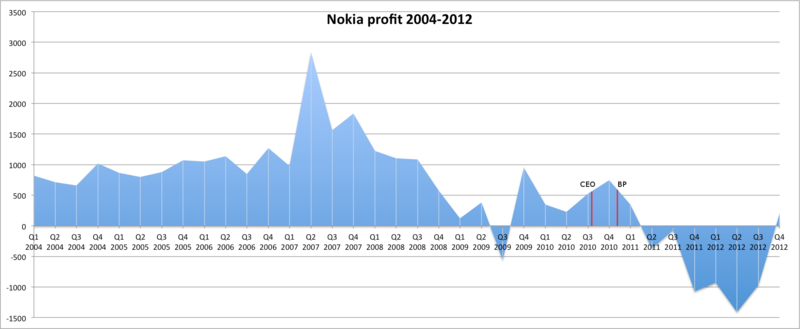
“CEO” and “BP” labels indicate, respectively, the moment when Stephen Elop became CEO of Nokia (September 2010) and the release of the “Burning Platform” address (February 2011- go). In fact, the turning point in the history of Nokia is precisely the second moment, the first I note solely for clarity.
So, we see that after the peak (2007-2008) and the fall (2009) Nokia's profit remained at a level lower than in previous years. That is, Elop came to the company when she was going through hard times, and this is certain.
But Nokia is a big company, and it deals not only with mobile phones, but also with telecommunication equipment (Nokia-Siemens Network) and, since the purchase of Navteq in 2008, navigation and maps. The grounds for Elop’s actions, if they were in Nokia’s position, should have been negative trends in smartphones. Let's dig into the past, again, taking a look at Nokia’s operational profit from mobile phones and services for 2004-2012:

And this is more interesting. Here, the blue graph means profit, while orange - profit averaged over three quarters - is added so that you can smooth out peaks and dips and evaluate the overall picture more clearly. As you can see from the graph, already in the middle of 2009, the profit from phones (including smartphones) almost returned to the level before the peak of 2007-2008. No cause for panic and statements like "Nokia, our platform is burning" is not yet visible.
Maybe it's in smartphones? It was smartphones that were in distress, and the schedule remained flat due to profit on regular phones? Well, there is an answer to this question. Fortunately, in the quarterly reports of Nokia there is information on operating profit from smartphones, starting in 2010:

Over the 2010th year, Nokia’s profit for smartphones grew by more than two and a half times. Still not like the "numerous hotbeds of fierce heat that feed the raging flames around us", right? But, perhaps, production fell at the same time?

Well, well, what a misfortune. Production also grew. It grew more slowly than profit, which shows that profit from one smartphone also grew - and doubled in 2010.
To summarize:
- The sales of smartphones in the 2010th year were growing and had no downward trend.
- The margin on smartphones grew and doubled in 2010.
- The profits of the smartphone division grew and in the 2010th year grew two and a half times.
- In general, profits from mobile devices stabilized at a level slightly lower than 2004-2006.
As far as one can see from the official Nokia reports, there were no prerequisites for the Burning Platform either in Nokia’s position at the beginning of 2011 or in the company's dynamics. The company did not need a sharp change of course - the “anti-crisis measures” adopted by Elop were not in Nokia’s interests. Elop's assurances to the contrary are a deliberate lie.
It is useless to try to guess what led Elop and how Nokia’s current position is in line with its plan — we cannot know. We cannot even say with certainty that the catastrophic events of 2011 are a direct result of Elop’s actions, and not a wonderful coincidence. All we can be sure of is that Nokia was not on a “burning platform”, did not need to change plans, and what Stephen Elop did was not in the interests of Nokia as a manufacturer of mobile phones.