January 31, 2013 at 09:37
Thermonuclear energy: the hope of mankind?
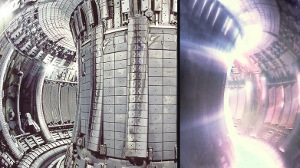 As a child, I liked to read the journal "Science and Life", in the village lay a binder from the 60s. They often talked about thermonuclear fusion in a joyful way - almost now, and it will be! Many countries, in order to catch the distribution of free energy, built Tokamaki at home (and set up a total of 300 of them worldwide).
 Years passed ... Now is the 2013th year, and humanity still receives most of its energy from burning coal, as in the 19th century. Why did it happen that prevents the creation of a thermonuclear reactor, and what should we expect in the future - under the cut.
Theory
The nucleus of an atom, as we recall, consists in a first approximation of protons and neutrons (= nucleons). In order to tear off all neutrons and protons from an atom, it is necessary to expend a certain energy - the binding energy of the nucleus. This energy is different for different isotopes, and naturally, in nuclear reactions, the energy balance must be maintained. If we plot the binding energy for all isotopes (per 1 nucleon), we get the following:
From here we see that we can get energy either by separating heavy atoms (like 235 U), or by connecting light ones.
The following synthesis reactions, most realistic and interesting in practical terms:
1) 2 D + 3 T -> 4 He (3.5 MeV) + n (14.1 MeV)
2) 2D + 2 D -> 3 T (1.01 MeV) + p (3.02 MeV) 50%
2 D + 2 D -> 3 He (0.82 MeV) + n (2.45 MeV) 50%
3) 2 D + 3 He -> 4 He ( 3.6 MeV) + p (14.7 MeV)
4) p + 11 B -> 3 4 He + 8.7 MeV
In these reactions, Deuterium (D) is used - it can be obtained directly from sea water, Tritium (T) is a radioactive isotope of hydrogen, now it receive as waste in conventional nuclear reactors, can be specially produced from lithium. Helium-3 - seems to be on the moon, as we all know. Bor-11 - natural boron is 80% boron-11. p (Protium, hydrogen atom) - ordinary hydrogen.
For comparison, when dividing 235 U, ~ 202.5 MeV of energy is released, i.e. much more than in the fusion reaction per 1 atom (but per kilogram of fuel - of course, thermonuclear fuel gives more energy).
According to reactions 1 and 2, many very high-energy neutrons are produced, which make the entire reactor structure radioactive. But reactions 3 and 4 - "aneutronic" - do not give induced radiation. Unfortunately, adverse reactions still remain, for example from reaction 3 - deuterium will itself react, and a small neutron radiation will still be.
Reaction 4 is interesting in that as a result we get 3 alpha particles, from which theoretically it is possible to directly remove energy (since they actually are moving charges = current).
In general, there are enough interesting reactions. The only question is how easy it is to implement them in reality?
About the complexity of the reaction Mankind has relatively easily mastered the 235 U fission : there is no difficulty here - since neutrons do not have a charge, they can literally “creep” through the nucleus even at a very low speed. Most fission reactors use precisely these thermal neutrons - in which the speed of motion is comparable to the speed of thermal motion of atoms.
But in the synthesis reaction - we have 2 nuclei having a charge, and they are repelled from each other. In order to bring them closer to the distance necessary for the reaction, it is necessary that they move at a sufficient speed. This speed can either be achieved in the accelerator (when all the atoms as a result move at the same optimal speed), or by heating (when the atoms fly randomly and randomly and randomly).
Here is a graph showing the reaction rate (cross-section) depending on the speed (= energy) of the colliding atoms:

Here is the same, but built on the temperature of the plasma, given the fact that the atoms fly there at a random speed: We
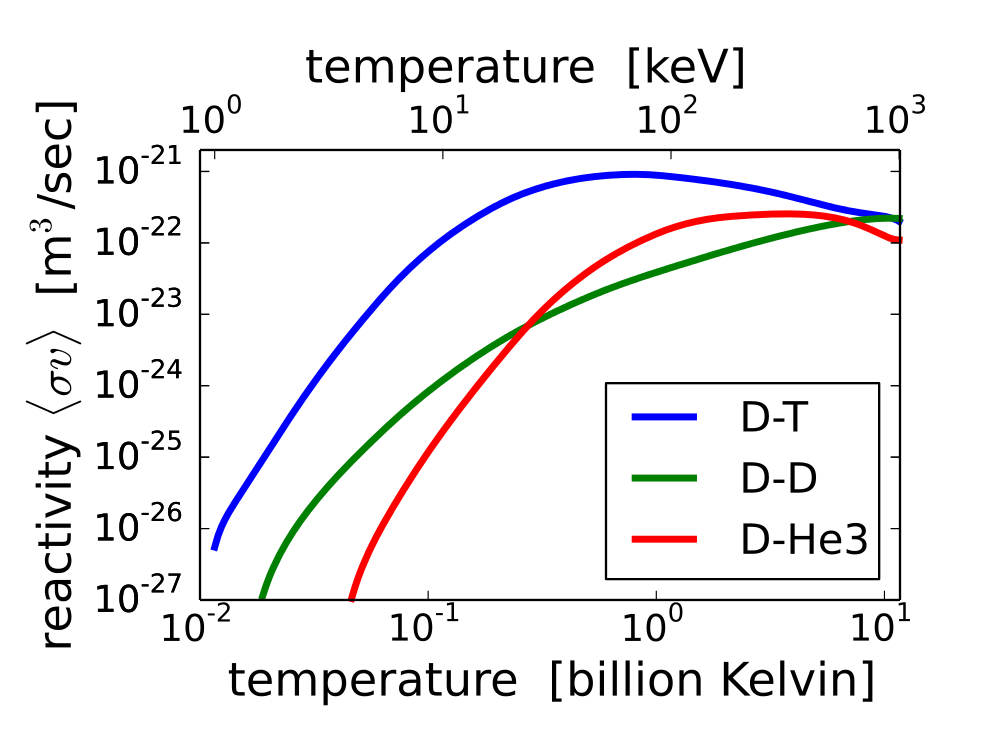
immediately see that the reaction D + T - the “lightest” one (it needs a miserable 100 million degrees), D + D - about 100 times slower at the same temperatures, D +3 He goes faster than competing D + D only at temperatures of the order of 1 billion degrees.
Thus, only the D + T reaction is at least remotely accessible to humans, with all its shortcomings (tritium radioactivity, difficulties in its production, radiation induced by neutrons).
But as you know, to take and heat something to one hundred million degrees and leave to react will not work - any heated objects emit light, and thus quickly cool. Plasma heated to hundreds of millions of degrees shines in the x-ray range, and what is most sad - it is transparent to it. Those. plasma with such a temperature cools down fatally quickly, and to maintain the temperature it is necessary to constantly pump in giant energy to maintain the temperature.
However, due to the fact that there is very little gas in a thermonuclear reactor (for example, in ITER - only half a gram), everything turns out not so bad: to heat 0.5 g of hydrogen to 100 million degrees you need to spend about the same amount of energy as to heat 186 liters of water at 100 degrees.
There is also Lawson's criterion , showing whether the reaction will give more energy than is spent. In addition to temperature, density is also important (plasma density is higher, the reaction is faster) and plasma retention time (in order to react). Accordingly, the systems can be pulsed (Z-Machine, NIF, thermonuclear charge - short reaction time, high temperature and density) and constant (tokamak - low density and temperature, long reaction time).
Let us see now what approaches there are to the implementation of a thermonuclear reactor.
Constructions
The star is a natural fusion reactor. Hot plasma under high pressure is retained by gravity, and all emitted x-ray radiation is absorbed due to its enormous density and size. Thus, the core does not cool even at relatively low reaction rates. Because of this, not only hydrogen and deuterium are burned in the nucleus, but also much heavier elements . Unfortunately, on earth such a design is difficult to implement. Thermonuclear (hydrogen) bomb- also quite simple in design. A hollow ball of plutonium in the delta phase (the delta phase has a 1/4 lower density than the alpha phase), and in the center in the simplest case there is thermonuclear fuel, lithium-6 deuteride. Using 2 types of explosives (“slow” and “fast”) and two detonators, a spherical shock wave is formed, which transfers plutonium into a smaller alpha phase, in which a fission chain reaction is possible. Optionally, you can add an external pulsed neutron initiator (about it below) - at the time of the greatest compression, it will give out a bunch of neutrons, which should give a sharp start to the reaction.
"Extra" neutrons are captured by lithium-6 with the formation of tritium, and the heated mixture of deuterium and tritium just needed is formed. They begin to react with each other - and the inertia force relative to the heavy charge housing from uranium keeps them from scattering. In addition, the uranium body is opaque to x-rays - accordingly, heat loss is less. The whole reaction ends in 1 microsecond - and the case is just starting to fly apart.
This was the so-called “booster scheme” of the nuclear charge, where the contribution of the thermonuclear reaction is small, and only allows you to slightly increase the power “cheaply” (plutonium is terribly expensive, and lithium is cheap as dirt in comparison with it).
Tritium is not directly used because it is radioactive and, accordingly, is not stored for a long time. And lithium-6 is stable, and the nuclear charge is always ready for battle. You can use lithium-7 - it not only gives tritium, but also another extra neutron. They did not know about this reaction when the Americans tested the Shrimp bomb (Shrimp). Due to the lack of pure lithium-6, they put partially enriched in which lithium-6 was only 40%, and counted on an explosion of 6 megatons, and it was dumbed by 15.
There is also a radiation implosion scheme - when a primary nuclear explosion by x-ray radiation compresses and heats a separate sphere with thermonuclear fuel.
Of course, this all works well in order to destroy, but in order to obtain energy, this approach cannot be used, the minimum explosion power is very high, and too many ordinary radioactive products of the plutonium / uranium reaction.
Linear accelerators : the idea is simple - we take a target from any convenient metal deuteride, and in a small linear accelerator we accelerate tritium atoms to the desired speed. We get a real thermonuclear reaction, and energy output and 14.1 MeV neutrons. Such a source can be used to search for oil and water (for example, the Russian pulsed DAN neutron source is on the MSL Martian rover), and as an external pulsed neutron initiator in nuclear charges.
Why, then, can not generate electricity? A lot more energy is spent on accelerating atoms than we get as a result of the reaction (far from all accelerated atoms react). According to my calculations, DAN for example has an efficiency of about 0.0016%.
Tokamak (toroidal chamber with magnetic coils) - the idea is already a little more complicated, in a plasma torus we induce a current in a transformer. Around the torus there are superconducting magnets that “squeeze” the plasma and prevent it from touching the walls. The plasma is heated by microwave radiation, and by resistive heating from the flowing current. When we started working in this direction, it seemed: just about everything would work.
About 300 tokamaks have been built around the world, and the most modern and largest of them is the ITER international project under construction(including with the participation of Russia). In it, the indicator Q = 10 should finally be achieved (i.e., the energy release is 10 times greater than that spent on heating and plasma confinement). They intend to ignite hydrogen plasma (i.e., without a thermonuclear reaction) in 2020, and start launches with deuterium-tritium plasma in 2027, unless of course everything goes according to plan and some other crisis does not happen.

Tokamaks have the following problems (with their future industrial use):
- Plasma instability. The discharge strives somewhere it becomes thinner, somewhere it is thicker, right up to the breaking of the ring (with the cessation of current) or touching the walls. They struggled with the problem of increasing the size of the camera, adding a poloidal magnetic field (around the vertical axis of the camera).
- Tritium is expensive, and it needs a lot to produce energy. If we convert the only neutron formed in the D + T reaction using lithium-6 into 1 tritium atom, due to the inevitable loss of neutrons, tritium will be less and less. It is necessary to use neutron multiplication - using, for example, lithium-7 or lead, with which it is necessary to cover the inner wall of the reactor (blanket), and somehow get tritium from there.
- Powerful neutron radiation: for the same generated power, the neutron flux is ~ 5-10 times greater than that of conventional nuclear reactors, and the neutrons themselves have much higher energy. This means that if the design of the reactor is made of the same materials, then its service life will be 5 years, and not 50 (as with conventional reactors).
- Since plasma with a huge temperature loses a lot of energy on radiation, and the chamber must be large to ensure stability - the minimum reactor power is large, hundreds of megawatts.
The stellarator is a “crumpled” donut, where the magnetic field is formed by external magnets of a very cunning shape and ensures plasma stability. Compared to a tokamak, it’s a much more complicated design. By the "quality" of plasma confinement, it is now inferior to tokamaks.

NIF - National Ignition Facility - the idea is to focus the light from 192 pulsed lasers on a target surrounding a capsule with a deuterium-tritium mixture. Light heats the target - it heats up to millions of degrees, and evenly “squeezes” the capsule with thermonuclear fuel with light. By the way, 3 years ago, on the hub, they wrote that almost everything was already ready there .
The project was completed on September 30, 2012. It turned out that there were inaccuracies in the computer model. According to a new estimate, the pulse power achieved in NIF is 1.8 megajoules - 33-50% of the required power so that as much energy is expended as it was expended.

Sandy Z-machine The idea is this: take a large pile of high-voltage capacitors, and sharply discharge them through thin tungsten wires in the center of the machine. The wires instantly evaporate, a huge current of 27 million amperes continues to flow through them for 95 nanoseconds. Plasma heated to millions and billions (!) Degrees emits x-ray radiation, and squeezes a capsule with a deuterium-tritium mixture in the center (the energy of the x-ray pulse is 2.7 megajoules).
It is planned to upgrade the system using the Russian power plant (Linear Transformer Driver - LTD). In 2013, the first tests are expected in which the production of energy is compared with the spent (Q = 1). Perhaps in this direction in the future there will be a chance to compare and surpass tokamaks. Dense Plasma Focus - DPF - “collapses” the plasma running along the electrodes to obtain gigantic temperatures. In March 2012, at a facility operating on this principle, a temperature of 1.8 billion degrees was reached. Levitated Dipole - “Inverted” Tokamak


, in the center of the vacuum chamber hangs a toroidal superconducting magnet which holds the plasma. In such a scheme, the plasma promises to be stable in itself. But the project does not have funding now, it seems that the synthesis reaction was not carried out directly at the facility.
Farnsworth – Hirsch fusor The idea is simple - we place two spherical grids in a vacuum chamber filled with deuterium, or deuterium-tritium mixture, we apply a potential of 50-200 thousand volts between them. In an electric field, atoms begin to fly around the center of the chamber, sometimes colliding with each other.
There is a neutron yield, but it is rather small. Large energy losses due to bremsstrahlung x-rays, the inner grid quickly heats up and evaporates from collisions with atoms and electrons. Although the design is interesting from an academic point of view (any student can assemble it), the neutron generation efficiency is much lower than linear accelerators.

 Polywell is a good reminder that not all fusion work is public. The work was funded by the US Navy, and was classified until negative results were obtained.
The idea is the development of Farnsworth – Hirsch fusor. We replace the central negative electrode, which was the most problematic, with a cloud of electrons held by a magnetic field in the center of the chamber. All test models had conventional rather than superconducting magnets. The reaction gave single neutrons. In general, no revolution. Perhaps the increase in size and superconducting magnets would change something.
Muon catalysis- a radically different idea. We take a negatively charged muon, and replace it with the electron in the atom. Since a muon is 207 times heavier than an electron, in a hydrogen molecule 2 atoms will be much closer to each other, and a fusion reaction will occur. The only problem is if helium is formed as a result of the reaction (chance of ~ 1%) and the muon flies away with it, it will not be able to participate in the reactions anymore (since helium does not form a chemical compound with hydrogen).
The problem here is that the generation of the muon at the moment requires more energy than can be obtained in the chain of reactions, and thus until the energy is received here.
Cold fusion(“cold” muon catalysis is not included here) - has long been a pasture of pseudo-scientists. There are no scientifically proven and independently repeatable positive results. And sensations at the level of the yellow press have been more than once before the E-Cat Andrea Rossi.
Summary
- Thermonuclear energy is not at all so crystal clear. In the only realistic reaction D + T at the moment, the neutron flux that will make any structural elements radioactive is ~ 10 times higher than in conventional reactors with the same power. The reactor vessel will have to be changed every 5-10 years.
- Humanity will certainly reach Q = 10 (we get 10 times more thermonuclear energy than we spend). This indicator is likely to be achieved on both Tokamak (ITER) and Z-Machine, in the 2030s and later.
- Despite the achievement of Q = 10, thermonuclear reactors will be much more expensive than classical uranium ones due to a more complex design, shorter service life of the body and superconducting magnets. Thermonuclear reactors will also not be small (such as floating mini-nuclear power plants)
- There is not much energy released during a thermonuclear reaction - 11.5 times more energy is released per uranium fission than during D + T synthesis (which has the highest energy release among fusion reactions)
- There are just not many thermonuclear fuels - tritium is very expensive and scarce. Obtaining it is neither easier nor cheaper than obtaining plutonium from uranium waste or U-233 from thorium.
- Helium-3 - would not help humanity in any way, even if there were mountains on earth. The parasitic reaction D + D will still produce radiation, and the optimum temperature will be a billion degrees, much more difficult than D + T over which humanity is beating at the moment.
- It looks like the next 1000 years we will use fast neutron reactors, burn cheap uranium-238 and thorium (unless of course humanity destroys itself in another war)
- Nevertheless, humanity is obligated to continue working on thermonuclear energy, even if the commercial result is after 1000 years, just as scientists worked on the basics of mathematics a millennium ago - without them there would have been no progress today.