January 7, 2013 at 19:39
Lego introduced Mindstorms EV3
On January 4, 2013, LEGO introduced the third version of the popular Mindstorms constructor - EV3:
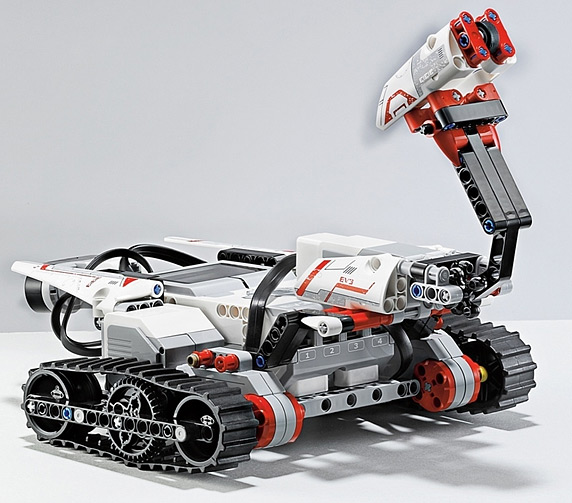
It is clear that the LEGO cubes have remained virtually unchanged, but the computer’s “brain” has undergone significant changes and promises to become a curious toy not only for children, but also for adult geeks (like this however, it was with previous versions of the constructor).
The programmable brick in the third reincarnation looks like this:

You can combine up to four of these modules.
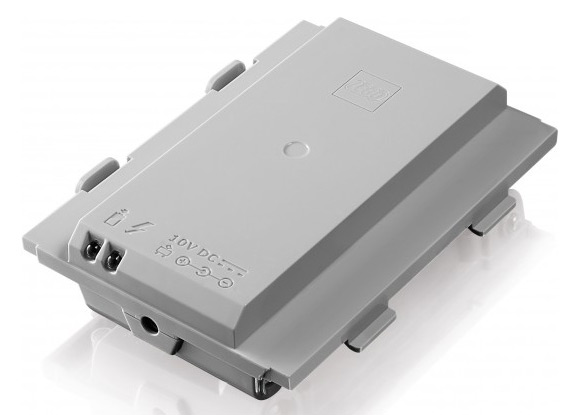
The bricks from these batteries are powered up (capacity, though currently unknown):
In addition to the main brick itself, the kit also includes:

In the photo, the second sensor on the left is a gyroscope-accelerometer; it seems to be not included in the basic package.
An infrared beacon is also available (you may need to buy it separately), with which you can control the robot, or you can create a robot that will independently search for the beacon.
The total number of Lego-Technics blocks in the kit is 594. The manufacturer promises to maintain backward compatibility with NXT2.0, that is, it will be possible to use motors and sensors from the previous version.
The declared price is 350 dollars. Let's hope that Lego will not consider the dollar equal to the euro, as is now fashionable, and in Europe it will cost at least 300 Euros. For comparison - Lego Mindstorm NXT 2.0D in Germany costs 274 Euros. In addition, the emergence of EV3 may cause a slight reduction in the price of NXT 2.0.
Programming will be carried out using a special graphics program supplied by National Instruments (as well as in the previous version of the designer). This program has a rather low "entry threshold", which is very good for teaching children the basics of robotics. Let's hope that adult children will not be left behind, and NI will continue to supply the library for LabVIEW. In general, the toy promises to be curious because of the presence of Linux on board - almost certainly after some time there will be firmware that extends the capabilities of the built-in computer.
Also of interest is the possibility of integration with iOS and Android (the robot can work autonomously, or receive control commands from the tablet via Bluetooth).
The designer will be available in the second half of this year. Perhaps if you are already going to buy NXT 2.0, then it makes sense to wait a bit. Recommended age of users - from 10 years.
In conclusion, here are some photos of robots that can be built using EV3 found on the open spaces of the network: A

conveyor with sorting cubes by color (this is for those children who want to devote their lives to industrial automation):


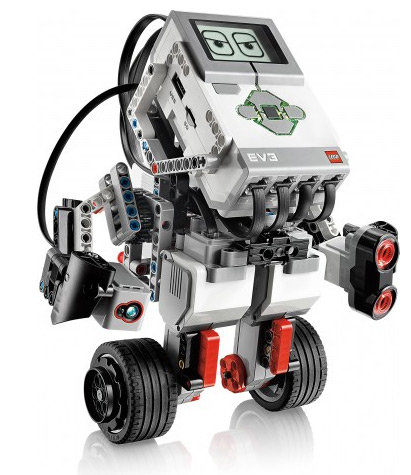
Balancer - what could be better for learning the basics of PID -regulator?
Sources:
Announcing LEGO MINDSTORMS EV3 - Official LEGO Release
Get ready to program! Lego's Mindstorms EV3 robots are here (cnet)
Neue Roboterplattform von Lego (golem.de - in German)
It is clear that the LEGO cubes have remained virtually unchanged, but the computer’s “brain” has undergone significant changes and promises to become a curious toy not only for children, but also for adult geeks (like this however, it was with previous versions of the constructor).
The programmable brick in the third reincarnation looks like this:
Specifications:
- Processor - ARM9 (ARM7 was used in the NXT 2.0 Designer)
- FLASH memory - 16 megabytes
- RAM - 64 megabytes
- Operating System - Linux
- SD expansion slot
- USB 2.0 (supports USB Host, i.e. you can insert a WiFi whistle)
- Bluetooth 2.1
- 4 ports for input and 4 ports for output
- Speaker
You can combine up to four of these modules.
The bricks from these batteries are powered up (capacity, though currently unknown):
Contents of delivery
In addition to the main brick itself, the kit also includes:
- Three servomotors (two large and one small)
- Touch Sensor (Touch Sensor, just a button)
- Color sensor
- Distance sensor (infrared is claimed in some press releases, but I suppose it's still ultrasonic)
In the photo, the second sensor on the left is a gyroscope-accelerometer; it seems to be not included in the basic package.
An infrared beacon is also available (you may need to buy it separately), with which you can control the robot, or you can create a robot that will independently search for the beacon.
The total number of Lego-Technics blocks in the kit is 594. The manufacturer promises to maintain backward compatibility with NXT2.0, that is, it will be possible to use motors and sensors from the previous version.
The declared price is 350 dollars. Let's hope that Lego will not consider the dollar equal to the euro, as is now fashionable, and in Europe it will cost at least 300 Euros. For comparison - Lego Mindstorm NXT 2.0D in Germany costs 274 Euros. In addition, the emergence of EV3 may cause a slight reduction in the price of NXT 2.0.
Programming will be carried out using a special graphics program supplied by National Instruments (as well as in the previous version of the designer). This program has a rather low "entry threshold", which is very good for teaching children the basics of robotics. Let's hope that adult children will not be left behind, and NI will continue to supply the library for LabVIEW. In general, the toy promises to be curious because of the presence of Linux on board - almost certainly after some time there will be firmware that extends the capabilities of the built-in computer.
Also of interest is the possibility of integration with iOS and Android (the robot can work autonomously, or receive control commands from the tablet via Bluetooth).
The designer will be available in the second half of this year. Perhaps if you are already going to buy NXT 2.0, then it makes sense to wait a bit. Recommended age of users - from 10 years.
In conclusion, here are some photos of robots that can be built using EV3 found on the open spaces of the network: A
conveyor with sorting cubes by color (this is for those children who want to devote their lives to industrial automation):
Balancer - what could be better for learning the basics of PID -regulator?
Sources:
Announcing LEGO MINDSTORMS EV3 - Official LEGO Release
Get ready to program! Lego's Mindstorms EV3 robots are here (cnet)
Neue Roboterplattform von Lego (golem.de - in German)