New Aruba Networks Controller - 72xx Series - First Look
Instead of joining ...
Good day to everyone who reads!
As you already understood, I work with Aruba equipment, which, unfortunately, is not very common in Russia so far. But this is temporary. You can read my first post about Aruba here .
The other day there was a new wireless network controller, which I would like to talk about very briefly - the piece of iron looks pretty advantageous against the background of already released controllers, as well as Cisco solutions, is great for building wireless networks for large organizations.
What is it?
WLAN controller is the core that allows you to centrally manage the network. In particular, to collect access points in groups (each with its own policies and settings, QoS, etc.), monitor the status of the network. The controller also performs the remaining service functions: firewall, WIPS (prevention of intrusion into wireless networks) and others. The main restrictions that are characteristic of all WLAN controllers are the number of supported access points, the number of users (in the case of implementing a user policy), the firewall throughput (traffic filtering speed), and, of course, the price.
What is good about the new controller
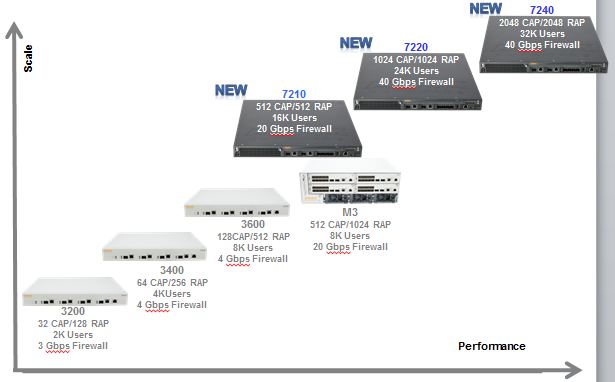
Until recently, the Aruba line did not have a solution that could support a large number of access points operating in the organization’s LAN for relatively little money. But now the situation has changed. The new controller can support from 512 (younger model) to 2048 (older model) access points. For comparison, 2048 access points are enough to cover, say, the main building of MSTU. N.E. Bauman (The one that stands on the Yauza). Well, or as marketers in Aruba compare - 3 Empire State Building. But we marketers have every right not to believe. But I vouch for MSTU. In addition, it is also good because it is ready for the new 802.11ac standard (for a brief description of the standard, see the apcsb comrade post) However, at the moment this, I think, does not play a big role, because at the moment there are no announced new access points from Aruba that would support this standard (leaving aside discussions about how viable this standard is in Russia) . Apparently, the first TDs will appear by the middle of next year. At the moment, this controller is already good because for relatively little money (about $ 23,000 for the younger model of the series and $ 43,000 for the older one) it supports:
- 512-2048 access points directly connected to it (via LAN)
- 20 to 40 Gbps Bandwidth
- SFP + Support
- Power redundancy
In order not to list everything, I will give a tablet - a comparison with existing older models of Aruba Networks controllers (taken from the official presentation on slideshare):

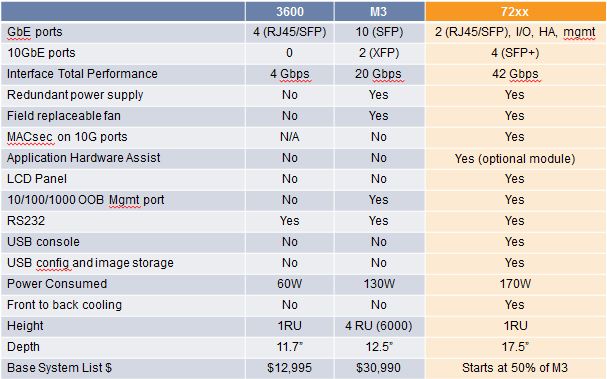
Accordingly, Aruba Networks itself positions its controller as something between 3600 and M3, which was top-end (at the moment, the situation at prices such that it is more profitable to take a 70xx controller than a modular 6000. It is not entirely clear what will happen to the 6000 controller, perhaps, it will be discontinued)
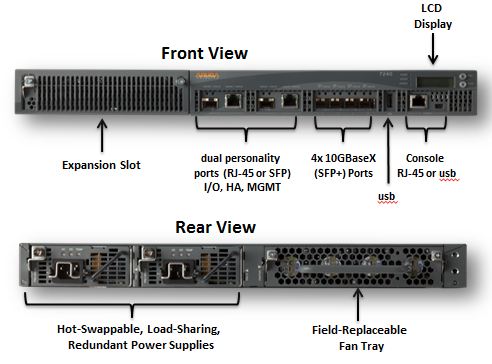
The controller itself is standard (1U) in size, looks like the figure below:
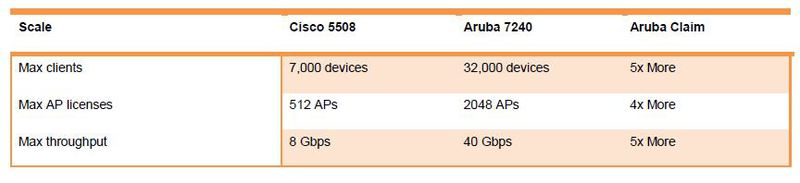
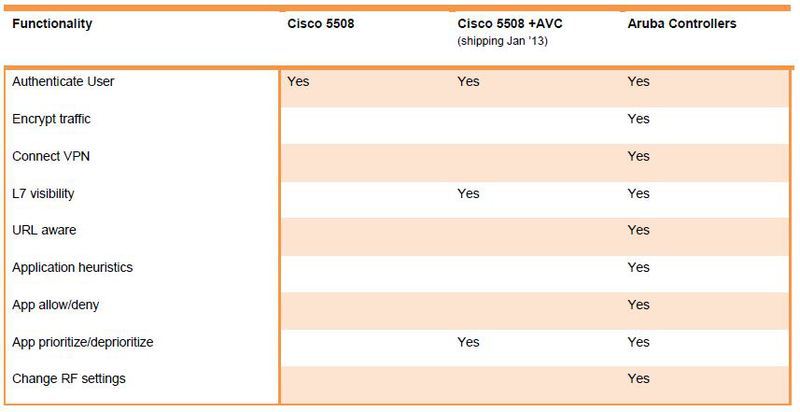
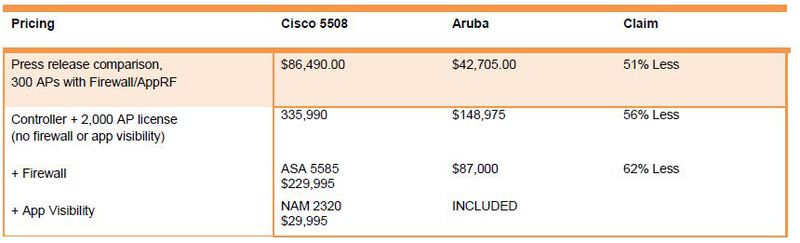
In conclusion, I suggest looking at a tablet (found by Google) that compares Aruba with Cisco (knowing the price ratio for current Cisco / Aruba equipment, I can say that the table is not unfounded; it is unlikely that the difference will reach 50% in real life, but 30-40 % - exactly. True, it depends, among other things, on many other factors):
Thank you all for your attention!
PS On Habré also found a free seminar on the basics of Aruba Networks - if someone was interested, maybe it would be useful to go.