
Theory of radio waves: educational program
I think everyone turned the radio knob, switching between "VHF", "DV", "SV" and heard hissing from the speakers.
But apart from deciphering the abbreviations, not everyone understands what is hidden behind these letters.
Let's get closer to the theory of radio waves.
Radio wave

The wavelength (λ) is the distance between adjacent wave crests.
Amplitude (a) is the maximum deviation from the average value during oscillatory motion.
Period (T) - time of one full oscillatory movement
Frequency (v) - number of complete periods per second
There is a formula that allows determining the wavelength by frequency:

Where: wavelength (m) is equal to the ratio of light speed (km / h) to frequency (kHz )
"VHF", "DV", "SV"
Ultra-long waves - v = 3-30 kHz (λ = 10-100 km).
They have the property of penetrating deep into the water column up to 20 m and, therefore, are used for communication with submarines, moreover, the boat does not have to float to this depth, it is enough to throw the radio buoy to this level.
These waves can propagate up to the envelope of the earth, the distance between the earth's surface and the ionosphere represents for them a “waveguide” along which they propagate freely.
Long waves (LW) v = 150-450 kHz (λ = 2000-670 m).

This type of radio wave has the ability to go around obstacles and is used for communication over long distances. It also has poor penetration, so if you do not have a remote antenna, you are unlikely to be able to catch any radio station.
Medium waves (SW) v = 500-1600 kHz (λ = 600-190 m).

These radio waves are well reflected from the ionosphere, located at a distance of 100-450 km above the earth. The peculiarity of these waves is that in the daytime they are absorbed by the ionosphere and the reflection effect does not occur. This effect is used practically, for communication, usually several hundred kilometers at night.
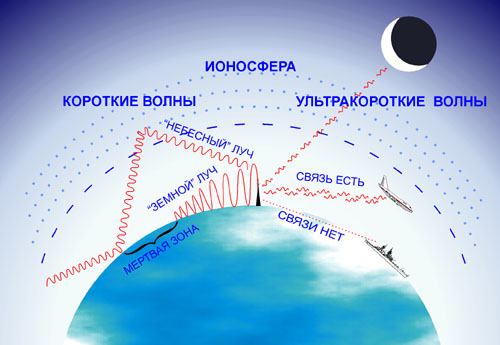
Short waves (HF) v = 3-30 MHz (λ = 100-10 m).

Like medium waves, they are well reflected from the ionosphere, but unlike them, regardless of the time of day. They can spread over long distances (several thousand km) due to rereflections from the ionosphere and the surface of the earth, this distribution is called hopping. High power transmitters are not required for this.
Ultrashort Waves(VHF) v = 30 MHz - 300 MHz (λ = 10-1 m).

These waves can go around obstacles several meters in size, and also have good penetration. Due to such properties, this range is widely used for radio broadcasts. The disadvantage is their relatively fast attenuation when faced with obstacles.
There is a formula that allows you to calculate the communication range in the VHF range:

So, for example, when broadcasting from the Ostankino TV tower 500 m high to a receiving antenna 10 m high, the communication range with direct visibility will be about 100 km.
High frequencies (HF-centimeter range) v = 300 MHz - 3 GHz (λ = 1-0.1 m).
They do not go around obstacles and have good penetration. Used in cellular networks and wi-fi networks.
Another interesting feature of the waves in this range is that water molecules are able to absorb their energy and convert it into heat. This effect is used in microwaves.
As you can see, wi-fi equipment and microwave ovens work in the same range and can affect water, therefore, you should not sleep in the arms with a wi-fi router for a long time.
Extremely high frequencies (EHF-millimeter range) v = 3 GHz - 30 GHz (λ = 0.1-0.01 m).
Reflected by almost all obstacles, freely penetrate the ionosphere. Due to their properties they are used in space communications.
AM - FM
Often, the receiving devices have the positions of the am-fm switches, what exactly is it:
AM - amplitude modulation

This is a change in the amplitude of the carrier frequency under the influence of coding oscillations, for example voice from a microphone.
AM is the first type of modulation invented by man. Of the disadvantages, like any analog type of modulation, it has low noise immunity.
FM - Frequency Modulation

This is a change in carrier frequency due to coding.
Although, this is also an analog type of modulation, but it has a higher noise immunity than AM and is therefore widely used in the soundtrack of TV broadcasts and VHF broadcasting.
In fact, those described by the type of modulation have subspecies, but their description is not included in the material of this article.
More terms
Interference - as a result of reflections of waves from various obstacles, the waves add up. In the case of addition in the same phases, the amplitude of the initial wave can increase; when added in the opposite phases, the amplitude can decrease down to zero.
This phenomenon is most manifested when receiving VHF FM and TV signal.

Therefore, for example, indoors, the quality of reception on a TV indoor antenna strongly “floats”.
Diffraction is a phenomenon that occurs when a radio wave encounters obstacles, as a result of which a wave can change its amplitude, phase and direction.
This phenomenon explains the connection at the HF and NE through the ionosphere, when the wave is reflected from various inhomogeneities and charged particles and thereby changes the direction of propagation.
The same phenomenon explains the ability of radio waves to propagate without line of sight, enveloping the earth's surface. To do this, the wavelength must be proportionate to the obstacle.
PS:
I hope the information described by me will be useful and bring some understanding on this topic.