September 13, 2012 at 10:45
Robotic tentacle with many degrees of freedom
Often, when creating robotic manipulators, not only the number of degrees of freedom and the gripping strength are taken into account, but also the ability to work with soft objects without damaging them. The new pneumatic plastic tentacle manipulator, created by scientists from the Harvard School of Engineering and Applied Sciences (USA), not only satisfies these requirements, but turned out to be much cheaper and more versatile than existing analogues. In addition, it is so delicate that it can operate with such a delicate object as a flower without causing it the slightest damage.
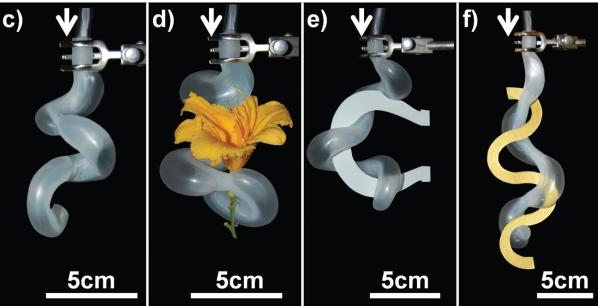
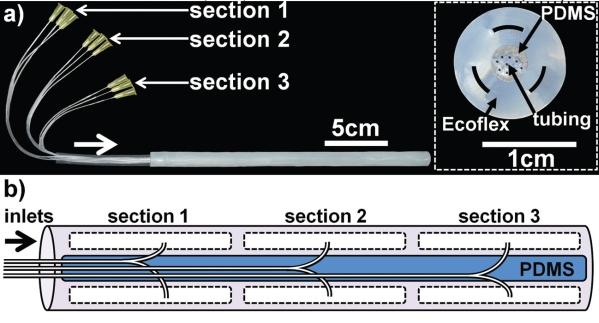
It is more common for humans to create limbs for robots that are the same or similar to those that he himself possesses. When creating a new manipulator, called the "tentacle" by researchers, the developers drew inspiration fromJapanese hentai artin the image of another creature living in the water element. The manipulator is created from a single plastic flexible pipe with three inner sections, each of which consists of three to four channels, regardless of the neighboring ones, filled with air to the required pressure, which contributes to the rotation of the tentacle in the right direction.

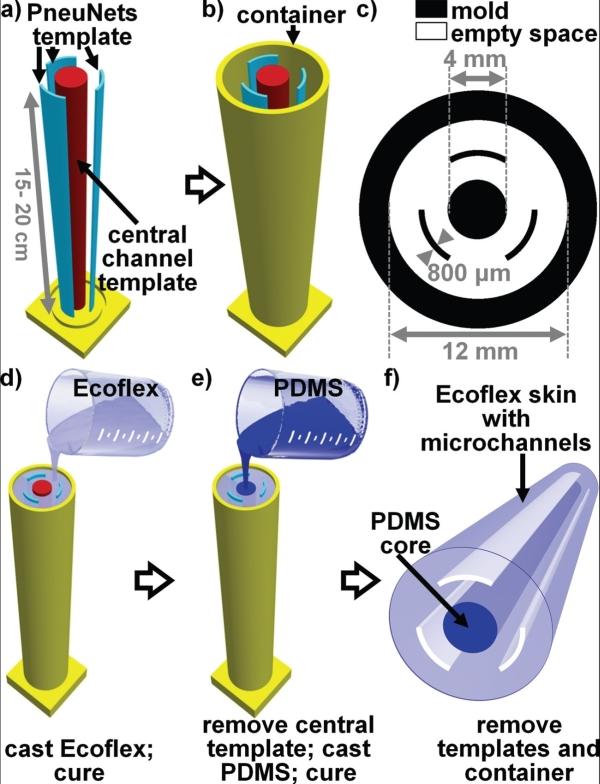
Thanks to the numerous channels inside the tentacle, scientists managed to give it the ability to bend in three dimensions, and not in one, as was done in previous designs of pneumatic manipulators. As materials, inexpensive elastomers were used , which were poured into a form previously printed on a 3D printer. After cooling the polymer, the central rod is removed and its place is filled with another type of polymer PDMS, to impart relative rigidity to the entire structure. Then peripheral profiles are retrieved. After removing from the mold, as a result, we see an elastomeric tentacle having three pneumatic channels located parallel to the central channel filled with PDMS.
The advantage of this technology is that you can create channels of various numbers and configurations, which leaves a wide field for improving the technology, as well as giving tentacles additional functions, to expand their possible applications.
For example, among the team’s promising finds is the placement of a camera at the end of the tentacle’s tent, which makes it possible to more accurately see small objects, as well as (in experimental order) a syringe and even a pneumatic suction cup, capable, like an octopus, of firmly capturing objects due to a decrease in pressure in the suction cup cavity.
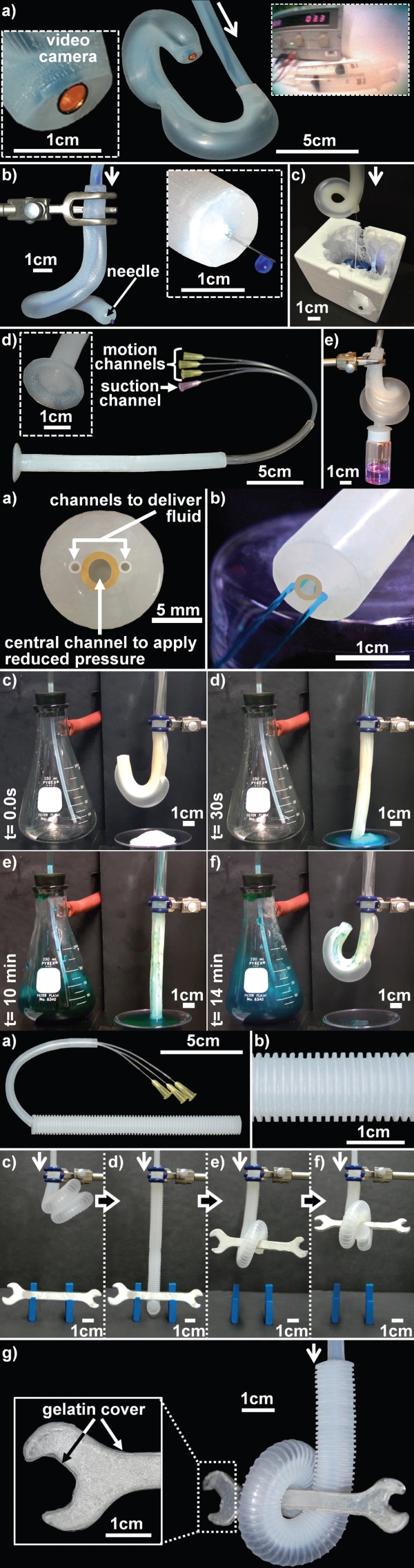
In short, this technology leaves a wide field for research and ideas where it can be applied. For example, you can use such tentacles as individual fingers of a certain robotic extremity, which will give it much more mobility and capabilities than usual, with a limited number of degrees of freedom. Since the tentacle is fully pneumatic and without a solid frame, it can be deflated and removed into the internal compartment of the robot, which saves space that can be used to place other tools.
For a more detailed study of the technology, see this PDF file (5.13mb)
It is more common for humans to create limbs for robots that are the same or similar to those that he himself possesses. When creating a new manipulator, called the "tentacle" by researchers, the developers drew inspiration from
Thanks to the numerous channels inside the tentacle, scientists managed to give it the ability to bend in three dimensions, and not in one, as was done in previous designs of pneumatic manipulators. As materials, inexpensive elastomers were used , which were poured into a form previously printed on a 3D printer. After cooling the polymer, the central rod is removed and its place is filled with another type of polymer PDMS, to impart relative rigidity to the entire structure. Then peripheral profiles are retrieved. After removing from the mold, as a result, we see an elastomeric tentacle having three pneumatic channels located parallel to the central channel filled with PDMS.
The advantage of this technology is that you can create channels of various numbers and configurations, which leaves a wide field for improving the technology, as well as giving tentacles additional functions, to expand their possible applications.
For example, among the team’s promising finds is the placement of a camera at the end of the tentacle’s tent, which makes it possible to more accurately see small objects, as well as (in experimental order) a syringe and even a pneumatic suction cup, capable, like an octopus, of firmly capturing objects due to a decrease in pressure in the suction cup cavity.
In short, this technology leaves a wide field for research and ideas where it can be applied. For example, you can use such tentacles as individual fingers of a certain robotic extremity, which will give it much more mobility and capabilities than usual, with a limited number of degrees of freedom. Since the tentacle is fully pneumatic and without a solid frame, it can be deflated and removed into the internal compartment of the robot, which saves space that can be used to place other tools.
For a more detailed study of the technology, see this PDF file (5.13mb)