Steve Jobs as a Rorschach test
In 1997, shortly after returning to Apple as CEO, Steve Jobs decided that the transport company was not delivering components fast enough. In response, the carrier stated that it could not deliver faster, and it should not: the terms fixed in the contract were respected. Jobs ordered to break the contract. And he added that if they try to sue, they will never again receive a cent.
The transport company sued. The manager who worked with her quit. The trial cost a large sum of money, but the goal was achieved: Apple found a new, more efficient carrier.
Biographies of successful people are used as sources of inspiration and instructions for action. What lesson can be learned from this story? That the end justifies any means. Jobs did not hesitate to call his subordinates idiots and say what they were doing wrong. No one was protected from his attacks, even the highest ranks of Apple. Jonathan Ive, the company's chief designer, once rented a room for Jobs at a five-star hotel in London. Jobs flew out from there with a bullet yelling, “What a shit!” Random people who fell victim to his anger (police officers, shop and restaurant workers) received the same "courteous" appeal.
Almost a year has passed since the death of Jobs, but his biographyauthored by Walter Isaacson is still a bestseller. For entrepreneurs, Jobs’s life is like the gospel and the anti-gospel all rolled into one. Some see it as a good example of how important it is to follow your vision and your goal. Others - an instructive story about how you can change the world, but set yourself up against everyone around you. This scatter of opinions indicates the existence within us of two strong, but conflicting needs: to succeed in work and still have a happy personal life. How does it feel to be Steve Jobs?
Among the businessman there are many such as Steve: aggressive, with dictatorial habits, tuned to constant competition, perceiving work as the most important thing in life. Jobs' biography only strengthened them in the thought that they were doing everything right. Here are some examples.
Steve Davis, the head of TwoFour , eagerly responded to my offer to tell me what impact Jobs had on his life and career. When Davis found half an hour to talk to me (with his busy schedule, this turned out to be a problem), he immediately admitted that he had sacrificed his family life to some extent for the sake of work. Fortunately, his wife was not opposed.
Talking about business, Davis gets excited. He loves risk and uncertainty, he enjoys every minute of his work. During the interview, the lawyer called and Steve admitted that he did not know what to answer him. “Entrepreneurs are different from ordinary people,” says Davis. - We are not afraid of trouble. Look at Jobs. There were enough failures in his life, but he continued to move forward. Jobs is alien to conventions; he follows his own path. You can either join him or get out of the way. ”
Joining or getting out of the way is the main thing that those who see Jobs as a role model have learned. “Jobs has shown how effective an authoritarian management style can be. He refuted the thesis of modern sociology that happy employees are always more efficient. ”
Tristan O'Tierni, co-founder of Square , confirms the benefits of aggression: “Don't be afraid to tell people directly: your job is shit. Great things are created only through frankness and uncompromising. ”
Aaron Levy, creator of the Box service , adds: “Jobs’s story has taught me that it’s necessary to demand the impossible from employees. They should know that I will not let the product go until it is polished to a shine. This is good for the product, but not so for people. ”
However, the team is easily reconciled with a rude and authoritarian management style if the organization shows impressive results. Jobs regularly called subordinates half-fools, but few people quit because of this. Moreover, employees considered themselves the happiest people, because they had a chance to work with Steve Jobs himself.
Bridgewater Associates , the world's most profitable hedge fund, is another example of the effectiveness of authoritarianism and brutal frankness. Its directors Ray Dalio is called "Steve Jobs in the world of investment." He cultivates a harsh manner of communication in the company, without regard to feelings. “At first it hurts,” Dalio says. “But the pain goes away quickly and you begin to have fun.”
Most of all, Jobs fans liked the clarity of his vision. Neil Sales-Griffin, Founder and CEOCode Academy , admits that thanks to Jobs, he stopped paying attention to the subtleties of etiquette. He ruthlessly closes unpromising projects, no matter how much time employees invested in them. Neil recalls MobileMe's failed launch and Jobs' reaction . For the team it was stress, but the problem was quickly resolved.
Jobs's opponents are horrified by his dictatorial style of behavior. Isaacson’s book contains many instances of Jobs’s unceremonious behavior. He was furious for the most insignificant reasons (he did not like the flowers in the hotel or the drink in the cafe), parked in places for the disabled, refused to get license plates for the car (because of which he changed the car every six months), for a long time he did not recognize the eldest daughter.

Jobs critics include Jeff Atwood, creator of Stack Exchange . “Running a startup is like getting involved in a war,” he says. “To succeed, you need an almost religious faith in the project and complete dedication.” Atwood left Stack Exchange and abandoned his thoughts on a startup. Enlightenment for him was the book of Isaacson.
Atwood was shocked by the description of Jobs' personal life. One story brought him almost to tears: Jobs showed the sketches of the new Apple campus to his son, but did not show his daughter Erin, although she was going to become an architect. He paid less attention to her, because Erin was quiet and introverted. She did not know how to behave with her father, especially when he began to let go of taunts. “Work should not subordinate everything else to itself. How can I choose between creating a damned iPad and raising children? Children are more important, ”Atwood gets excited.
Verinder Sial, a former owner of a coffee shop chain, and now a consultant and teacher at the business school, is less categorical: “I always admired Jobs, but Isaacson’s book made me look at him from a different angle. Why did Jobs always want to be right and blame the rest? Why did he appropriate other people's ideas? ”According to Verinder, Jobs was like dynamite. Dynamite clears the way, but destroys everything around it. “Bill Gates was an ass, but eventually turned into a decent person. Jobs remained as an ass, ”said Sial.
The claims of Siala and especially Atwood are only partially justified. If you read the book carefully, then towards the end you can find a fragment where Jobs explains why he asked Isaacson to write a biography: “I wanted my children to recognize me. "I was not always with them and I want them to understand why this happened." Brad Wardell, CEO of the Stardock gaming company , was shocked when he realized that Jobs died prematurely for the same reason that he created the iPod, iPhone and iPad. His perception of reality was greatly distorted. He refused to believe in the severity of the disease and delayed treatment for nine months.. “Jobs’s example gave me the strength to work 80–90 hours a week,” says Wardell. “But then I realized that I was also mortal.” Jobs did not communicate well with his children. I made the same mistake. " Now Brad is trying to work more often from home and delegate more.
Many Jobs fans closer to 40 years old come to the conclusion that a small, calm life-style business (like 37signals) is preferable to a life-long business that will swallow you without a trace. Two products a year instead of six, thirty letters a day instead of two hundred, several hundred thousand or several million dollars in revenue per year instead of an IPO on the NASDAQ.
Such an approach has the right to exist, but it is not necessary to pose the question so categorically: either work or personal life. Successful women combine both. The need for motherhood forces them from a youth to build the right balance. Heidi Messer, co-founder of LinkShare , says: “Jobs did created two multibillion-dollar corporations - Apple and Pixar. So, I can combine business and family. ”
Some time after the book was released, Isaacson published an article in the Harvard Business Review. In it, he called for less fixation on the grumpy nature of Jobs and more on his outstanding achievements at Apple and Pixar. Isaacson summarizes Jobs's views in 14 short commandments: “Distort reality”, “Achieve perfection”, “Keep around you only people from the big leagues”, etc. “His unserviceable nature will be forgotten,” writes Isaacson, “and achievements will forever remain in history.” Along with Edison, Ford and Disney. "
Isaacson himself usually does not agree with attacks on Jobs: “Even in his worst moments, he was no worse than other powerful people of his level ... I personally know several readers who are outraged that Jobs parked in places for the disabled. Do you know who these readers are? Investment bankers. The very ones that the derivatives came up with that left millions without savings and led to the global crisis . ”
“When people criticize Jobs’s behavior towards his own family,” Isaacson continues, “I ask: how did it happen that you yourself were married three times and your daughter doesn't talk to you anymore?” Jobs's personal life was not perfect, but in the end he created a strong family and raised four children who supported him to the very end. Why blame him? Well, okay. To convince critics is like arguing with fundamentalists about different versions of the gospel. ”
Using Jobs as an example, we can clearly see why we are so desperately looking for role models. Jobs never had a mentor. He always made decisions based on his own vision and intuition. We all face the same uncertainty, albeit on a smaller scale. That's why we turn to the biographies of great people - for answers and a roadmap.
The paradox is that Jobs’s experience does not apply to most people . Few of us run Apple-sized companies and get a chance to change the world. Our employees, if they are modeled after Jobs’s example, will simply leave for another company. Our family will fall apart. Jobs acted on a completely different level, where much was forgiven. For others, this behavior will end badly.
Robert Sutton, author of The No Asshole Rule, notes Jobs as an extremely effective tyrant. But in the vast majority of cases, Sutton argues, dictatorial ways create only problems. Creativity and productivity of employees are reduced, an indifferent attitude to work is being formed, the level of absenteeism and staff turnover is growing.
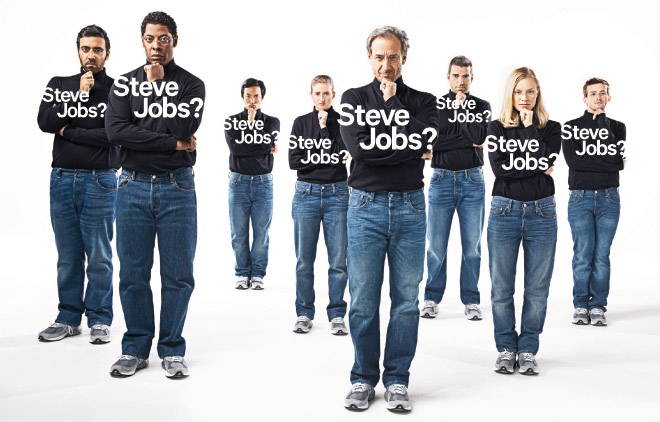
Sutton believes that Jobs was too special and too controversial to be oriented. This is a Rorschach test for entrepreneurs and managers: everyone sees in Jobs what they want to see .
Source: Wired