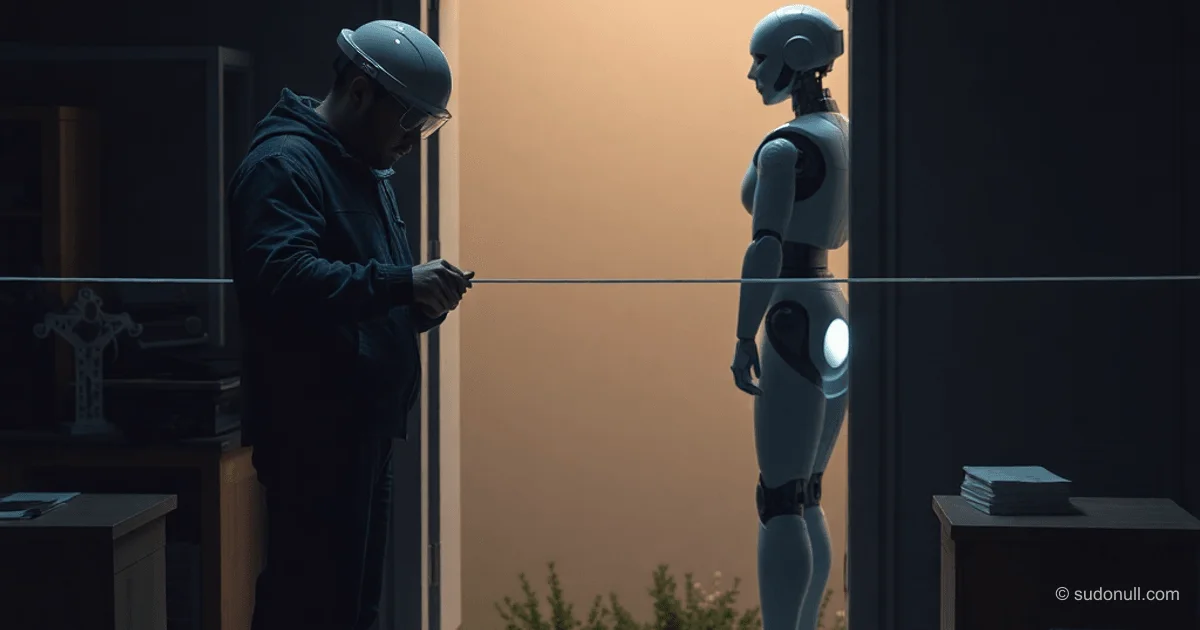
Humanoid Robot Vulnerabilities: Anatomy, Sensors, and Countermeasures
Humanoid robots like Tesla Optimus, Boston Dynamics Atlas, and Figure 01 demonstrate impressive mobility—but their physical architecture creates inherent weaknesses. Understanding their anatomy reveals critical failure points: joint-mounted servos, sensor arrays, and battery compartments. This knowledge forms the foundation for identifying real-world vulnerabilities.
Anatomy of Key Systems
Robot joints rely on electric motors and gearboxes—not elastic human muscles. Mechanical impact to the knee, elbow, or hip joint disrupts balance instantly. Without mobility, the robot becomes inert metal.
The sensor suite—mounted in the "head"—is a rotating platform housing stereo cameras and LiDAR units. The neck contains fragile data cables; severing them cuts off environmental input to the CPU.
The torso-mounted battery pack stabilizes the center of gravity. Lithium-ion batteries are prone to thermal runaway when damaged. Common battery chemistries:
- NMC (Lithium Nickel Manganese Cobalt Oxide): High energy density, but elevated fire risk.
- LFP (Lithium Iron Phosphate): Thermally stable and safe, but heavier and cold-sensitive.
- LMFP: An enhanced LFP variant with reduced weight.
- LTO (Lithium Titanate): Fast-charging, freeze-tolerant—but expensive and heavy.
- Solid-State: Lightweight, inherently safe, yet costly and currently limited by short cycle life.
Field identification: measure cell voltage and mass. Use these formulas:
$$E(Wh) = V(Volts) \cdot C(Ah)$$
$$Energy\ Density = \frac{E(Wh)}{m(kg)}$$
Typical energy densities:
| Chemistry | Energy Density (Wh/kg) | Nominal Cell Voltage (V) |
|-----------|------------------------|--------------------------|
| LTO | 70–110 | 2.3–2.4 |
| LFP | 140–170 | 3.2 |
| NMC/Li-Po | 200–280 | 3.6–3.7 |
| Solid-State | >300 | — |
Additional identifiers: LTO operates reliably in subzero temperatures; NMC cells swell and ignite under stress.
Sensor Evasion Tactics
Robots rely on RGB cameras, LiDAR, and microphone arrays. Adversarial attacks disrupt computer vision: asymmetrical clothing patterns distort bounding boxes, tricking neural networks into misclassifying humans as inanimate objects.
Camera blinding: strobe lights or low-power lasers overload image sensors.
For LiDAR, aerosols are highly effective—smoke, fog, or fire extinguisher powder scatter laser beams. Mirrors generate false 3D point clouds.
Acoustic masking: noise from toys, speakers, or radios interferes with sound-source triangulation—fragmenting the system’s attention.
Mechanical Countermeasures
Robot balance systems cannot detect ultra-thin filaments like Kevlar fishing line (<1 mm diameter). At 1.5 m/s and 75 kg mass, momentum is:
$$p = m \cdot v = 75 \cdot 1.5 = 112.5\, kg\cdot m/s$$
Stopping force over 0.1 s:
$$F = \frac{\Delta p}{\Delta t} = \frac{112.5}{0.1} = 1125\, N$$
A braided cord rated at 136 kg (~1334 N) withstands this force—jamming servos or toppling balance. Anchoring to structural supports is essential.
Alternative Communication Channels
When RF spectrum is jammed:
- Contextual codes: references to personal memories (e.g., "where we burned carbide back in 7th grade") remain opaque to AI.
- Optical signaling: heliograph by day; avoid IR at night.
- Seismic signaling: tapping on pipes transmits low-frequency signals through walls.
Key Takeaways
- Joints and neck cabling are priority targets for mechanical disruption.
- Battery chemistry dictates risk profile: NMC ignites; LTO thrives in freezing conditions.
- Adversarial patterns and aerosols reliably degrade vision and LiDAR performance.
- Thin-filament traps are highly effective—when strength is correctly calculated.
- Human creativity consistently outperforms algorithmic optimization.
— Editorial Team










No comments yet.