June 15, 2012 at 21:59
DIY biofuel elements
I want to warn you right away that this topic is not entirely related to Habrism , but in the comments to the post about the element developed in MIT, the idea seems to be supported, so below I will describe some considerations about biotolating elements.
The work on the basis of which this topic was written was carried out by me in the 11th grade, and took second place at the INTEL ISEF international conference.
A fuel cell is a chemical current source in which the chemical energy of a reducing agent (fuel) and an oxidizing agent, continuously and separately supplied to the electrodes, is directly converted into electrical
energy. A schematic diagram of a fuel cell (TE) is presented below:
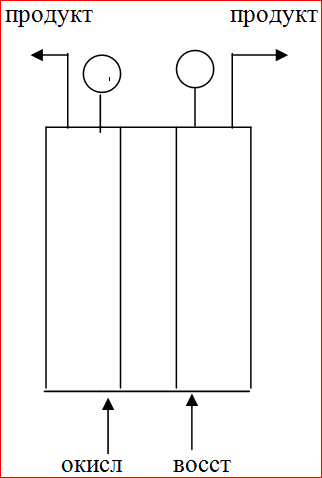
A fuel cell consists of an anode, a cathode, an ion conductor, an anode and a cathode chamber. At the moment, the power of biofuel elements is not enough for use at industrial scales, but BFC with low power can be used as sensitive sensors for medical purposes, since the current in them is proportional to the amount of processed fuel.
To date, a large number of structural varieties of fuel cells have been proposed. In each case, the design of the FC depends on the purpose of the FC, the type of reagent and the ionic conductor. Biofuel elements in which biological catalysts are used are a special group. An important distinguishing feature of biological systems is their ability to selectively oxidize various fuels at low temperatures.
In most cases, immobilized enzymes are used in bioelectrocatalysis, i.e. enzymes isolated from living organisms and attached to a carrier, but retaining catalytic activity (partially or completely), which allows them to be reused. Consider, for example, a biofuel element in which an enzymatic reaction is coupled with an electrode when using a mediator. Scheme of a biofuel element based on glucose oxidase:
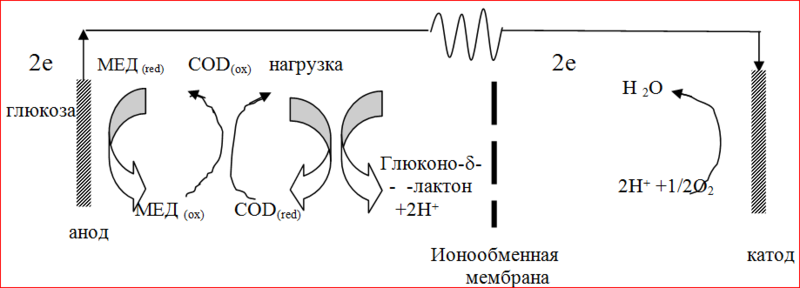
A biofuel cell consists of two inert electrodes of gold, platinum or carbon immersed in a buffer solution. The electrodes are separated by an ion-exchange membrane: the anode compartment is purged with air, the cathode compartment with nitrogen. The membrane allows you to spatially separate the reactions that occur in the electrode compartments of the element, and at the same time provides the exchange of protons between them. Membranes of various types suitable for biosensors are produced in the UK by many companies (VDN, VIROKT).
The introduction of glucose into a biofuel cell containing glucose oxidase and a soluble mediator at 20 ° C leads to the appearance of an electron flux from the enzyme to the anode through the mediator. Electrons go through the external circuit to the cathode, where under ideal conditions water forms in the presence of protons and oxygen. The resulting current (in the absence of saturation) is proportional to the addition of a rate-determining component (glucose). By measuring stationary currents, it is possible to quickly (5s) determine even low glucose concentrations - up to 0.1 mM. As a sensor, the biofuel element described has certain limitations associated with the presence of a mediator and certain requirements for an oxygen cathode and membrane. The latter should retain the enzyme and at the same time pass low molecular weight components: gas, mediator, substrate. Ion exchange membranes are usually satisfy these requirements, although their diffusion properties depend on the pH of the buffer solution. The diffusion of components through the membrane leads to a decrease in the efficiency of electron transfer due to adverse reactions.
Today, there are laboratory models of fuel cells with enzyme catalysts, which in their characteristics do not meet the requirements of their practical application. The main efforts in the next few years will be aimed at finalizing biofuel elements and the further use of the biofuel element will be associated to a greater degree with medicine, for example: an implantable biofuel element using oxygen and glucose.
When using enzymes in electrocatalysis, the main problem that needs to be solved is the problem of pairing the enzymatic reaction with the electrochemical, that is, ensuring the efficient transport of electrons from the active center of the enzyme to the electrode, which can be achieved in the following ways:
1. The transfer of electrons from the active center of the enzyme to the electrode using a low molecular weight carrier - mediator (mediator bioelectrocatalysis).
2. Direct, direct oxidation and restoration of the active centers of the enzyme on the electrode (direct bioelectrocatalysis).
In this case, the mediator conjugation of the enzymatic and electrochemical reaction can, in turn, be carried out in four ways:
1) the enzyme and the mediator are in the volume of the solution and the mediator diffuses to the electrode surface;
2) the enzyme is on the surface of the electrode, and the mediator is in the volume of the solution;
3) the enzyme and mediator are immobilized on the surface of the electrode;
4) the mediator is attached to the surface of the electrode, and the enzyme is in solution.
In this work, the catalyst for the cathodic reaction of oxygen reduction was laccase, and the catalyst for the anodic reaction of glucose oxidation was glucose oxidase (YEAR). Enzymes were used as part of composite materials, the creation of which is one of the most important stages in the creation of biofuel elements, simultaneously performing the function of an analytical sensor. In this case, biocomposite materials should ensure selectivity and sensitivity of substrate determination and at the same time have high bioelectrocatalytic activity, approaching enzymatic activity.
Laccase is a Cu-containing oxidoreductase, the main function of which under native conditions is the oxidation of organic substrates (phenols and their derivatives) with oxygen, which is then reduced to water. The molecular weight of the enzyme is 40,000 g / mol.
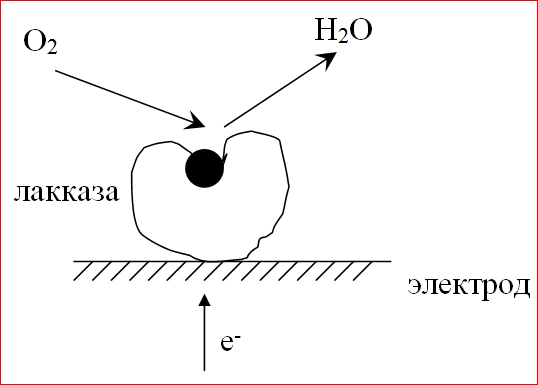
To date, it has been shown that laccase is the most active electrocatalyst for oxygen reduction. In its presence, a potential close to the equilibrium oxygen potential is established on the electrode in an oxygen atmosphere, and oxygen reduction proceeds directly to water.
As a catalyst for the cathodic reaction (oxygen reduction), a composite material based on laccase, acetylene black AD-100 and Nafion was used. A feature of the composite is the structure that ensures the orientation of the enzyme molecule with respect to the electron-conducting matrix, necessary for direct electron transfer. The specific bioelectrocatalytic activity of laccase in the composite approaches that observed in enzymatic catalysis. A method for coupling an enzymatic and electrochemical reaction in the case of laccase, i.e. The method of electron transfer from the substrate through the active center of the laccase enzyme to the electrode is direct bielectrocatalysis.
Glucose coxidase (GOD) is an enzyme of the oxidoreductase class, has two subunits, each of which has its own active center - (flavin adenine dinucleotide) FAD. YEAR is an enzyme that is selective with respect to the electron donor glucose, and many substrates can be used as electron acceptors. The molecular weight of the enzyme is 180,000 g / mol.
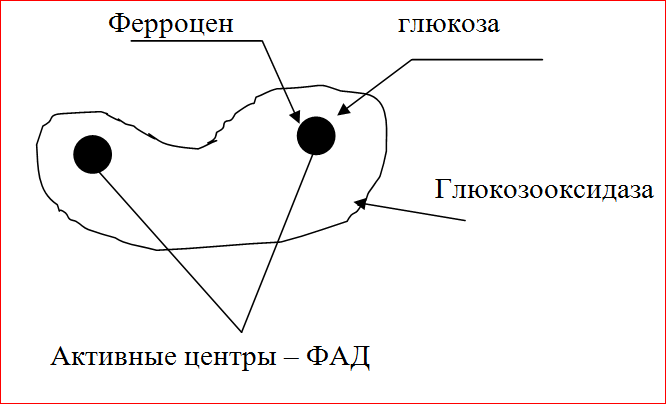
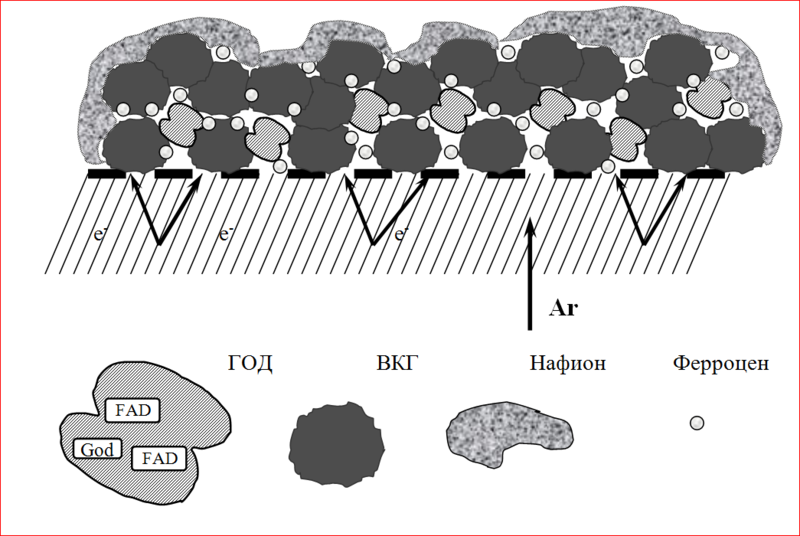
In the work, we used a composite material based on GOD and ferrocene (FC) for anodic oxidation of glucose by the mediator mechanism. Composite material includes YEAR, highly dispersed colloidal graphite (VKG), FC and Nafion, which made it possible to obtain an electrically conductive matrix with a highly developed surface, to ensure efficient transport of reagents to the reaction zone and stable characteristics of the composite material. A method for coupling enzymatic and electrochemical reactions, i.e. ensuring efficient electron transport from the active center of the YEAR to the mediator electrode, while the enzyme and mediator were immobilized on the electrode surface. Ferrocene was used as a mediator - an electron acceptor. During the oxidation of the organic substrate - glucose, ferrocene is restored and then oxidized at the electrode.
If anyone is interested, I can describe in detail the process of obtaining coverage of the electrodes, but for this it is better to write in a personal. And in the topic, I just describe the resulting structure.
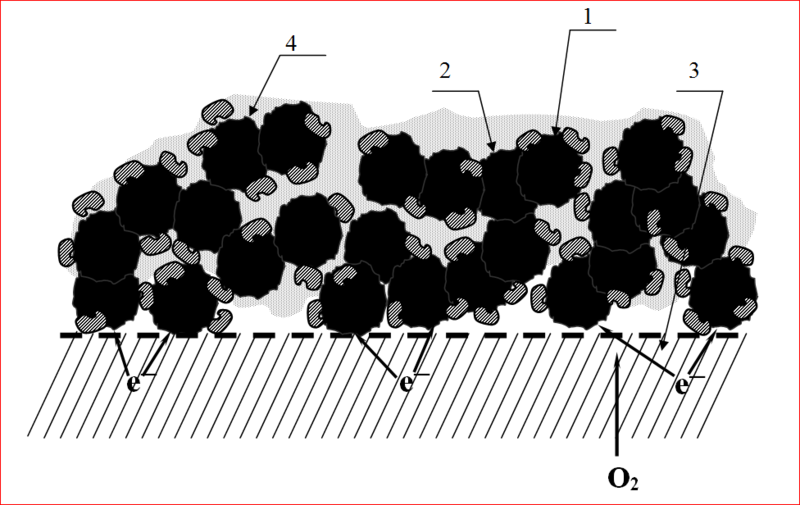
1. AD-100.
2. laccase.
3. hydrophobic porous substrate.
4. Nafion.
After the electrodes were received, we went directly to the experimental part. This is what our working cell looked like:
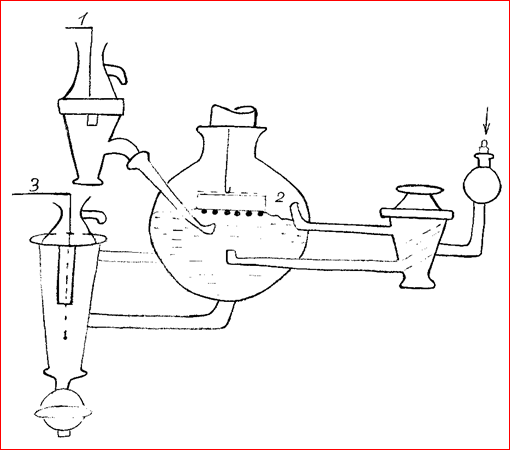
1. Ag / AgCl reference electrode;
2. working electrode;
3. auxiliary electrode - PT.
In the experiment with glucose oxidase, it was purged with argon, and with laccase, it was oxygen.
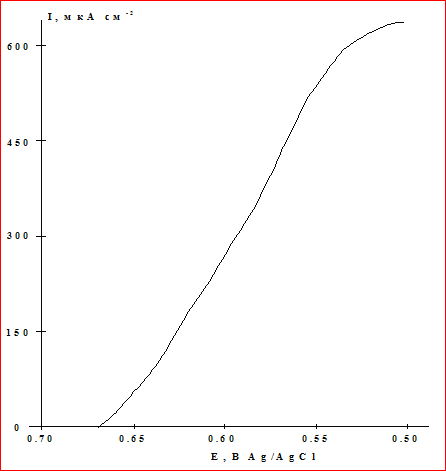
The recovery of oxygen on soot in the absence of laccase occurs at potentials below zero and occurs in two stages: through the intermediate formation of hydrogen peroxide. The figure shows the polarization curve of oxygen electroreduction of oxygen by the laccase immobilized on AD-100, obtained in an oxygen atmosphere in a solution with a pH of 4.5. Under these conditions, a stationary potential is established close to the equilibrium oxygen potential (0.76 V). At potentials cathode 0.76 V, a catalytic reduction of oxygen is observed on the enzyme electrode, which proceeds by direct bioelectrocatalysis directly to water. In the potential region cathode more than 0.55 V, a plateau is observed on the curve that corresponds to the limiting kinetic current of oxygen reduction. The value of the limiting current was about 630 μA / cm2.
The electrochemical behavior of the composite material, based on the NOD of Nafion, ferrocene, and VKH, was studied by cyclic voltammetry (CVA). The state of the composite material in the absence of glucose in the phosphate-buffered saline was monitored by charging curves. On the charging curve at a potential of (–0.40) V, the maxima related to the redox transformations of the active center of the YEAR are observed (FAD), and at 0.20–0.25 V, the maxima of oxidation and reduction of ferrocene are observed.
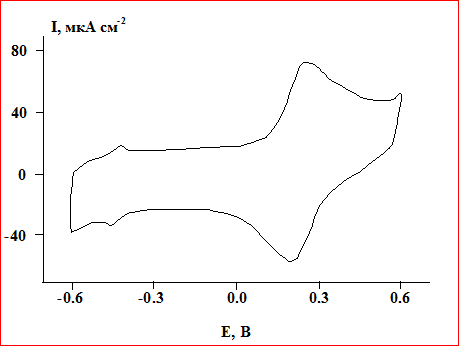
From the results it follows that on the basis of a cathode with laccase, as an oxygen reaction catalyst, and an anode based on glucose oxidase for glucose oxidation, there is a fundamental possibility of creating a biofuel element. True, there are many obstacles in this way, for example, peaks in enzyme activity are observed at different pH. This led to the need to add an ion-exchange membrane to the BFC. The membrane allows you to spatially separate the reactions that occur in the electrode compartments of the element, and at the same time ensures the exchange of protons between them. Air enters the anode compartment.
The introduction of glucose into a biofuel cell containing glucose oxidase and a mediator leads to an electron flow from the enzyme to the anode through the mediator. Electrons go through the external circuit to the cathode, where under ideal conditions water forms in the presence of protons and oxygen. The resulting current (in the absence of saturation) is proportional to the addition of a speed-determining component - glucose. By measuring stationary currents, it is possible to quickly (5s) determine even low glucose concentrations - up to 0.1 mM.
Unfortunately, I failed to bring the idea of this BTE to practical implementation, because Immediately after the 11th grade, I went to study as a programmer, which I am diligently doing today. Thanks to everyone who mastered.
The work on the basis of which this topic was written was carried out by me in the 11th grade, and took second place at the INTEL ISEF international conference.
A fuel cell is a chemical current source in which the chemical energy of a reducing agent (fuel) and an oxidizing agent, continuously and separately supplied to the electrodes, is directly converted into electrical
energy. A schematic diagram of a fuel cell (TE) is presented below:
A fuel cell consists of an anode, a cathode, an ion conductor, an anode and a cathode chamber. At the moment, the power of biofuel elements is not enough for use at industrial scales, but BFC with low power can be used as sensitive sensors for medical purposes, since the current in them is proportional to the amount of processed fuel.
To date, a large number of structural varieties of fuel cells have been proposed. In each case, the design of the FC depends on the purpose of the FC, the type of reagent and the ionic conductor. Biofuel elements in which biological catalysts are used are a special group. An important distinguishing feature of biological systems is their ability to selectively oxidize various fuels at low temperatures.
In most cases, immobilized enzymes are used in bioelectrocatalysis, i.e. enzymes isolated from living organisms and attached to a carrier, but retaining catalytic activity (partially or completely), which allows them to be reused. Consider, for example, a biofuel element in which an enzymatic reaction is coupled with an electrode when using a mediator. Scheme of a biofuel element based on glucose oxidase:
A biofuel cell consists of two inert electrodes of gold, platinum or carbon immersed in a buffer solution. The electrodes are separated by an ion-exchange membrane: the anode compartment is purged with air, the cathode compartment with nitrogen. The membrane allows you to spatially separate the reactions that occur in the electrode compartments of the element, and at the same time provides the exchange of protons between them. Membranes of various types suitable for biosensors are produced in the UK by many companies (VDN, VIROKT).
The introduction of glucose into a biofuel cell containing glucose oxidase and a soluble mediator at 20 ° C leads to the appearance of an electron flux from the enzyme to the anode through the mediator. Electrons go through the external circuit to the cathode, where under ideal conditions water forms in the presence of protons and oxygen. The resulting current (in the absence of saturation) is proportional to the addition of a rate-determining component (glucose). By measuring stationary currents, it is possible to quickly (5s) determine even low glucose concentrations - up to 0.1 mM. As a sensor, the biofuel element described has certain limitations associated with the presence of a mediator and certain requirements for an oxygen cathode and membrane. The latter should retain the enzyme and at the same time pass low molecular weight components: gas, mediator, substrate. Ion exchange membranes are usually satisfy these requirements, although their diffusion properties depend on the pH of the buffer solution. The diffusion of components through the membrane leads to a decrease in the efficiency of electron transfer due to adverse reactions.
Today, there are laboratory models of fuel cells with enzyme catalysts, which in their characteristics do not meet the requirements of their practical application. The main efforts in the next few years will be aimed at finalizing biofuel elements and the further use of the biofuel element will be associated to a greater degree with medicine, for example: an implantable biofuel element using oxygen and glucose.
When using enzymes in electrocatalysis, the main problem that needs to be solved is the problem of pairing the enzymatic reaction with the electrochemical, that is, ensuring the efficient transport of electrons from the active center of the enzyme to the electrode, which can be achieved in the following ways:
1. The transfer of electrons from the active center of the enzyme to the electrode using a low molecular weight carrier - mediator (mediator bioelectrocatalysis).
2. Direct, direct oxidation and restoration of the active centers of the enzyme on the electrode (direct bioelectrocatalysis).
In this case, the mediator conjugation of the enzymatic and electrochemical reaction can, in turn, be carried out in four ways:
1) the enzyme and the mediator are in the volume of the solution and the mediator diffuses to the electrode surface;
2) the enzyme is on the surface of the electrode, and the mediator is in the volume of the solution;
3) the enzyme and mediator are immobilized on the surface of the electrode;
4) the mediator is attached to the surface of the electrode, and the enzyme is in solution.
In this work, the catalyst for the cathodic reaction of oxygen reduction was laccase, and the catalyst for the anodic reaction of glucose oxidation was glucose oxidase (YEAR). Enzymes were used as part of composite materials, the creation of which is one of the most important stages in the creation of biofuel elements, simultaneously performing the function of an analytical sensor. In this case, biocomposite materials should ensure selectivity and sensitivity of substrate determination and at the same time have high bioelectrocatalytic activity, approaching enzymatic activity.
Laccase is a Cu-containing oxidoreductase, the main function of which under native conditions is the oxidation of organic substrates (phenols and their derivatives) with oxygen, which is then reduced to water. The molecular weight of the enzyme is 40,000 g / mol.
To date, it has been shown that laccase is the most active electrocatalyst for oxygen reduction. In its presence, a potential close to the equilibrium oxygen potential is established on the electrode in an oxygen atmosphere, and oxygen reduction proceeds directly to water.
As a catalyst for the cathodic reaction (oxygen reduction), a composite material based on laccase, acetylene black AD-100 and Nafion was used. A feature of the composite is the structure that ensures the orientation of the enzyme molecule with respect to the electron-conducting matrix, necessary for direct electron transfer. The specific bioelectrocatalytic activity of laccase in the composite approaches that observed in enzymatic catalysis. A method for coupling an enzymatic and electrochemical reaction in the case of laccase, i.e. The method of electron transfer from the substrate through the active center of the laccase enzyme to the electrode is direct bielectrocatalysis.
Glucose coxidase (GOD) is an enzyme of the oxidoreductase class, has two subunits, each of which has its own active center - (flavin adenine dinucleotide) FAD. YEAR is an enzyme that is selective with respect to the electron donor glucose, and many substrates can be used as electron acceptors. The molecular weight of the enzyme is 180,000 g / mol.
In the work, we used a composite material based on GOD and ferrocene (FC) for anodic oxidation of glucose by the mediator mechanism. Composite material includes YEAR, highly dispersed colloidal graphite (VKG), FC and Nafion, which made it possible to obtain an electrically conductive matrix with a highly developed surface, to ensure efficient transport of reagents to the reaction zone and stable characteristics of the composite material. A method for coupling enzymatic and electrochemical reactions, i.e. ensuring efficient electron transport from the active center of the YEAR to the mediator electrode, while the enzyme and mediator were immobilized on the electrode surface. Ferrocene was used as a mediator - an electron acceptor. During the oxidation of the organic substrate - glucose, ferrocene is restored and then oxidized at the electrode.
If anyone is interested, I can describe in detail the process of obtaining coverage of the electrodes, but for this it is better to write in a personal. And in the topic, I just describe the resulting structure.
1. AD-100.
2. laccase.
3. hydrophobic porous substrate.
4. Nafion.
After the electrodes were received, we went directly to the experimental part. This is what our working cell looked like:
1. Ag / AgCl reference electrode;
2. working electrode;
3. auxiliary electrode - PT.
In the experiment with glucose oxidase, it was purged with argon, and with laccase, it was oxygen.
The recovery of oxygen on soot in the absence of laccase occurs at potentials below zero and occurs in two stages: through the intermediate formation of hydrogen peroxide. The figure shows the polarization curve of oxygen electroreduction of oxygen by the laccase immobilized on AD-100, obtained in an oxygen atmosphere in a solution with a pH of 4.5. Under these conditions, a stationary potential is established close to the equilibrium oxygen potential (0.76 V). At potentials cathode 0.76 V, a catalytic reduction of oxygen is observed on the enzyme electrode, which proceeds by direct bioelectrocatalysis directly to water. In the potential region cathode more than 0.55 V, a plateau is observed on the curve that corresponds to the limiting kinetic current of oxygen reduction. The value of the limiting current was about 630 μA / cm2.
The electrochemical behavior of the composite material, based on the NOD of Nafion, ferrocene, and VKH, was studied by cyclic voltammetry (CVA). The state of the composite material in the absence of glucose in the phosphate-buffered saline was monitored by charging curves. On the charging curve at a potential of (–0.40) V, the maxima related to the redox transformations of the active center of the YEAR are observed (FAD), and at 0.20–0.25 V, the maxima of oxidation and reduction of ferrocene are observed.
From the results it follows that on the basis of a cathode with laccase, as an oxygen reaction catalyst, and an anode based on glucose oxidase for glucose oxidation, there is a fundamental possibility of creating a biofuel element. True, there are many obstacles in this way, for example, peaks in enzyme activity are observed at different pH. This led to the need to add an ion-exchange membrane to the BFC. The membrane allows you to spatially separate the reactions that occur in the electrode compartments of the element, and at the same time ensures the exchange of protons between them. Air enters the anode compartment.
The introduction of glucose into a biofuel cell containing glucose oxidase and a mediator leads to an electron flow from the enzyme to the anode through the mediator. Electrons go through the external circuit to the cathode, where under ideal conditions water forms in the presence of protons and oxygen. The resulting current (in the absence of saturation) is proportional to the addition of a speed-determining component - glucose. By measuring stationary currents, it is possible to quickly (5s) determine even low glucose concentrations - up to 0.1 mM.
Unfortunately, I failed to bring the idea of this BTE to practical implementation, because Immediately after the 11th grade, I went to study as a programmer, which I am diligently doing today. Thanks to everyone who mastered.