May 22, 2012 at 13:15
Photo report on connecting the most powerful switch in the world Black Diamond X8
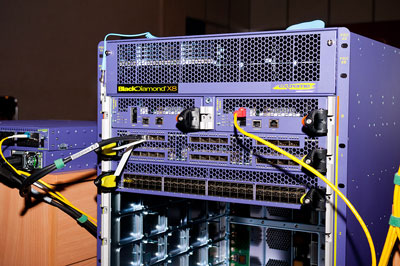
Extreme Networks currently has the world's most powerful Black Diamond X8 switch in its portfolio, which has really impressive performance in terms of chassis bandwidth (20Tb / s), power consumption, latency and at the same time it occupies 1/3 of the standard rack. The switch has received many awards and broke many records, which can be read at your leisure in the reports of the famous company Lippis www.bradreese.com/lippis-report-dec-2011.pdf or other resources.
Since the device has a rather specific positioning and not every IT specialist will have a chance to see or work with such a miracle of Ethernet technology in their life, I would like to share my impressions of what I saw under the habracat:
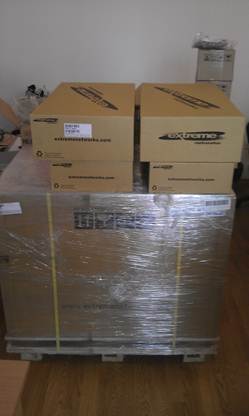
The chassis itself arrived on a pallet. Four of us, and sometimes together, where there was not enough space, we brought it in quite easily, the impression was that the total weight was not more than 100 kg.

To the chassis itself you need many more other boxes: factories, line cards, module management, power supplies ...
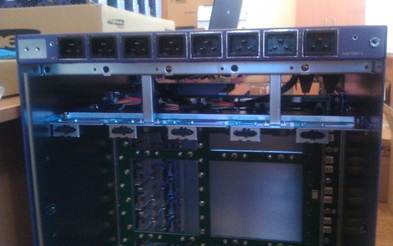
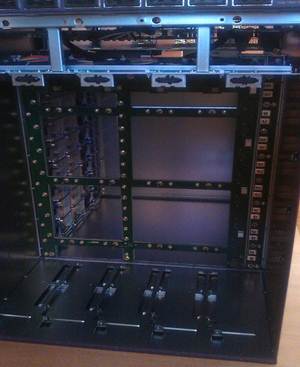
The switch is built on the now-growing orthogonal architecture, when line cards are directly connected to the module factories, it has no limitations on the backplane and midplane, everything is ready for 100 Gigabit Ethernet. The photo was taken with the fan blocks already taken, and if you look from top to bottom, they are arranged in order: connectors for power supply, a niche for power supplies, five small connectors for connecting the fan blocks themselves, as well as guides for four module factories at the bottom (there are they are just not visible in the photo).

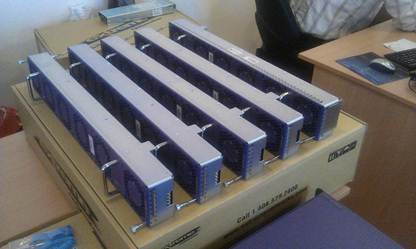
The switch has five fan blocks, which are reserved according to the 4 + 1 scheme, each of the blocks also has 5 + 1 redundancy.
Blowing of the iron itself is organized by Front-to-Back, which allows you to organize the necessary direction of thermal corridors in data centers.
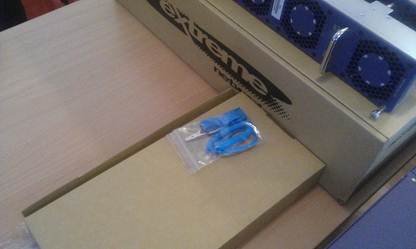
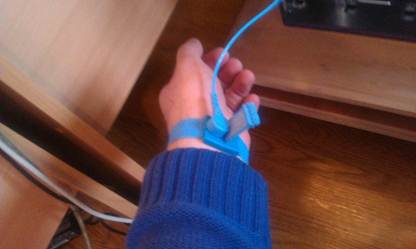
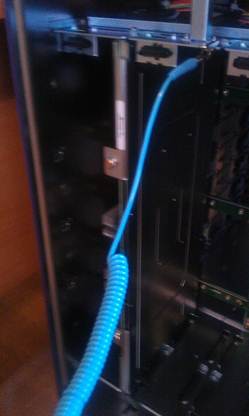
One of the most necessary things when installing such expensive equipment is already included - an antistatic wristband.
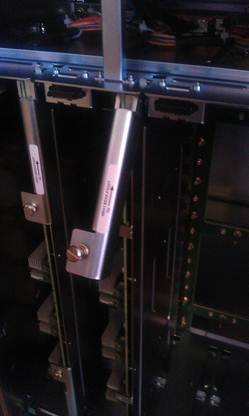

Factories are installed quite easily, if you get into the guides correctly)) There are door closers from above and below that you need to fix later.
Factories are also reserved 3 + 1, while even when one is released, all ports will work at full speed. The equipment installation manual recommends installing the cards from left to right in the first three places, leaving the latter as a reserve, if you did not immediately have the funds for all the factories.
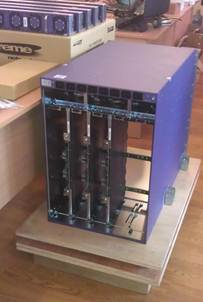
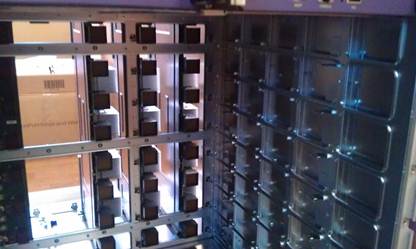
This is how it looks after installing factories. Each such connector, as in the photo on the right, gives out 320Gb of bandwidth, which means that when three factories and a line card are installed on 24 40GbE ports, we get linear speed on all ports (960 Gbps). Extreme Networks also developed factories that have half the bandwidth, for those who do not need a high 40GbE density per slot and are going to install cards with support for 12x40GbE and 48x10GbE ports, respectively.
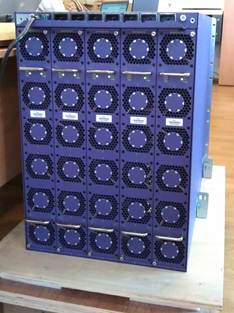
And so after installing the fans.
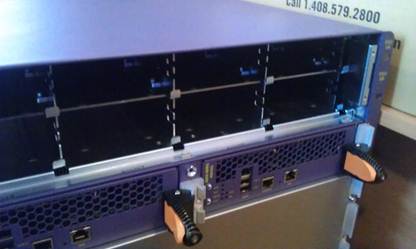
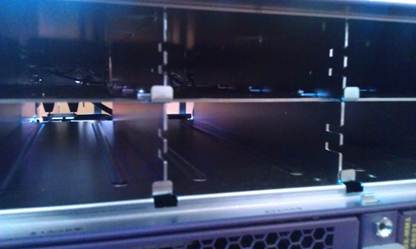
On the front side under the decorative panel there are eight cells for installing power supplies, which are traditionally reserved N + 1, N + N. After turning on the power, the installed boards are initialized and, accordingly, the necessary budget is calculated for their power supply. If you don’t get into the budget, some line cards may not start.
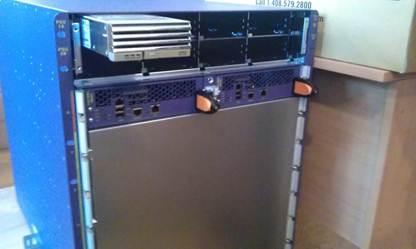


The blocks are easy to install, while being fixed using a small latch. Places for installing line cards are covered by a solid panel, which is intended only for installation during transportation. If the chassis is not completely filled with line cards, then the blank panels for each slot need to be purchased separately, they do not come in the kit.
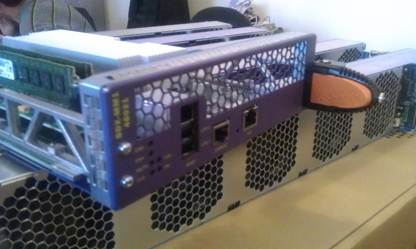
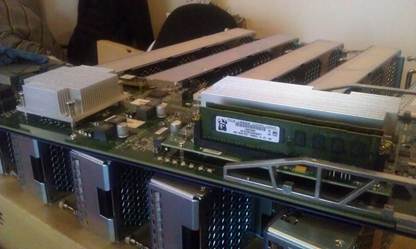
The switch has a powerful Control-plane which is controlled using the "2GHz Intel i7 Dual Core CPU." The management module itself has a form factor different from line cards and occupies only half the width of the slot.
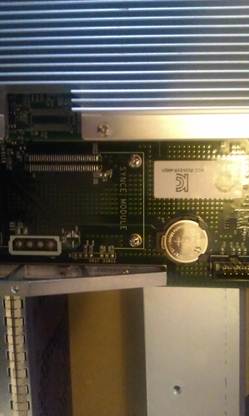
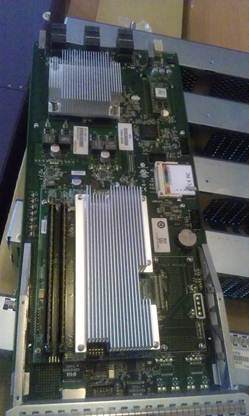
It was interesting to see a place on the board for wiring the SyncE (synchronous Ethernet) support elements, although the positioning of the device is completely different and the vendor claims that there is no support and will not be)) At the moment, this functionality is only supported on Summit X460 switches and E4G routers.
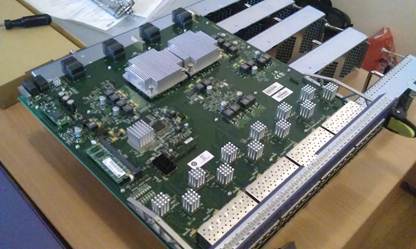
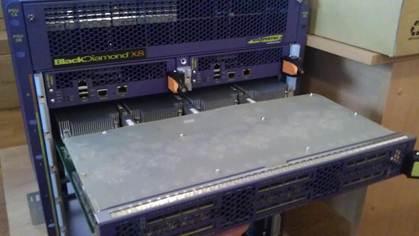
On line cards supporting 48 SFP + and 24 QSFP + ports, 2 and 4 ASICs are installed, respectively. Extreme Networks uses the latest Broadcom ASICs in its equipment, which allows you to achieve maximum performance with minimum power consumption, about 5W per 10GbE port.
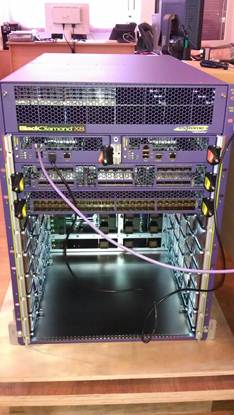
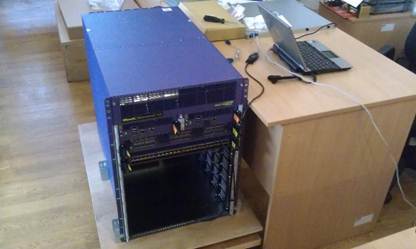
After switching on, we immediately get into the already loved (for those who worked in it) interface of the proprietary ExtremeXOS operating system, which is absolutely identical to the interface of even the youngest model. It was also verified that the switch supports OEM SFP + and QSFP + modules from manufacturers.
Impressions:
There were pleasant impressions that such powerful hardware is so easy to assemble and start, I would also like to see its work under full load. It was also pleasantly surprised that the switch has a fairly low noise level and if we compare the unloaded chassis Black Diamond X8 and the rack-mount Summit X650-24x, then Summit will most likely win.
Extreme Networks company continues to not only actively promote this product, but does not stop at its development, as evidenced by the recent announcement (at Interop 2012) of new line cards that will support 48 10GBase-T ports. And since Intel introduced CNA adapters of the same standard at the same event, with support for converged Ethernet over copper, this solution is even more attractive for data centers.
Extreme Networks Solutions Distribution in Ukraine and the CIS
Extreme Networks Authorized Training Courses
MUK-Service - all types of IT repair: warranty, non-warranty repair, sale of spare parts, contract service
Since the device has a rather specific positioning and not every IT specialist will have a chance to see or work with such a miracle of Ethernet technology in their life, I would like to share my impressions of what I saw under the habracat:
The chassis itself arrived on a pallet. Four of us, and sometimes together, where there was not enough space, we brought it in quite easily, the impression was that the total weight was not more than 100 kg.
To the chassis itself you need many more other boxes: factories, line cards, module management, power supplies ...
The switch is built on the now-growing orthogonal architecture, when line cards are directly connected to the module factories, it has no limitations on the backplane and midplane, everything is ready for 100 Gigabit Ethernet. The photo was taken with the fan blocks already taken, and if you look from top to bottom, they are arranged in order: connectors for power supply, a niche for power supplies, five small connectors for connecting the fan blocks themselves, as well as guides for four module factories at the bottom (there are they are just not visible in the photo).
The switch has five fan blocks, which are reserved according to the 4 + 1 scheme, each of the blocks also has 5 + 1 redundancy.
Blowing of the iron itself is organized by Front-to-Back, which allows you to organize the necessary direction of thermal corridors in data centers.
One of the most necessary things when installing such expensive equipment is already included - an antistatic wristband.
Factories are installed quite easily, if you get into the guides correctly)) There are door closers from above and below that you need to fix later.
Factories are also reserved 3 + 1, while even when one is released, all ports will work at full speed. The equipment installation manual recommends installing the cards from left to right in the first three places, leaving the latter as a reserve, if you did not immediately have the funds for all the factories.
This is how it looks after installing factories. Each such connector, as in the photo on the right, gives out 320Gb of bandwidth, which means that when three factories and a line card are installed on 24 40GbE ports, we get linear speed on all ports (960 Gbps). Extreme Networks also developed factories that have half the bandwidth, for those who do not need a high 40GbE density per slot and are going to install cards with support for 12x40GbE and 48x10GbE ports, respectively.
And so after installing the fans.
On the front side under the decorative panel there are eight cells for installing power supplies, which are traditionally reserved N + 1, N + N. After turning on the power, the installed boards are initialized and, accordingly, the necessary budget is calculated for their power supply. If you don’t get into the budget, some line cards may not start.
The blocks are easy to install, while being fixed using a small latch. Places for installing line cards are covered by a solid panel, which is intended only for installation during transportation. If the chassis is not completely filled with line cards, then the blank panels for each slot need to be purchased separately, they do not come in the kit.
The switch has a powerful Control-plane which is controlled using the "2GHz Intel i7 Dual Core CPU." The management module itself has a form factor different from line cards and occupies only half the width of the slot.
It was interesting to see a place on the board for wiring the SyncE (synchronous Ethernet) support elements, although the positioning of the device is completely different and the vendor claims that there is no support and will not be)) At the moment, this functionality is only supported on Summit X460 switches and E4G routers.
On line cards supporting 48 SFP + and 24 QSFP + ports, 2 and 4 ASICs are installed, respectively. Extreme Networks uses the latest Broadcom ASICs in its equipment, which allows you to achieve maximum performance with minimum power consumption, about 5W per 10GbE port.
After switching on, we immediately get into the already loved (for those who worked in it) interface of the proprietary ExtremeXOS operating system, which is absolutely identical to the interface of even the youngest model. It was also verified that the switch supports OEM SFP + and QSFP + modules from manufacturers.
Impressions:
There were pleasant impressions that such powerful hardware is so easy to assemble and start, I would also like to see its work under full load. It was also pleasantly surprised that the switch has a fairly low noise level and if we compare the unloaded chassis Black Diamond X8 and the rack-mount Summit X650-24x, then Summit will most likely win.
Extreme Networks company continues to not only actively promote this product, but does not stop at its development, as evidenced by the recent announcement (at Interop 2012) of new line cards that will support 48 10GBase-T ports. And since Intel introduced CNA adapters of the same standard at the same event, with support for converged Ethernet over copper, this solution is even more attractive for data centers.
Extreme Networks Solutions Distribution in Ukraine and the CIS
Extreme Networks Authorized Training Courses
MUK-Service - all types of IT repair: warranty, non-warranty repair, sale of spare parts, contract service