March 11, 2012 at 15:16
Data Mining in football: let's digitize the match and count everyone!
The coach is watching you. The trainer remembers. The trainer does not forget and does not forgive.
If you saw the film “The Man Who Changed Everything,” then you already know almost everything. Players need to be evaluated by the mass of indicators, and intuition does not always work. With the help of analytics, you can significantly increase the effectiveness of training, find new players who will help the team and simply increase the level of the game. Analytics rules .
Football in reality at first resembles something like an RPG without rules, where you need to understand. After the introduction of analytics - this is the same RPG, to hundreds of indicators of which there is an instruction. The coach gets the opportunity to "grow" a real munchkin cheater.
On the field for 90 minutes there are 22 players and the ball. A coach can keep track of only a part of the players - plus his perception is very much prone to emotions. Studies were conducted on how many episodes are remembered: even the most experienced coaches recalled only about 35% of situations, and always near the ball. Everything else is a dead zone. You can’t cover the whole field and understand where someone stood - and did it right or wrong. This requires a post-match analysis.
At first, Steve McLaren - known to us as the head coach of the England team in 2006 (then the Russian team defeated the English in Luzhniki) - began using video replay as a way to analyze the game. At first, Prozone company was engaged in systematization of video data, selecting and signing the most characteristic moments. This went from 1999 to about 2005, when video recognition appeared.
Interview
For 12 years, the company has conquered the English market and has come to many countries, including Russia. We took a special interview from the domestic representative of Prozone for Habr on the eve of a purely technical lecture on special software that will be held on March 14 in Digital October (here is the event on Habr ).
- Who is already using this system?
Too many. Following the recent merger of Prozone with AMISCO, the customer base has doubled. These are almost all the clubs in England, including Arsenal, Manchester United, Man City, Liverpool, as well as such world grandees as Real Madrid, Inter Milan, Bavaria Munich, Lyon. In Russia, CSKA and Dynamo became the first , then Spartak and Wings of the Soviets . Plus Dynamo Kiev , known for its research center, since the summer of 2011.- How it works?
There are different types of analysis. The easiest is to take one camera that shoots the match from one point (for example, from the roof of the stadium). Video data from it is run through analytical services, after which you get accurate data for analysis. If you need to build an “animated simulator” of the match and get the fitness data of the players, special equipment is already used, consisting of a complex of cameras: this guarantees increased accuracy in recognizing players on the field and their movements.- Why is post-match analysis important?
The coach and his staff want to know everything to increase the effectiveness of the game. Standard methods did not give high accuracy. It is very important to provide exactly the exact data - otherwise they become unnecessary. It is important not only to remove the data array, but also accurately translate it into the language of the head coach. In the early 2000s, this task was solved more by video editing, now it is Data Mining with the help of a team analyst.- What do I get after the match?
We start with an electronic report that can be printed on paper immediately after the game. This is about 1,500 events on the field, describing the technical and tactical actions of the players.There is an interactive platform for watching matches - it analyzes the technical and tactical actions of the team. Here much more is estimated: up to 2300 events per game, and analysis can be obtained 12 hours after the end of the match.
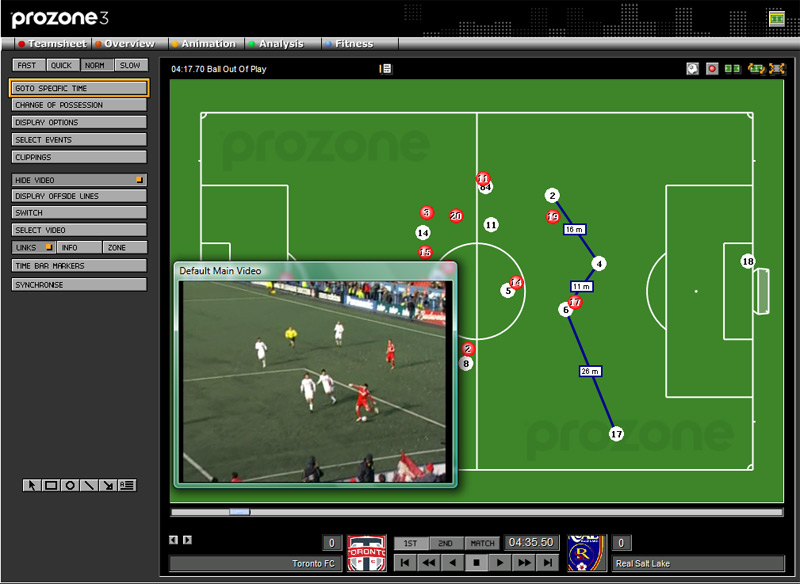
It looks like this: at the headquarters there is special software that uploads to the local machine about 2-megabyte prepared analysis of the match from the server. Further in the interface, you can select the details for the desired actions and compare various numerical indicators. They wanted to see Ivanov for the whole match - they only watched him in dynamics and numbers. I want to know in which square of the field the team took the most goals? No problem.
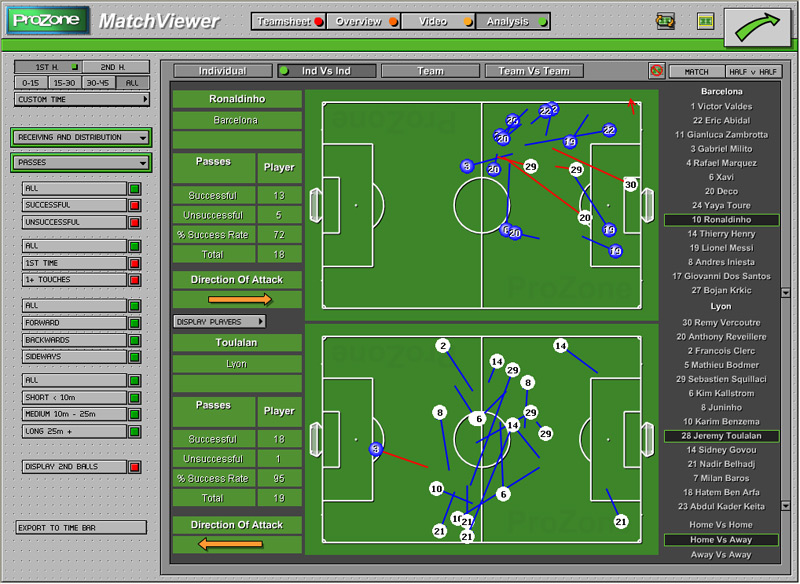
There are statistics on their players and players of the opponent, a review of the match (to compare their and other defenders or their two attackers, for example), automatic point markers for video editing and analysis (interactive maps of the football field: you can see the directions of tactical and technical actions where they were performed and what football players). You can compare the teams on the accuracy of gears and other indicators. For example, you can sort the programs by the criteria of success, direction, length of the pass, whether it reached the goal, type (head, canopy) and many other options. More than 40-50 filters per section are available, and all this will be shown in a lecture.

- What, in fact, with Data Mining?
The pride of the company is a system of in-depth analysis of the match, which requires special cameras for recognition. The simplest thing is that at any moment you can see an “animated” picture with detailed numerical data and the location of the objects themselves in dynamics, which is an invaluable thing for a post-match theoretical lesson.More complicated - for example, the fitness section, it shows what kind of running work a footballer did. The peculiarity is that there are six types of such “exercises”, and for many trainers it is important to work at high speed (more than 5.5 meters per second), which is almost impossible to sort by hand and reduce. You can also see when and who got tired: these data go to the fitness trainer, which is simply invaluable for assessing the physical condition and training plan.
The most important thing -the trainer can simulate the training process and identify non-obvious “bottlenecks” of the team’s actions in order to improve various critical points.
- Is it possible to find out if a player is worth his money?
Yes, there is a separate product for scouting. About 10 thousand games are processed in a season. The club that bought the license can see the data for any player for all time: these are statistics and analytics. You can compare the level of this player and the level of the average player in the Russian championship. For example, if a midfielder makes an average of 4 crossings in the box, you can immediately assess whether a new player fits this criterion.Another online product “Trend” allows you to assess the development trend based on all the matches of your team and assesses the dynamics of the players' development. Prozone provides raw objective data, but does not make expert predictions of the value of players. Forecasts are the task of the manager.

- What kind of hardware is required for recognition?
For technical and tactical analysis without "fitness and animation", you need a regular camera - just get a picture that tracks the ball. Football players are recognized by special software. It is important to get a technical picture, without repetition and advertising, of course (on a regular record for some reason, about 2% of the actions are lost).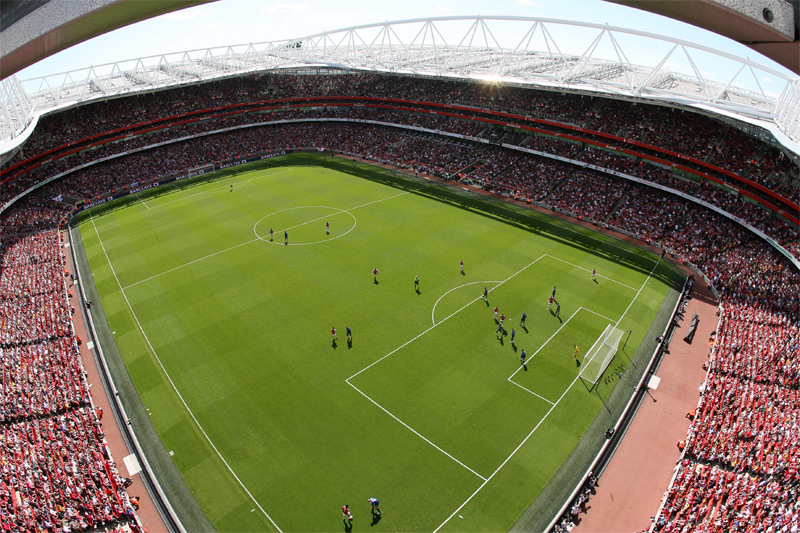
An example of a camera picture
You can recognize old matches based on video recordings: for example, the Everton football club put up a box for sale, where the iconic match against Bayern was completely sorted out: there is a video and detailed tactical and technical analysis.
Interestingly, Prozone is a certified system that provides 100% accurate data. In the world of football, such a guarantee means about something as impossible as “100% software without bugs” in IT. To achieve this accuracy, special equipment is needed at the stadium. Basically, these are IP cameras that monitor the movement. 8 cameras are installed around the perimeter, on the roof according to a special scheme. A server is connected to collect data and a channel for delivery to the sales center.

Grouping cameras in a static complex
There is a light version (with an error of 5-7 percent) - 4 portable cameras on tripods. It is convenient where you need to quickly turn around and there are operators, for example, on the road. Wings of the Soviets carry such things to every away game.
Static sets of 8 cameras placed onLuzhniki and the Khimki Arena in Moscow and at the Lobanovsky Stadium in Kiev.
- How easy is it to learn how to work with the service?
Usually from 1 to 5 days, after a couple of weeks the system is perceived as “native”. Ideally, in every club there is an analyst who can turn the coach’s questions into system requests and track what the coach potentially needs, and this area is already developing in the Russian Federation. In Europe, this has long been used: after all, a trainer cannot sit at the monitor for days. Usually, the analyst is also the video operator of the team.- Do you have special educational programs?
Yes. There are separate trainings as well as global educational programs for analysts and team trainers.- What are the difficulties of implementation?
Firstly, a slightly conservative attitude. Now, of course, there is not a single trainer on the market who would say that he does not like the system. Everyone recognizes that the data is useful and necessary, but, nevertheless, there is some resistance, in particular, due to the fact that the analytics industry is not developed in the domestic market compared to Europe.- Will it be possible to do without such tools in 10-15 years?
Unlikely. In England, for example, almost everyone is already using analysis one way or another. This is important for the success of the club.- What are the next steps in development you see?
Let's try 3D modeling by capturing data from multiple cameras. Already started testing the analysis of hockey matches NHL.- Which of your model cannot be repeated?
It is very difficult to repeat the high accuracy of the data: we have a number of key patents and a lot of practice. Large investments will be required to catch up with hardware and software: we are a generation ahead of all other analytical companies. Few people will be able to maintain constant contact with the coaching staff - we are aware of their needs and tasks, we receive very high-quality feedback.- Where can I find out more technical details?
At a lecture at Digital October March 14th.Now about the lecture itself
The lecture will be led by Blake Worcester, a trusted adviser to FIFA, UEFA, Chelsea FC and Real Madrid, the business leader of Prozone. He will talk about the technical side and the specific effect of using the system. Experts Igor Meshchanchuk, sports director of the Russian Football Premier League, Ilya Rustamov, marketing director of Chempionat.com and Alexander Ivansky, project manager of InStat Football (essentially a domestic competitor of Prozone) were invited to the lecture as experts . A practicing trainer is also expected to be able to explain the situation on his part.
Yes, you can come to the lecture, it’s free. Here is an event on Habré , and here is registration . In the comments on this topic, you can still leave tricky questions to Blake and experts.