Doppler effect in networks: GSM, 3G, 4G
After reading this article, I almost flew off the chair and ate my radio engineering diploma. To clarify the situation and calm the habrozhiteli decided to write about the Doppler effect in more detail.
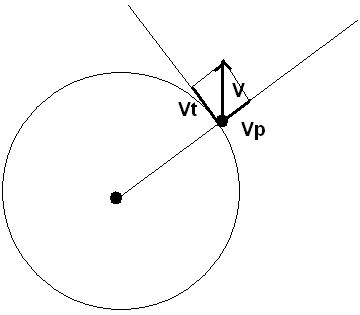
Let's start with the basics. The Doppler effect is observed only in the presence of a parallel component of the speed of movement; in the tangential motion of the Doppler shift, there will be no frequency (at least at relativistic speeds).
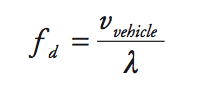
In the above formula:
Vp will appear. It is easy to see that if the body moves in a circle, then the Doppler effect will not be observed at all. There are very good illustrations on Wikipedia about this.
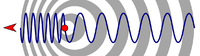
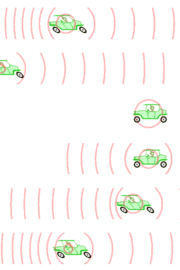
Since most people are accustomed to working with frequency, I allow myself to perform some obvious transformations on the formula for the Doppler effect. We translate the wavelength into frequency, and also take into account the angle of direction to the base station:

But let's continue to consider the case when our body moves away (or approaches) from the BS in a straight line. In this case, the calculations from the first article will be correct:
Oh! What is it? The speeds are equal, but the frequencies are different. In the heat of distrust of the author, we recount. The result is 34 * 2.5E9 / 3E8 = 283.3 (3) Hz. It is at this value that the signal frequency will change: increase if the body approaches or decrease if the body moves away. We also note that when the direction of movement changes, this frequency will change, but it will never be more than 283.3 (3) Hz, because cos (x) does not happen more than 1. With the Doppler effect everything seems to be. We got all the data we need.
Now let's turn to such a thing as a radio.
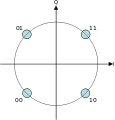
GSM and 3G networks use phase shift keying with noise-resistant coding. For us, it is important that this is phase manipulation (hereinafter PSK). Any PSK signal, except for a standard set of parameters, is characterized by such a thing as phase inflorescence. Here I will give an inflorescence for the most common type of PSK, namely QPSK:
More information on what phase manipulation is can be found on Wikipedia.
To receive such signals, synchronous or digital detectors are used, which require an exact value of the reference frequency for their operation (for more details on this topic, see books on receiving and processing signals or in the specification for the development of dialup modems). Since there is nothing perfect in our world, these types of receiversfundamentally, they cannot work without the AFC system (auto frequency control). The characteristics of the operation of such a system can be seen in the passport to the receiver in the graphs: capture band. Let's turn to the standard. According to the standard, the BS frequency instability in the GSM system is of the order of 10E – 6 ... 10E – 7, which implies that the AFC capture band should be twice (at least) wider than this value and be 500..5000 Hz. In addition, there is still such a thing as stock, and the value of this parameter is clearly greater. We see that this value is clearly greater than 283.3 (3) Hz, which indicates the ability of the AFC system to completely compensate for the Doppler effect at such speeds and even higher.
For those who are not at all gullible, as an argument, I propose to read the article in the highly respected IEEE magazine.
Let's start with the basics. The Doppler effect is observed only in the presence of a parallel component of the speed of movement; in the tangential motion of the Doppler shift, there will be no frequency (at least at relativistic speeds).
In the above formula:
Vp will appear. It is easy to see that if the body moves in a circle, then the Doppler effect will not be observed at all. There are very good illustrations on Wikipedia about this.
Since most people are accustomed to working with frequency, I allow myself to perform some obvious transformations on the formula for the Doppler effect. We translate the wavelength into frequency, and also take into account the angle of direction to the base station:
But let's continue to consider the case when our body moves away (or approaches) from the BS in a straight line. In this case, the calculations from the first article will be correct:
Here c is the speed of light, which for simplicity we take equal to 3x10 ^ 8 and f is the signal frequency: 2.5 GHz
Thus, the wavelength is 3x10 ^ 8 / 2.5x10 ^ 9 = 0.12 (m)
For a vehicle moving at a speed of 122 km / h (34 m / s), the Doppler frequency change will be 34 / 0.12 = 283 (Hz)
That is, when the subscriber moves relative to the base station at a speed of 122 km / h, the signal frequency for him will change by 272 Hz.
Oh! What is it? The speeds are equal, but the frequencies are different. In the heat of distrust of the author, we recount. The result is 34 * 2.5E9 / 3E8 = 283.3 (3) Hz. It is at this value that the signal frequency will change: increase if the body approaches or decrease if the body moves away. We also note that when the direction of movement changes, this frequency will change, but it will never be more than 283.3 (3) Hz, because cos (x) does not happen more than 1. With the Doppler effect everything seems to be. We got all the data we need.
Now let's turn to such a thing as a radio.
GSM and 3G networks use phase shift keying with noise-resistant coding. For us, it is important that this is phase manipulation (hereinafter PSK). Any PSK signal, except for a standard set of parameters, is characterized by such a thing as phase inflorescence. Here I will give an inflorescence for the most common type of PSK, namely QPSK:
More information on what phase manipulation is can be found on Wikipedia.
To receive such signals, synchronous or digital detectors are used, which require an exact value of the reference frequency for their operation (for more details on this topic, see books on receiving and processing signals or in the specification for the development of dialup modems). Since there is nothing perfect in our world, these types of receiversfundamentally, they cannot work without the AFC system (auto frequency control). The characteristics of the operation of such a system can be seen in the passport to the receiver in the graphs: capture band. Let's turn to the standard. According to the standard, the BS frequency instability in the GSM system is of the order of 10E – 6 ... 10E – 7, which implies that the AFC capture band should be twice (at least) wider than this value and be 500..5000 Hz. In addition, there is still such a thing as stock, and the value of this parameter is clearly greater. We see that this value is clearly greater than 283.3 (3) Hz, which indicates the ability of the AFC system to completely compensate for the Doppler effect at such speeds and even higher.
For those who are not at all gullible, as an argument, I propose to read the article in the highly respected IEEE magazine.