Canadian Startup Moment Energy Raises $40M for Traction Battery Recycling
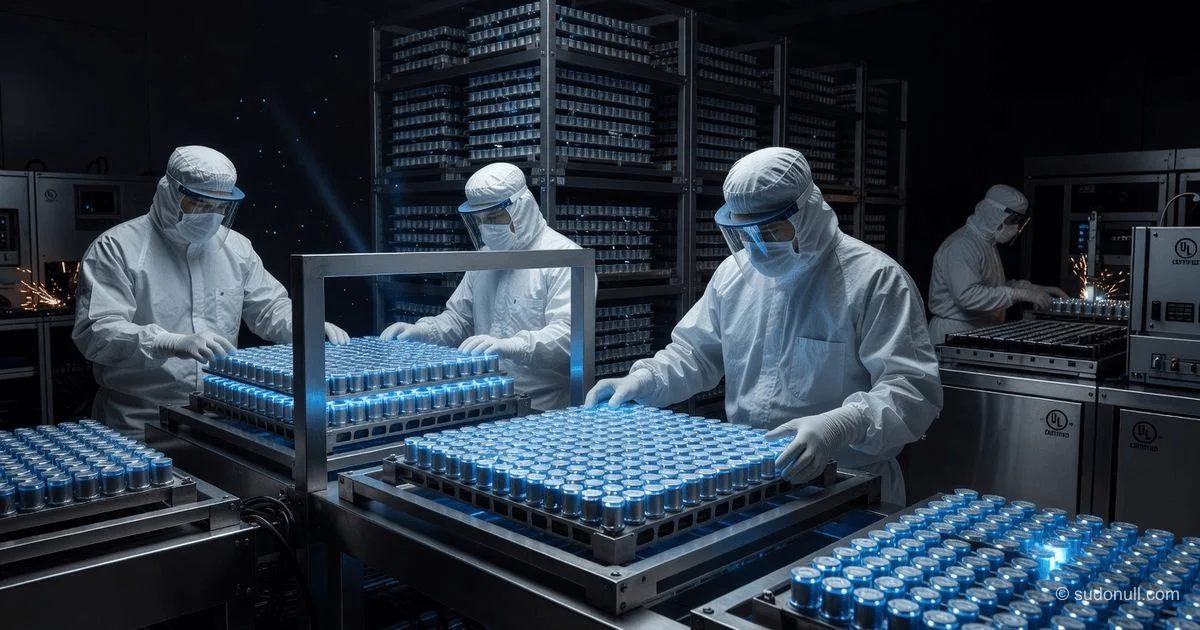
The UL-certified company has developed a battery pack swapping architecture that extends service life up to 30 years. The technology delivers energy storage costs as low as 3 cents per kWh for industrial users.
Insight: Moment Energy and $40M on 'Used' Batteries. This Isn't About the Environment—It's a Weapon Against the Chinese Monopoly
When you read the headline "Canadian Startup Raises $40M for Traction Battery Recycling," your brain likely paints a picture: a dirty warehouse, waste sorting, green grants, and yet another story about saving the planet. But that's a deep misconception.
The deal Moment Energy closed on June 4, 2026, isn't about the environment. It's about the physics of energy scarcity, the battle for lithium, defense contracts, and the quiet panic of data centers. And the most important fact you won't read in press releases: Moment Energy doesn't just have a UL certificate. Among its investors is In-Q-Tel—the venture arm of the CIA.
That's where the analysis must begin.
[The Core]: What's Really Happening
The world faces a paradox. On one hand, we have millions of electric vehicles whose batteries lose 20% capacity. Officially, these are "waste" that needs recycling. On the other hand, North America's power grid is cracking under the energy demands of AI data centers. New battery energy storage systems (BESS) from Tesla or CATL are expensive, require months of waiting, and supply chains are controlled by China.
The crux of the moment: a "spent" EV battery with 80% residual capacity is as strategic a resource as lithium in the ground. Moment Energy takes these batteries (they have contracts with Nissan and Mercedes), removes the manufacturer's protection, installs its own smart management system, and sells them as ready-made industrial storage units.
Media write about "3 cents per kWh." That number is a nuclear bomb for the market. A new battery from CATL or Tesla costs users about 10-15 cents per kWh over its lifecycle. 3 cents is the price at which coal-fired power plants become instantly unprofitable. But more importantly, it's the price at which dependence on Chinese imports becomes pointless.
Why is this happening now? Because AI energy demand has exploded the market. In Q1 2026 alone, OpenAI, Amazon, and Microsoft signed contracts to build data centers totaling 15 GW—equivalent to 15 nuclear reactors. The grid doesn't have time to wait five years for new substations. They need battery containers that can be installed in a parking lot within a month. Moment Energy delivers that speed by using what's already on the roads.
Timeline and Context
To grasp the scale, look at the calendar. On May 19, 2026, Moment Energy received UL 60730-1 certification. This is a "license to carry a weapon." Without it, insurance companies refuse to insure storage units made from used batteries due to fire risk. Moment Energy is the first company in the world to obtain the full UL package (1974, 9540A, 60730-1). This means their system can be installed in residential areas, hospitals, and data centers without special permits. Competitors (Redwood, B2U) still operate under "gray" schemes.
Next, on May 23, 2026, they announced the construction of a gigafactory in Vancouver with a capacity of 1 GWh by 2030. This is the world's largest battery repurposing facility. Then, on June 4, a $40M Series B round. The company's total valuation has exceeded $100M just four years after its founding (2020).
Finally, the context of the "big game." In March 2026, Redwood Materials (a competitor) deployed a 12 MW / 63 MWh system for Bitcoin mining and AI data centers at Crusoe. The market is starting to consolidate. But Moment's key differentiator is their modular hot-swap architecture (pack-swapping).
What does that mean? A conventional storage unit dies when the weakest battery in the chain dies (the "weak link" effect). Moment Energy designed a system where any compartment can be removed and replaced with a new one, like a battery in a remote control, without shutting down the entire station. This extends the system's life to 30 years—twice as long as a new Chinese battery.
Who Wins and Who Loses
Winner #1: Amazon. It's no coincidence that the Climate Pledge Fund is among the investors. Amazon needs gigawatts for AWS. Traditional grids can't keep up. Amazon isn't buying batteries; it's buying "fault tolerance" and "green PR" at a bargain price. With every penny saved on energy, AWS can lower cloud server prices, crushing competition.
Winner #2: Japan's Tokyo Gas. Its venture arm Acario participated in the round. This is an inside move. Japan (Nissan) supplies batteries, Japan (Tokyo Gas) provides money for storage. Japan is building its energy independence using Canadian engineering. In the process, Japanese corporations reduce dependence on Middle Eastern gas and Australian coal by switching to "battery taxis" from old Leafs.
Winner #3: The Pentagon. Through IQT (In-Q-Tel), the CIA gained access to technology that allows military bases in remote areas (Pacific islands, Alaska, desert bases) to have cheap energy without long fuel supply chains. A soldier in Alaska doesn't need diesel that can freeze. They need a container of Nissan batteries that works at -40°C.
Loser #1: CATL (China). China dominates the market for new batteries. But their business model assumes old batteries go to recycling (shredding, smelting, metal extraction). Moment Energy's model says: "Don't smelt. Use them as is." If the US and Canadian markets switch to second-hand, China loses an outlet for its cheap LFP storage units, which they churn out by the thousands.
Loser #2: Recyclers (Redwood Materials). Ironically, Redwood Materials also makes storage units, but their business relies on destroying batteries (metal extraction). Moment Energy keeps the battery intact. They aren't competitors; Moment Energy is stealing Redwood's raw material. Every battery that works for 10 years in a Moment storage unit doesn't end up in Redwood's furnace. In 10 years, Redwood will go bankrupt if it doesn't change strategy.
Unexpected Loser: Tesla Megapack. Tesla sells new batteries at $300 per kWh of installed capacity. Moment Energy promises 3 cents per kWh of consumed energy. At 6,000 cycles, that's pennies. A large utility provider that buys Moment will save millions of dollars per year compared to buying a Megapack. Elon Musk will need to urgently justify the price tag of his solutions.
What the Media Isn't Saying
First and foremost: there is no independent verification of the 30-year lifespan.
Moment Energy talks about 30 years. They got funding based on that claim. But who verified it? A 2018 Nissan Leaf battery physically hasn't existed for 30 years to test. Their "30 years" is a degradation data extrapolation done in software. The contracts likely have fine print: "30 years at ideal temperature and 0.2C load." In a real data center where the battery discharges 80% every night, it might die in 7 years.
Second silence: balancing cells of different ages.
Moment Energy says their technology allows mixing batteries from different manufacturers. Engineering fact: a Nissan battery (laminated) and a Mercedes battery (cylindrical) have different discharge curves. Connecting them in parallel without active balancing means a short circuit. Their "next-generation BMS" must solve this. But how much processing power and heating transistors are needed to coordinate a hundred such "ragged" cells? They're silent on this. Likely, in practice, they still sort batteries strictly by model and year, otherwise the system self-destructs.
Third and most important insight: the danger of competition with China. Chinese companies are already copying this model, but with one difference: China doesn't have such strict regulations (UL and NFPA 855). The Chinese can churn out storage units from waste even cheaper because they don't need insurance. When, in 12-18 months, Chinese "gray" storage units flood African and South American markets disguised as new, Moment Energy will struggle to compete on price. The American market is closed by tariffs, but the global South will go to China.
Forecast: Next 30 Days and 90 Days
Next 30 Days.
The Vancouver plant will launch by the end of June, as promised. Watch for news of the first grid connection. If there's no fire in the first 24 hours (always a risk with such systems), shares of all public competitors (Eos Energy Enterprises, ESS Tech) will drop 5-7%.
Expect an announcement of a contract with a major data center. Likely not Amazon (already inside), but an operator like Equinix or Digital Realty. They need 500 MW of capacity and will sign a $200-300M deal with Moment Energy. This will trigger the next funding round in 2027.
Next 90 Days.
By September 2026, the Chinese government will strike back. They will ban the export of certain types of spent batteries (e.g., LFP) to keep them for domestic secondary recycling. This will show they see Moment Energy as a real threat.
Also, with high probability, Tesla will make an undeclared move. They will introduce a "universal storage unit" that works with different cell types but will use only new 4680 cells. In the press release, they'll call Moment Energy's approach "an unsafe hobby." In reality, they simply can't guarantee 30 years on waste because their management is tied to selling new hardware.
The main takeaway from this deal: the $40M Moment Energy received isn't money for "green technology." It's money for an infrastructure war. They told the grid: "Don't build new power plants; take old batteries." And the grid replied: "Show us your certificates." If they succeed, in five years no one will care about lithium scarcity. Because lithium will already be sitting in garages as old Nissan Leafs. And the CIA knows it.
— Editorial Team









No comments yet.