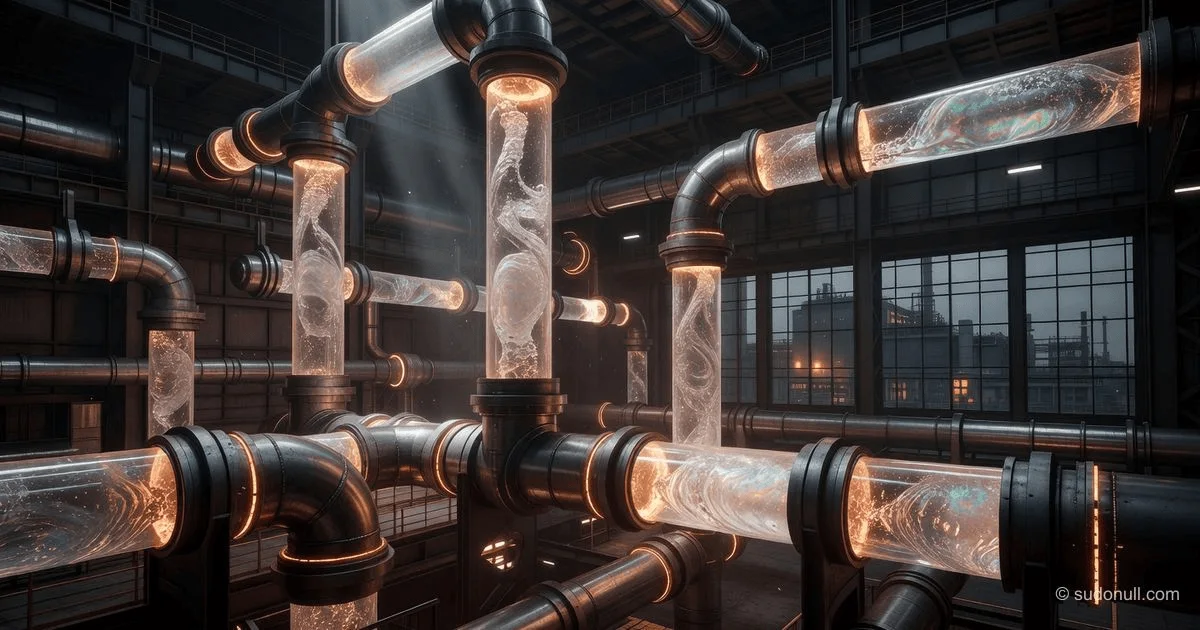
China Launches World's First Power Plant Using Supercritical CO2
China has commissioned a 30 MW power plant operating on supercritical carbon dioxide. The facility uses industrial waste heat to generate electricity, demonstrating a breakthrough in energy efficiency.
'Carbon Time Bomb': Why a 30 MW Supercritical CO₂ Plant Is Not a Breakthrough but an Engineering Gamble
Analytical Note: Insights on the True Cost of 'Green' Energy from Someone Who Has Seen Hype Technologies Die
June 4, 2026
Introduction
While everyone is discussing robots and quantum chips, an event occurred in China's Guizhou province that I call 'the riskiest energy bet of the decade.' On May 30, 2026, the second unit of the 'Super Carbon No. 1' project (also known as Chaotan One, '超碳一号') was connected to the grid at the Shougang Shuicheng steel plant. Total capacity reached 30 MW. China has officially launched the world's first commercial power plant using supercritical carbon dioxide.
If you think this is just 'another step toward green energy,' you are mistaken. This is the 'hydrogen moment' for the energy sector: a technology that was a laboratory toy for decades is finally entering the real world. But, as with hydrogen cars, the real world can be harsh.
I have been closely monitoring energy technologies since 2020, and I must say: what CNNC (China National Nuclear Corporation) has done is impressive. But as an analyst, what concerns me is not the launch itself, but what all these enthusiastic articles are silent about: how long will it last? And what will be the cost of repairs? Let's find out.
[The Core]: What Is Really Happening
Forget about 30 megawatts for a minute. The essence here is a fundamental paradigm shift: instead of water, carbon dioxide in a supercritical state is used as the working fluid for turbines. What is a supercritical state? It is when a substance is at a temperature and pressure above its critical point—for CO₂, that is about 31°C and 73 atmospheres. In this state, CO₂ behaves both like a liquid (dense) and a gas (fluid).
Why is this advantageous from an engineering perspective? Higher density means the turbine can be smaller and operate faster. The theoretical efficiency of a supercritical CO₂ Brayton cycle can reach 45-47%, which is 5-10 percentage points higher than steam systems. This is not just 'a little better.' Over a year, for a 30 MW plant, the efficiency difference translates into millions of dollars in fuel savings.
But there is a nuance that is not highlighted in headlines: this technology was originally developed for fourth-generation nuclear reactors. CNNC adapted knowledge gained from developing advanced nuclear power systems for industrial heat recovery. In essence, we are dealing with 'nuclear technology' at a steel plant. It is like putting a Formula 1 engine on a tractor—powerful, but reliability is questionable.
A key point that is overlooked: the plant uses not pure heat, but exhaust gases from steel furnaces. These gases contain impurities—sulfur oxides, nitrogen oxides, water vapor, dust particles. For a steam turbine, this is a problem but solvable. For supercritical CO₂ operating at 200 atmospheres and 500-600°C, this is a disaster that is just beginning to unfold.
Timeline and Context
Understanding how quickly China deployed this project is critical to assessing its true nature—this is not a 'long academic work' but a forced engineering sprint.
The first unit of the plant was launched on December 20, 2025. And already on May 30, 2026, just over five months of continuous operation later, the second unit was connected. During these five months, as CNNC claims, all performance indicators met or exceeded design targets.
Note the speed. In the US, a similar project—the 10 MW STEP (Supercritical Transformational Electric Power) demonstration plant—only began operation in 2024 after years of construction and is still considered 'experimental.' The Chinese deployed 30 MW at a real industrial facility in half a year and are already announcing plans for 50-100 MW units.
Who is behind this? CNNC is a state-owned giant that builds nuclear reactors worldwide. Their Nuclear Power Institute (NPI), together with Jigang International and steel company Shougang Shuicheng, implemented the project. This is not a private startup with venture capital. It is a public-private partnership where the state takes on risks and industry provides a testing ground.
And here we come to the main point: 'Super Carbon No. 1' is not a commercial project in the Western sense. It is a demonstration site. China is using it to 'learn the hard way' and refine the technology before replicating it at other plants. The only question is how much those 'hard lessons' will cost.
Who Wins and Who Loses
When such a disruptive technology enters the market, billions of dollars are redistributed and entire industries change.
Winner #1: Chinese heavy industry. Steel plants, cement factories, chemical plants—all have huge amounts of waste heat. If the technology proves viable in the long term, China could generate tens of gigawatts of 'free' electricity from waste, reducing dependence on coal. This directly benefits state corporations: less coal to buy, less to pay for emissions, more electricity to sell to the grid.
Winner #2: CNNC and the Chinese nuclear lobby. They have gained a real testing ground for technologies that can later be used in fourth-generation reactors. Gas-cooled reactors using supercritical CO₂ are potentially more compact and efficient nuclear power plants. Success at a steel plant is not just a victory in energy; it is a reconnaissance mission for the future of nuclear power.
Winner #3 (conditional): Global climate change mitigation. If the technology scales, humanity gains a tool for utilizing low-grade heat with high efficiency. This reduces the carbon footprint of industry. But that 'if' is the key word.
Loser: Western energy equipment suppliers (Siemens Energy, GE Vernova, Mitsubishi Heavy). While they cautiously test supercritical cycles in labs, the Chinese have launched a commercial plant. Even if it runs for only 2-3 years, China will have data points that the West lacks. This could lead to Chinese companies selling such plants worldwide in 5-7 years, displacing traditional steam turbine suppliers.
Loser: Traditional steam turbine generation. In waste heat recovery, the steam turbine is king. If the Chinese prove that the sCO₂ cycle has 20-30% higher efficiency and is 2-3 times smaller, orders for steam turbines in these niches will start to decline. This is not a fast process, but the trend is clear.
What the Media Is Not Saying
Now—what you won't read in CNNC press releases, but what thermal engineers whisper about in the corridors.
Insight #1: The problem of corrosion and carburization has not gone away.
The main engineering challenge of supercritical CO₂ is materials. At temperatures of 500-600°C and pressures of 200 atmospheres, CO₂ reacts with metals. It causes carburization—the incorporation of carbon into the steel crystal lattice, leading to embrittlement and microcracks. Heat exchangers are especially vulnerable, where walls are thin and channels are small (millimeter-sized).
CNNC claims their first unit ran for five months without failure. But five months is nothing for industrial equipment that should operate for years. In the US, where this technology has been studied in national laboratories for decades, the main conclusion is: 'the problem has always been materials and durability.' China likely used special heat-resistant alloys, but their cost and availability for mass production are big questions.
Insight #2: The problem of seals and leaks—the 'silent killer' of efficiency.
Keeping supercritical CO₂ inside the system is a non-trivial task. Due to high density and penetrating ability, the gas seeps through micro-gaps in shaft seals and flanges. Loss of working fluid directly reduces efficiency, and refilling the system requires a shutdown.
Experience with hydrogen energy shows that seal degradation is the main cause of gradual efficiency decline. There is no reason to believe sCO₂ cycles will be an exception. Hydrogen refueling stations in California showed that seals fail in 50% of cases. China will likely face a similar problem but will not report it.
Insight #3: Maintenance cost—the elephant in the room.
No one talks about how much it costs to replace a heat exchanger or turbine. Water steam is cheap and robust. Replacing a leaking pipe in a steam circuit costs pennies. Replacing a sealed monoblock of sintered metal with a microstructure means dismantling half the plant and ordering an expensive component with a long lead time.
China is likely building an economic model with low maintenance costs, assuming everything will run like clockwork. But global experience (e.g., with Siemens gas turbines, where blade replacement costs millions) suggests otherwise. If sCO₂ cycles prove maintenance-intensive, the economics will not add up. And all the enthusiastic articles are silent about this.
Forecast: Next 30 Days and 90 Days
Based on typical commissioning cycles of Chinese demonstration projects and signals from equipment suppliers, I form the following scenarios.
Next 30 Days (July 2026):
Expect the first industry reports from analytical agencies (e.g., BloombergNEF or Wood Mackenzie) attempting to estimate the real LCOE for sCO₂ plants. These reports will contain assumptions based on data scarcity. Also, CNNC will likely announce the start of construction of a similar plant at another industrial site—possibly a coal-fired power plant or cement factory. This will signal to the market that the technology is deemed successful.
Next 90 Days (September 2026):
A key moment—possible detection of the first signs of degradation. If after 8-9 months of continuous operation (from December 2025 to September 2026) micro-leaks or a 1-2% efficiency drop are recorded, this will be a 'red flag.' China will probably not publicize it, but Western spy satellites and think tanks (e.g., CSIS) may notice unusual thermal anomalies at the plant.
Also, expect the US Department of Energy to announce additional funding for the STEP program or similar projects. Seeing China's progress, Americans will want to accelerate their research to avoid falling further behind. This could result in $50-100 million grants for national laboratories (INL, ANL).
The main risk I see now: 'Demonstration project syndrome.' China has a habit of building beautiful demonstration plants, publishing scientific papers and press releases, and then... not scaling the technology if it proves economically unviable. Examples: small modular reactors (SMRs), hydrogen energy. If no announcement of technology replication at dozens of plants follows within 12-18 months, it will mean sCO₂ cycles turned out too finicky for real industry.
Summary: We have witnessed a bold experiment. China deserves respect for its willingness to take risks and invest billions in the unknown. But it is too early to applaud. The carbon 'superhero' has just entered the arena. The question is whether it has enough stamina to avoid collapsing in the first round against corrosion and leaks. I bet that in three years, this plant will either be heavily rebuilt or operating at 10% lower efficiency than claimed. But the Chinese may be prepared for that too. Because even negative experience is experience that the West currently lacks. And that is their main advantage.
— Editorial Team










No comments yet.