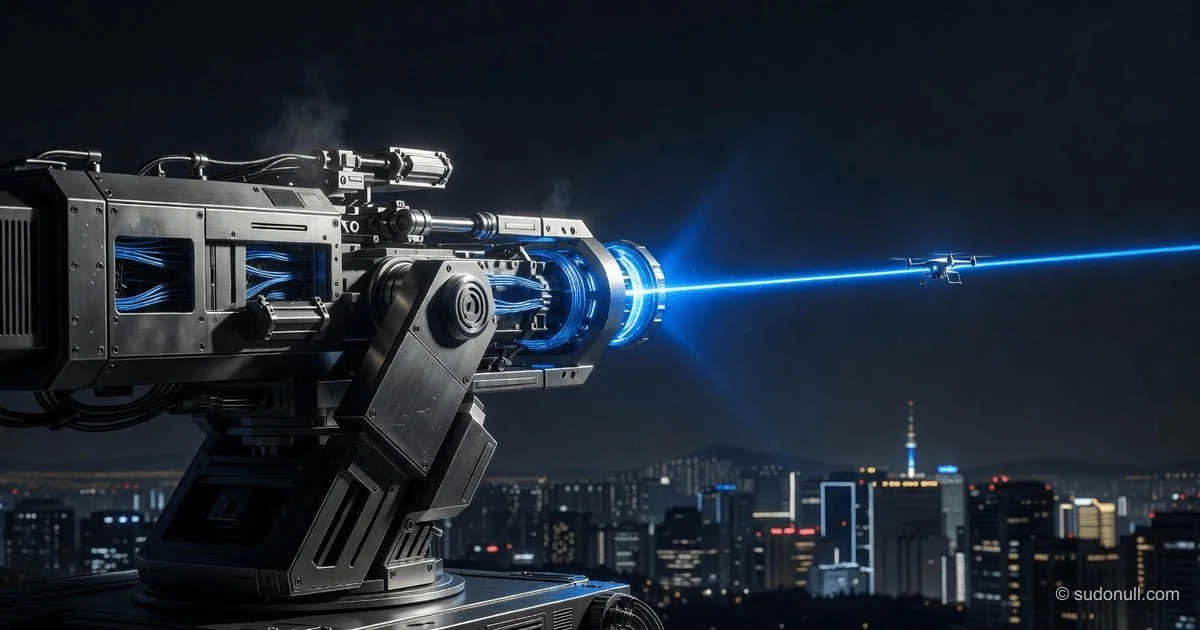
South Korea Tests Powerful Cheongwang Laser System for Drone Interception
South Korea's Defense Acquisition Program Administration announced the successful development of a domestic laser generator for the Cheongwang Block I system. Drone interception time dropped from 2-4 seconds to 1-2 seconds, placing the country in the elite club of manufacturers of such weapons.
Cheongwang Laser Bluff: Why South Korea Became Fifth but Not a Leader
You saw the news. South Korea announced the successful development of a domestic laser generator for the Cheongwang ("Heavenly Light") system. Drone interception time dropped from 2-4 seconds to 1-2 seconds. The country joined an elite club of five nations capable of independently producing combat lasers — the USA, Israel, China, Germany, and now South Korea.
It sounds like a triumph of Korean engineering. A 20-kilowatt fiber laser, shot cost at one and a half dollars, localization level rose from 76% to 90%. The system has been guarding the skies over Seoul since December 2024, including the area around the presidential residence in Yongsan.
But as an analyst specializing in defense technologies and directed energy weapons, I see a story the press releases won't tell. What South Korea just did is not a technological breakthrough that shifts the balance of power. It is the completion of a catch-up program that arrived five years late and addresses yesterday's threat. Here's why.
[The Core]: What Is Really Happening
Successful localization of the laser generator for Cheongwang is undoubtedly an engineering achievement. But let's look at the numbers soberly. The Block I system is a 20-kilowatt laser effective against small drones at 2-3 kilometers. That's enough to take down a hobby quadcopter or a small reconnaissance UAV. But it's not enough to stop drone swarms, strike drones like the Shahed, or cruise missiles.
The insider detail that changes everything: look at the system's first deployment date — December 2024. Now look at the incident that triggered the entire program — December 2022, when five North Korean drones flew unimpeded over Seoul, and one violated the no-fly zone over the presidential residence.
South Korea needed two years to deploy the system and another year and a half to localize the key component. In that time, drone technology has moved far ahead. North Korea has already demonstrated swarm attacks. Russian Geran-2 drones in Ukraine showed that even primitive UAVs can penetrate air defenses through sheer numbers. A 20-kilowatt laser that spends 1-2 seconds per drone will simply be overwhelmed by a swarm of 50 targets.
This is the hidden truth: Cheongwang Block I solves the threat of yesterday. Korean command knows this, which is why the Block II program with increased power and reduced size has already been announced, and Block III is slated to receive a 100-kilowatt laser for intercepting ballistic missiles and aircraft. But when these systems arrive — in 3-5 years — threats will have moved ahead again.
Timeline and Context
Let's trace how Seoul reached this point and why the pace proved insufficient.
December 2022: Five North Korean drones cross the border, one enters the restricted zone around the presidential residence in Seoul. South Korean forces attempt to shoot them down with helicopters and attack aircraft — unsuccessfully. The drones return home. This humiliation exposes a fatal gap in air defense: Seoul lacks an economical means to intercept small targets.
June 2023: DAPA accelerates the Cheongwang program. Instead of the standard "develop the system first, then localize components" approach, it decides to run generator localization in parallel with system development. This is an unconventional, risky step, but there is no time to waste.
April 2023: Prototype tests show 100% effectiveness against intended targets.
June 2024: Hanwha Aerospace receives a production contract worth 100 billion won (about $72 million).
December 2024: Cheongwang Block I enters combat duty. South Korea becomes the first country in the world to deploy a combat laser with troops — ahead of the USA, whose HEL-TVD and DE M-SHORAD programs are still experimental.
End of May 2026: DAPA announces successful development of a domestic laser generator — a key component previously imported. Output power increased more than 50% over the imported equivalent.
June 1, 2026: Information spreads across global media. South Korea is named the fifth country in the world capable of independently producing combat lasers.
What stands out in this timeline? Two and a half years from incident to system deployment. And three and a half years to full localization. In that time, the potential adversary adapted. North Korea, watching Cheongwang's progress, is almost certainly developing countermeasures — smaller drones, thermal coatings, swarms.
Winners and Losers
This story has clear and hidden winners, and they are not the ones shown in the news.
The main winner — Hanwha Systems and Hanwha Aerospace. This South Korean defense giant secured not only the Cheongwang production contract but also exclusive status as developer of the domestic laser generator. Now it has competencies that can be exported — with the caveat that laser technologies are strictly controlled and not eligible for export. This makes Hanwha an indispensable contractor for future Korean directed-energy programs.
The second winner — South Korea's military, but only in the short term. They finally have a means to protect critical sites from lone intruder drones. Interception cost is about $1.50 per shot versus tens of thousands of dollars for a surface-to-air missile. This fundamentally changes the economics of air defense at the lower tier.
The third winner — Israel and the USA. Both countries already have more advanced programs (Israel's Iron Beam, American systems on Stryker platforms), yet they have not been fielded operationally at scale. Korean deployment experience gives them invaluable data on how laser weapons perform in real conditions — heat, cold, rain, fog. This dataset cannot be obtained in a lab.
The main loser — those who believe Cheongwang will solve the drone problem. A 20-kilowatt laser works against single small UAVs. But the modern battlefield is swarms. Russian Lancets and Iranian Shaheds fly in packs of 10-20. A system spending 1-2 seconds per target will be overwhelmed. Lasers are also vulnerable to weather — rain, fog, dust sharply reduce effectiveness.
Also losing is the concept of the "invisible war" promoted by DAPA. The laser is indeed silent and invisible. But that does not matter if the target is not a lone reconnaissance drone but a kamikaze carrying explosives. The fact that you shot it down unnoticed does not matter — only interception before it reaches the target counts. With a swarm, that becomes a problem.
What the Media Is Not Saying
Journalists write about the "elite club," "breakthrough," and "world's first combat deployment." I will point out three facts that change how this news is perceived.
Insider #1: Generator development ran in parallel with the system — a sign of catching up, not leading.
DAPA takes pride in launching generator localization in parallel with system development rather than waiting for a sequential cycle. Press releases present this as an innovative approach.
In reality, it is evidence that the original imported components were unsatisfactory. If Koreans had possessed their own technology from the start, they would not have spent years on parallel development. They had to catch up. And they did — three years after the drone incident.
China, the USA, and Israel do not boast about "parallel development" because their laser technologies were already mature. They focus on the next generation — 100+ kW, compact size, mobile platforms. Koreans have just finished a stage their competitors completed 3-5 years ago.
Insider #2: 90% localization is not 100%, and the remaining 10% is the most critical part.
Localization by cost rose from 76% to 90%. That sounds impressive. But the remaining 10% is likely the most high-tech components: top-grade optical elements, nonlinear optics crystals, specialized coatings.
No country in the world has 100% localization in laser technologies. The USA imports some crystals from China (despite sanctions, via intermediaries). China imports optics from Germany and Japan. This interdependence is the Achilles' heel of any laser weapon. If an adversary severs the supply chain for even one critical component, Cheongwang stops.
Insider #3: The reconnaissance and targeting problem stayed off camera.
The laser is only the effector. Before firing, the drone must be detected, identified, classified, and tracked. Cheongwang is equipped with an integrated radar mast. But a radar capable of detecting a small drone against Seoul's urban backdrop is a nontrivial task.
Media report 1-2 seconds for interception but omit detection and tracking time. That can take tens of seconds. In urban conditions, with reflections from buildings and false targets (birds, balloons), system effectiveness may be far below lab figures.
Forecast: Next 30 Days and 90 Days
Forget the "entry into the elite club." Here is what will actually happen in the coming months and years.
Next 30 days: Wave of export requests — and refusals.
Cheongwang's success will spark interest from countries facing drone threats: the United Arab Emirates, Saudi Arabia, Poland, Baltic states. Requests will pour in.
Here DAPA will face a dilemma. Laser generators fall under strictly controlled technologies not eligible for export. Selling complete Cheongwang systems is possible. But their key component — the generator — is subject to export restrictions. Seoul will be forced to refuse, sell stripped-down versions, or enter complex negotiations with the USA (which holds veto rights on re-export of technologies containing American components). None of these options promise quick money.
Next 90 days: North Korea responds — with new drones.
Pyongyang is watching Cheongwang's progress closely. Within three months, North Korean engineers will present modifications to their drones aimed at defeating laser air defense: smaller size (harder to lock on), thermal coatings (more time to burn through), swarms (overloading the targeting system).
This is the classic weapon-counterweapon spiral. Seoul gained an advantage, but it will be temporary. North Korea will adapt — it has experience operating under sanctions and shortages and knows how to find unconventional solutions.
What about 12 months from now? Cheongwang Block I will prove its effectiveness in real conditions — or it will not. If the system successfully intercepts a real threat (a North Korean intruder drone), it will be the biggest PR success for the Korean defense industry. If the first combat incident reveals shortcomings — weather limits, detection difficulties, swarm problems — the Block II program will receive extra funding, but trust in laser weapons overall will waver.
Block II, which DAPA discusses in future tense, is to be mobile, based on the K239 MLRS chassis. This is the right direction — stationary protection of the presidential residence does not help the army in the field. But when will Block II appear? Given Block I's development pace (3 years), Block II is unlikely to be fielded before 2028-2029.
Long-term forecast (5 years): South Korea will remain in the "elite club" — as the fifth or sixth player. It will not overtake the USA or China but will hold its position. The main question is not technology but tactics. If Koreans are the first to develop an effective doctrine for using mobile lasers in combined-arms combat, they can offset technological lag behind the leaders. If not — Cheongwang will remain an expensive toy for guarding government buildings, while artillery and missiles continue to dominate the battlefield.
I gave you an insider view. Now you know: joining the club is not the finish line but the start of a race in which Korea is still catching up.
— Editorial Team









No comments yet.