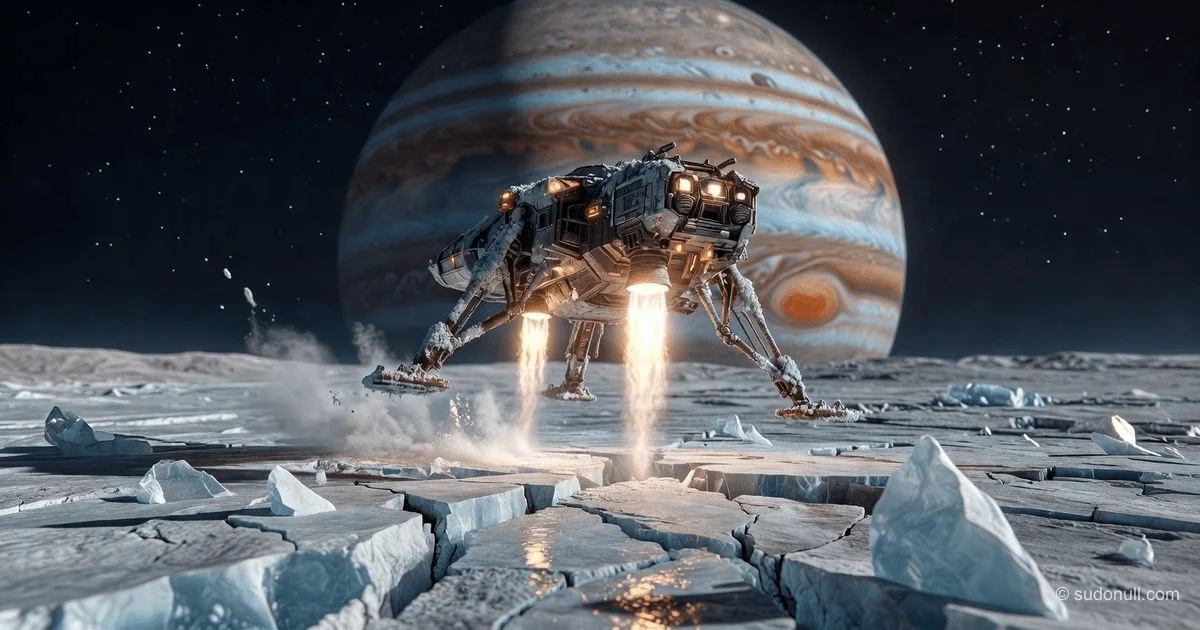
Europe Tests Lander for Jupiter's Moon Europa
The European Space Agency (ESA) has successfully tested a prototype lander designed to study Jupiter's moon Europa. The vehicle was tested under conditions simulating the surface of the icy moon.
Playing the Long Game: Why Europe's Lander Tests Are a Hidden Victory Over NASA
[The Gist]: What's Really Happening
When the European Space Agency reported successful tests of a prototype lander for Jupiter's icy moon Europa in late May 2026, global media treated it as just another entry in the space chronicle. But those who follow the industry more closely understand: this event marks a shift in strategic paradigm. Europe isn't just testing a piece of hardware. It is staking its claim on the "second wave" of Solar System exploration, where flybys and orbital missions give way to physical contact with the surface.
The key non-obvious insight that even authoritative outlets like SpaceNews miss is that these tests are not so much a scientific as a political maneuver. The official narrative says: we are preparing to land on Europa. The reality is far more complex. The lander tested by ESA (let's call it ELP — Europa Lander Prototype) currently has no approved budget, no confirmed launch vehicle, and no clear launch timeline. Insiders at ESTEC (ESA's technical center in the Netherlands) say the real launch window is no earlier than 2035-2040.
So why is ESA spending tens of millions of euros on tests now? The answer lies in transatlantic competition. NASA, with its Europa Clipper launched in October 2024, will be the first to conduct a detailed reconnaissance of Europa from Jupiter orbit, performing 49 close flybys. But the Americans have already made it clear that the next step — their own Europa Lander mission, whose concept is being developed at JPL — could launch in the late 2030s. ESA fears being late to the pie-splitting. These tests are a demonstration that "we too can do it and are already ready, don't forget about us when you're dividing assembly contracts."
Timeline and Context
It's important to understand that the current stage is inextricably linked to the flagship missions of this decade. On April 14, 2023, the JUICE (JUpiter ICy moons Explorer) mission launched. Its target is not so much Europa as Ganymede and Callisto, but data from JUICE, which will arrive at Jupiter in July 2031, will form the foundation for all future landing missions. Exactly a year and a half later, on October 14, 2024, NASA's Europa Clipper launched, which will be the first to reach the Jupiter system in April 2030 and begin mapping.
ESA's logic is simple: while Clipper is in transit (its journey will take 5.5 years), Europe has time to prepare a "second echelon." The 2026 tests concerned not so much spaceflight as the final meters before the surface. Since Europa has no atmosphere (or rather, it is extremely tenuous), parachutes are useless. Landing is only possible using braking engines. European engineers from Thales Alenia Space (the prime contractor) simulated a "blind landing" — where cameras are blinded by dust from engine exhaust — using next-generation radar altimeters and lidars.
Another important context was the successful test of thermal protection for another European vehicle — Space Rider. Although Space Rider is an Earth-orbital shuttle, the technologies for atmospheric entry at speeds of 27,000 km/h and temperatures of 1,600°C are directly applicable to return modules or even aerobraking technology at Jupiter. Space Rider's 28-meter parachute, tested by drops from a helicopter over Sardinia, is a rehearsal of the "soft landing" skills critical for Europa. ESA is using Space Rider as a "sandbox" for technologies that will later fly to Jupiter.
Who Wins and Who Loses
The first and obvious winner is Thales Alenia Space. This Italian-French industrial giant gains exclusive experience in building vehicles for the outer Solar System. They already have contracts for JUICE instrumentation. If ESA announces a tender to build the Europa Lander in 5-7 years, Thales will be first in line. That's billions of euros that might otherwise go to Airbus Defence and Space or Germany's OHB.
The second beneficiary is the Italian Space Agency (ASI). Italy has traditionally been Europe's gateway to precision landing. The tests took place at Italian industrial facilities. Rome's political influence in ESA is growing in proportion to its investments in the Vega-C rocket and landing technologies.
The main loser is NASA. The situation from the American side is paradoxical. They have a spacecraft (Europa Clipper) and dreams of a Lander, but no congressionally approved budget for landing (estimates start at $5-7 billion). ESA, with a modest budget (about €7 billion per year vs. NASA's $25 billion), is showing an aggressive test schedule. This prompts American congressmen to ask: "Why are we falling behind Europe?" If ESA can prepare the technology earlier, NASA might be offered a partnership role rather than leadership in a mission to Europa — which would be humiliating for American space pride.
A hidden loser — China. CNSA (China National Space Administration) is actively working on its own icy moons exploration program (the "Gan Yu" mission), but for a full-fledged Europa lander, they only have general concepts. ESA's success in creating a working prototype "for cold worlds" shifts the international scientific community's attention to Europa, diverting resources and interest from Asian programs. While China builds a station on the Moon, Europe prepares to storm Jupiter.
What the Media Isn't Saying
First and most important — the energy problem. Any lander on Europa must operate in Jupiter's radiation belts. The radiation dose there is so high (about 540 rem per day) that it would kill any modern processor within hours without heavy shielding. ESA tested the mechanical part of the landing but is silent about the fact that the control unit (a radiation-hardened computer based on the Leon processor) is still under development. Without solving radiation hardness, all the mechanics are just a pile of titanium on dead ice.
Second undisclosed factor — an orbital relay. The lander cannot transmit data directly to Earth — it is too small, and Earth is too far away. It needs a powerful satellite in Jupiter orbit to relay the signal. The US has Europa Clipper (which will serve as such a relay). Europe will not have such a satellite until JUICE enters Ganymede orbit in 2034. So even if the European lander touches down on Europa in 2035, it will have no one to "talk to" until JUICE switches from Ganymede to Europa, which is not in the mission plans. The European Lander could end up deaf.
Third, the most cynical point — lack of funding for deployment. The current tests are paid for from ESA's research budget (General Studies Programme). But to build a flight model, a Ministerial Council program is needed, where member states chip in money. The next such council will only take place in late 2026 or early 2027. If Germany or France, facing budget crises, refuse to pay, the program will freeze for a decade. The 2026 tests are a beautiful presentation designed to squeeze money out of stingy finance ministers.
Forecast: Next 30 Days and 90 Days
Next 30 days.
In the coming month, ESA will release a detailed technical report on the tests, specifying the exact landing loads (expected 5-7g) and landing accuracy (likely within a 100-meter radius). If the numbers turn out better than American counterparts (JPL declares 200 meters for its concepts), it will cause slight tension in NASA-ESA relations. Also expect statements from Roscosmos (outside your analysis, but for context) and CNSA criticizing Europe's "colonial approach." In response, France and Germany may sign a bilateral agreement to allocate €300 million for the next development phase.
Next 90 days.
By September 2026, a specific "mission architecture" will be defined. Most likely, ESA will abandon the idea of launching a heavy lander on Ariane 6 (its payload capacity may be insufficient for a direct transfer) and consider a scenario using gravity assists at Earth and Mars, extending the flight to 10-12 years. Also by autumn, the fate of JUICE will become clear — the probe will perform another gravity assist at Earth (September 2026), which will either confirm or refute trajectory corrections toward Jupiter. If JUICE executes the maneuver perfectly, confidence in ESA's navigation capabilities will increase, boosting the Lander project's prospects.
Final forecast: we are on the brink of a cold space war between ESA and NASA for the right to first touch Europa. The US has a speed advantage (Europa Clipper is already en route). Europe has a specialization advantage (their vehicle is built as a lander from the start, not an orbiter). Neither vehicle will land before 2035. But already now, in 2026, Europe is winning the battle for public opinion and technological demonstrations. If by the end of 2026 ESA announces the creation of an international coalition (Japan or Canada joining the Lander project), NASA will be forced to accelerate its program, risking safety. The race for the icy ghost has begun.
— Editorial Team










No comments yet.