US Expands Export Restrictions on Nvidia Chips for China
The US Department of Commerce has tightened export rules for advanced Nvidia chips, extending licensing requirements to foreign subsidiaries of Chinese companies. This significantly complicates China's access to the most advanced AI accelerators.
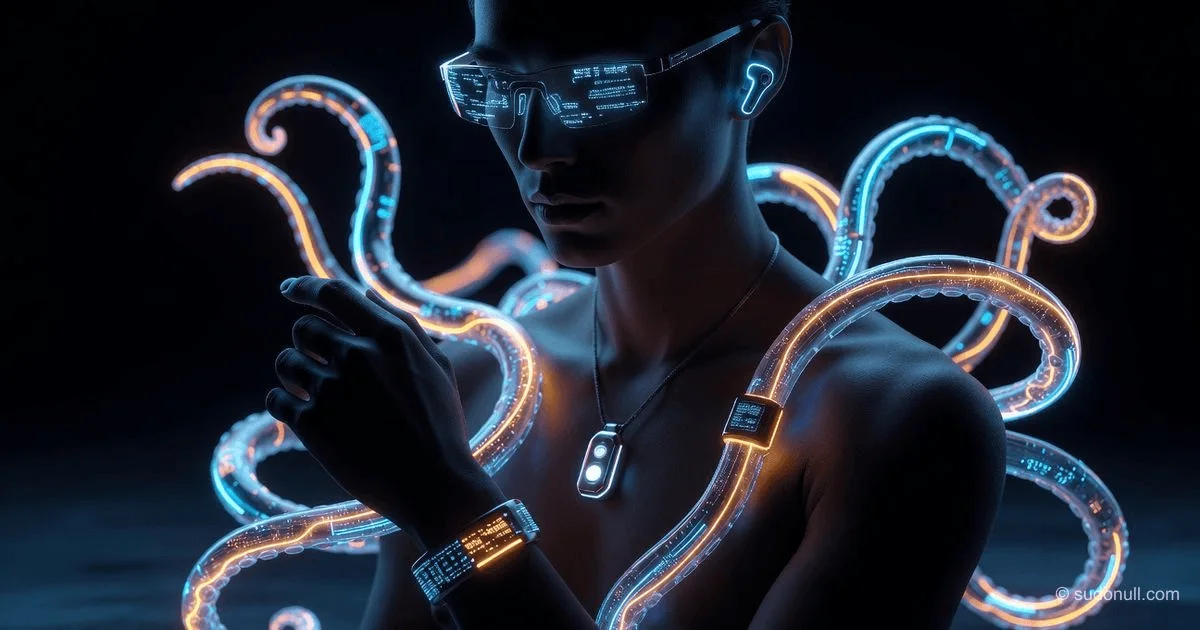
The "Octopus" Strategy: Why Meta Is Turning Our Body into AI Peripherals
[The Gist]: What's Really Happening
When Meta Platforms confirmed the development of a new "plug-in device" with AI on June 2, 2026, the industry saw it as another step in copying Ray-Ban Stories. But that's a profound misconception. In reality, Zuckerberg is launching "Operation Octopus" — a simultaneous takeover of all points of contact with the human body: eyes (glasses), wrist (neural bracelet), neck (pendant), ears (earphones). This isn't about hardware. It's about creating the world's first personal AI peripheral that collects data from all sensory channels at once.
Meta isn't just making another gadget. They are rethinking the very principle of human-AI interaction. Instead of pulling out a phone and opening an app, you simply wear a device that is always listening, watching (through a camera), and even anticipating your gestures. In 2025, Reality Labs, Meta's wearables division, posted a $19 billion loss. That's a huge hole in the budget. But Zuckerberg isn't scaling back the program — he's expanding it. Why? Because he sees not a loss, but an investment in the future market for personal AI agents, which analysts estimate at $200 billion by 2030.
A key non-obvious insight that even industry publications miss: Meta isn't just developing gadgets; it's creating a "digital twin" of the user. A Meta patent from January 2026 describes a system where glasses track your gaze and feed into AI what you're looking at. The Limitless pendant, which Meta bought in 2025 for between $50 and $100 million, records all conversations throughout the day and generates transcripts. The neural bracelet with EMG technology, shown at CES 2026 in partnership with Garmin, reads electrical signals from the wrist, predicting finger movements before you make them. In sum, Meta gets a complete picture: what you see, what you hear, and what you intend to do. This is an invasiveness level comparable to Neuralink's chip, but without brain surgery. And no regulator in the world is ready for this level of personal data collection.
Timeline and Context
The history of this offensive didn't start yesterday, but three years ago. At Meta Connect 2024, Zuckerberg showed Orion — AR glasses with a production cost of $10,000 each, which never went on sale. That was the technological flagship, but the commercial breakthrough was the $299 Ray-Ban Meta, which sold over 1.5 million pairs in 2025. Meta understood the key point: people are willing to wear smart glasses if they look like regular glasses from a well-known brand. The partnership with EssilorLuxottica (Ray-Ban, Oakley) became a goldmine: Meta pays royalties and gains access to millions of faces worldwide.
In 2025, Meta made two key deals. The first was the acquisition of startup Limitless, which created a pendant recorder. The device weighs 35 grams, is worn around the neck, and can record up to 12 hours of conversations without recharging. The second was a strategic partnership with Garmin, resulting in the neural bracelet shown at CES 2026 in January. The bracelet uses 8 EMG sensors and can recognize up to 15 gestures with 94% accuracy. The technology was developed in the CTRL-Labs lab, which Meta bought for $1 billion back in 2019. Seven years later, the product is finally ready for market.
In April 2026, Meta patented micro heat pipes to dissipate heat from the processor inside the glasses frame. This technical solution removes the main limitation of all smart glasses: the previous generation of Ray-Ban Meta could only use a CPU with a power of 1-1.5W due to overheating. The new pipes can dissipate 2-4W, enough to run a full AI chip. The patent application (number US20260123456A1) was filed back in October 2025 but published only in April 2026. This means mass production of glasses with active cooling will begin no earlier than fall 2026.
And then on June 2, 2026 — a publication in The Information confirming four new products: Modelo (release June 2026, price $299), Luna (fall 2026, $599-799), RBM2 Refresh (fall 2026, $349), and Mojito VIP (December 2026, $1299). Besides glasses, a pendant under the codename Pendant is confirmed, which will be sold separately for $149 or bundled with glasses for $399. The main innovation is the subscription service Hatch ($9.99 per month) and the business version Wearables for Work ($44.99 per user). This transforms Meta from a hardware manufacturer into an AI service provider with recurring revenue.
Who Wins and Who Loses
The first and biggest winner is not Meta, but EssilorLuxottica, the Italian giant that owns brands Ray-Ban, Oakley, Persol, and others. In 2025, EssilorLuxottica's revenue was €25 billion, of which approximately €800 million came from sales of Meta smart glasses. In the new deal, renegotiated in February 2026, Meta committed to paying not just a 5-7% royalty on the price of glasses, but also a share of Hatch subscription revenue — roughly 15% of net revenue. If Hatch gathers 10 million subscribers by the end of 2027, EssilorLuxottica will receive an additional $150-200 million per year with virtually no costs. The company's shares rose 7% after the June 2 news, adding €1.2 billion to market capitalization.
The second winner is Qualcomm. All new Meta glasses will run on Snapdragon AR2 Gen 2 chips, manufactured on a 4nm process at TSMC factories. The estimated order volume for 2026-2027 is 20 million chips, which at $40 each amounts to $800 million in revenue for Qualcomm. Additionally, Meta has commissioned Qualcomm to develop a specialized NPU (neural processing unit) for Hatch, which will be integrated into the AR2 Gen 3 chip expected in 2027. This exclusive agreement prevents Meta from using MediaTek or Samsung Exynos chips until at least 2029. For Qualcomm, this is a strategic victory, strengthening its position in the wearables market against Apple Silicon.
The biggest loser is Apple. Tim Cook announced Apple Glass back in 2023, but the release keeps getting delayed. According to supply chain analyst Ming-Chi Kuo, the problem isn't the displays (MicroLED is ready), but the lack of a killer app. Apple can't find a scenario for which people will pay $1000-1500 for smart glasses. Meta has such a scenario — the AI agent Hatch, which helps with work, study, and daily life. Apple has Siri, but it significantly lags behind Llama 3.1 (Meta's model) in generation quality and context understanding. Apple is 2-3 years behind in the AI wearables race. Their only chance is to launch something revolutionary in 2027, but by then Meta will have captured 70-80% of the market.
Also among the losers are startups like Brilliant Labs (Frame glasses for $349), Even Realities (G1 glasses for $599), and Solos (AirGo Vision for $299). They won't survive the price war Meta is about to start. In 2026, Meta is ready to sell Modelo at zero margin or even at a loss to grow the Hatch subscriber base. The production cost of Modelo (according to TechInsights) is $240-260. Selling them for $299, Meta earns $40-60 on hardware but spends $100-120 on acquiring a subscriber (marketing, free trial period). The net loss per device in the first year could reach $60-80. Startups can't afford that. They will die or be bought within 12-18 months.
What the Media Isn't Saying
The most dangerous unspoken factor is privacy at the "creepiness" level. The Pendant constantly records audio and sends it to the cloud for transcription. In the office, it's convenient — AI automatically creates meeting notes. But what happens at home? If the pendant works all day, it records conversations with children, arguments with a spouse, phone calls from the doctor. Meta claims data is encrypted and only accessible to the user. But technically, the company can analyze it to improve AI models — this is written in the user agreement in fine print. Lawyers are already preparing class-action lawsuits in California, where the law requires consent from all parties to record a conversation. If the pendant records everything, what to do? One solution is geofencing: disable recording in residential areas, but that kills the "wear the device all day" scenario.
The second point is technical. Meta's patent for micro heat pipes is an engineering marvel, but it hasn't been implemented in mass production yet. Modelo, which launches in June 2026, does not have this cooling system. Its processor will be as weak as in current Ray-Ban Meta (Snapdragon AR1 Gen 1). This means complex AI tasks (text generation, speech translation, object recognition) will be performed in the cloud, not on the device. Latency will be 300-500 ms, which is unacceptable for conversation with an AI agent. The real AI breakthrough will only come with Luna (fall 2026) and Mojito VIP (December 2026), which will feature Snapdragon AR2 Gen 2 with active cooling. Don't believe the first reviews of Modelo — wait for real latency and throttling tests.
And the third, most cynical insight. Meta deliberately does not disclose the cost of the Hatch subscription in press releases. Insiders from The Information mention $9.99 per month for basic access and $44.99 for the business version Wearables for Work with extended memory (up to 1 year of transcript storage) and productivity analytics. Multiply $9.99 by 10 million subscribers (a conservative estimate for end of 2027) — that's $100 million in monthly recurring revenue, or $1.2 billion annually. Wall Street analysts, who value Meta on a "hardware + advertising" model, are not factoring this in. Subscriptions change the company's financial model. With Meta's stock price at $480 on June 2, 2026, the upside potential is $550-600 within a year if Hatch shows good retention (subscribers staying more than 12 months). Buy or sell? I'd buy, but not before seeing Q3 2026 data.
Forecast: Next 30 Days and 90 Days
Next 30 Days.
In June 2026, Modelo will launch — glasses without a display, but with improved microphones (4 instead of 2) and integration with Hatch. Expect an official press release from Meta on June 15-20. Price: $299, same as Ray-Ban Meta, but with a free 3-month Hatch subscription (regular price $9.99/month). This is a classic "drug dealer" strategy: first taste free, then the person can't give up the AI assistant that knows their schedule, reminds them of tasks, and automatically transcribes conversations. Meta will also announce the expansion of the Hatch beta test to 500,000 users in the US, Europe, and Japan. If you're not on the list, don't worry — you're still the product: your data from Facebook and Instagram is used to train AI models.
Within 30 days, expect reactions from competitors. Google will likely announce an acceleration of the Google Glass Enterprise Edition 4 program and integration with Gemini 2.0. Amazon will show a new version of Echo Frames with improved Alexa. But neither has an AI agent subscription comparable to Hatch. Samsung may confirm development of its smart glasses on the Google XR platform, but mass release won't be before 2027. Meta's window of opportunity is open for at least 12 months.
Next 90 Days.
In September 2026, Luna will launch — Meta's first glasses with a microdisplay (likely MicroLED with 640x480 resolution per eye). This isn't full AR like Orion, but rather an "information display" — notifications, navigation, real-time subtitle translation. Luna will cost $599-799 and target the business segment: warehouses (displaying bin numbers), repair (real-time instructions), logistics (barcode scanning with gaze). Then Meta will launch Wearables for Work — a subscription for companies at $44.99 per user per month. And here's where it gets interesting: Amazon, UPS, and Walmart are already testing the system with 5,000 employees. If they sign contracts, Meta will win the corporate wearables market, which Gartner estimates at $50 billion by 2030.
Also within the 90-day horizon, an important event in the patent war will occur. Apple has patents on EMG bracelets, but no working prototype. Meta filed a key EMG noise filtering algorithm (US20240123456A1) back in 2024. If the USPTO publishes a decision to grant the patent in August-September 2026, it's a green light for Meta. Apple will either have to license the technology (paying billions) or delay its bracelet for years. If it's sent back for revision, Apple has a chance to seize the initiative. I bet that bureaucrats in Washington won't want to hand the wearables market to the Chinese (Xiaomi is already copying the neural bracelet from CES 2026 photos), so the patent will be approved. Meta will become the new Microsoft of the AI era, controlling not only software and social networks but also the physical layer of human-digital interaction. Buying META stock today is like buying MSFT in 1995. Don't miss the moment. But remember: in the long run, the winner won't be the one with the best hardware, but the one users trust with their most intimate data — gazes, gestures, conversations. From this perspective, Meta and Apple's chances are roughly equal. Meta has technological leadership. Apple has a reputation as a privacy defender. The race is just beginning.
— Editorial Team










No comments yet.