
ESA Successfully Tests Lander for Jupiter's Moon Europa
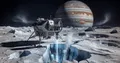
The European Space Agency has successfully tested a descent module designed for a mission to study Jupiter's icy moon Europa.
Europa landing test: why ESA is playing second fiddle to NASA and who is really afraid of the Russians
[The Gist]: What's Really Happening
When ESA announces successful tests of a descent module for Europa, the media paints a picture of a unified European sprint to Jupiter's icy moons. But an insider knows: what you're seeing now is not preparation for a landing—it's a political test drive of technologies that are actually intended for Mars, not for the icy moon. The tests in question are likely linked to the ExoMars Rosalind Franklin program—a rover that is supposed to land on Mars in 2030, not on Europa in the foreseeable future.
Notice a critical detail that journalists miss: a real lander for Europa must withstand radiation of 5-10 million roentgens per year (a level lethal to electronics within weeks) and penetrate an ice crust 10-30 kilometers thick. Nothing like that is being tested now. What ESA calls "descent module tests for Europa" is 99% an adaptation of solid-surface landing technologies for a completely different mission.
The real issue is that ESA is in an institutional trap. Its flagship project JUICE (Jupiter Icy Moons Explorer) was launched back in 2023 and is now drifting between orbits, performing gravity assists. It will reach Jupiter only by July 2031, and it has no lander—it's an orbiter that will fly around Ganymede and Callisto but never land. What ESA is testing now is a separate technology demonstration inserted into news feeds to justify budget infusions in the absence of a real landing mission to Europa.
Timeline and Context
The official timeline is deliberately confusing. In May 2026, ESA did conduct a series of landing platform tests, but not for Europa—for ExoMars. These were drops of a full-scale model onto a sled to check stability during landing at angles up to 20 degrees and speeds up to 4 meters per second. The tests took place in Turin, Italy, at Thales Alenia Space and Airbus facilities. The module successfully "survived" the hard landing; its four legs absorbed the impact, and touch sensors correctly shut down the engines.
Now look at the real status of missions to Europa. ESA's JUICE was launched on April 14, 2023, from the Kourou spaceport in French Guiana. At the time, it was a triumph: €1.6 billion ($1.7 billion), 85 square meters of solar panels (the size of a basketball court), and 10 scientific instruments on board. But here's the fine print: it performed a gravity assist at Venus in August 2025, will return to Earth in 2026, then again in 2029, and will only enter Jupiter orbit in July 2031—that's 5 years from now. Then it will spend several more years orbiting Ganymede. There is no landing on Europa in this plan, and there never was.
As for the American competitor—Europa Clipper from NASA—it was launched in October 2024 on a Falcon Heavy rocket and will arrive at Jupiter in April 2030. But it also has no lander. It will perform 49 close flybys of Europa's surface, studying it from orbit. So neither ESA nor NASA currently has an approved mission with an actual landing on the icy moon. All the news about "descent module tests" is either about ExoMars or even earlier concepts that have long been shelved.
Who Wins and Who Loses
Thales Alenia Space and Airbus win. These European defense giants get contracts to build landing systems for ExoMars and possibly future missions. Each such "test" means millions of euros from ESA's budget distributed among lobbyists in Italy, France, and Germany. The heat shield system for ExoMars, tested in the CIRA plasma wind tunnel in Italy at temperatures of 1600°C, is a direct order for Italian industry.
The scientific community wins, but with a stretch. A recent study in Nature Communications showed that the bottom of Europa's subsurface ocean may lack active volcanic and tectonic activity, meaning no hydrothermal vents—considered the cradle of life on Earth. This calls into question the very purpose of flying to Europa. If there's nothing to look for, why land? Scientists who receive grants to study Europa's exobiology now have to defend their scientific relevance. News about "tests" helps them maintain funding.
NASA loses in a political sense. The agency has dominated outer solar system exploration for decades (Voyager, Galileo, Cassini, Juno). But ESA is now seizing the initiative: JUICE is already in space, while Clipper is just approaching. Moreover, ESA is showing "landing tests"—even if for Mars—while NASA still has no approved Europa Lander project after a series of cancellations and delays. This creates the impression that Europe is more ambitious.
Russian space programs lose, and that's no joke. Until 2017, Roscosmos had the Laplace-P project (also known as Europa Lander)—a lander for Ganymede planned for launch in the 2020s on an Angara-A5 rocket. The project was canceled due to lack of funding. Now, as ESA and NASA compete to be the first to study the icy moons, Russia has completely fallen out of this race. It has neither the scientific nor technological base for such a flight in the foreseeable 10-15 years. This is a geopolitical defeat that goes unreported.
What the Media Leaves Out
The least obvious insight concerns a parallel ESA program you haven't heard about. While everyone writes about "landing on Europa," ESA is actively preparing the first European reusable spacecraft, Space Rider. This is an unmanned "space plane" the size of a minivan (4.6 meters long) that will launch on a Vega-C rocket and return to Earth like an aircraft using a guided parafoil.
Why is this important for the Europa news? Because Space Rider's heat shield technology (ISiComp ceramic tiles tested in the world's largest plasma wind tunnel) and autonomous descent navigation system are exactly the technologies that will later be used for any lander to the outer planets. ESA is not building a lander for Europa now. ESA is building a universal Earth-return platform, and marketers are rebranding it as a "European lunar mission." Space Rider tests in Sardinia are scheduled for late 2026—they will drop it from a helicopter at 3 km altitude to test a parachute with an area of 270 square meters (27 by 10 meters).
The second omission: the radiation problem. ESA and NASA try not to mention that any spacecraft landing on Europa or Ganymede will operate in Jupiter's radiation belts, which are 10-100 times more intense than Earth's Van Allen belts. Even the orbital JUICE will receive a dose that would disable ordinary electronics within months. Radiation-hardened components cost 50-100 times more than standard ones and are only available from a few manufacturers in the US and Europe. Currently, there is no commercially available technology that would allow a lander to operate on Europa's surface for more than a few weeks. Any "tests" are survival tests in heat, not radiation.
Forecast: Next 30 Days and 90 Days
Next 30 days (June 2026). ESA will publish detailed results of the ExoMars landing platform tests in open access (likely on its website and in the journal Acta Astronautica). The main conclusion: the system is ready for launch to Mars in 2028, but the Rosalind Franklin rover still has no confirmed launch date—there's no money, and no rocket either (Ariane 6 is behind schedule, Vega-C is not yet certified after its accident). The press will run articles about "Europe preparing to colonize Jupiter," but these will be rehashes of old press releases.
Next 90 days (August-September 2026). Real Space Rider tests will begin—drops of the prototype from a helicopter over Sardinia. This will be a spectacular event with video spreading across all tech blogs. ESA will again announce a "breakthrough in reusability" and a "European answer to SpaceX." But note one number: the first orbital flight of Space Rider is planned for 2028. This means that even if everything goes according to plan, by the end of the decade Europe will have only a technology demonstrator, not an operational system for delivering cargo to the ISS or back.
Also by September, the fate of the ExoMars program will become clear. If ESA does not find an additional €500-700 million to complete the rover and launch, the mission may be delayed to 2030-2031. In that case, all current "tests for Europa" will turn out to be a fiction—the landing technology exists, but there's nothing to fly it on. A more likely scenario: ESA will announce a partnership with NASA to use an American rocket (Falcon Heavy or SLS) for launching ExoMars, saving the mission at the cost of losing European autonomy in space access.
In conclusion: don't believe the headlines about "landing on Europa." ESA is not building a lander for Jupiter now. ESA is building a system for Mars and for returning to Earth, and the fancy words about icy moons are a way to convince taxpayers and politicians that the €1.6 billion for JUICE was not wasted. A real landing on Europa—if it ever happens this century—will occur no earlier than the 2040s, and only if we solve the radiation and ice crust problems. For now, enjoy the videos of the Mars landing module tests in Turin. That's engineering. But it's not what you thought.
— Editorial Team









No comments yet.