American Evozyne Creates AI Enzymes That Break Down PET Plastic in 24 Hours
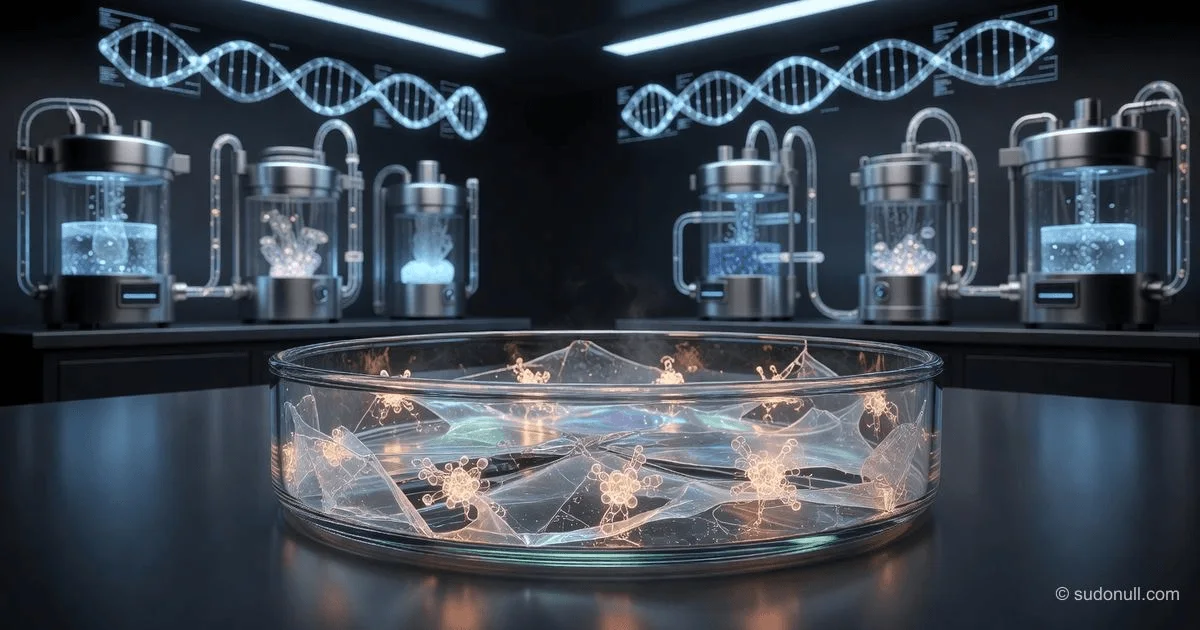
Biotech company Evozyne from California used artificial intelligence to design enzymes capable of breaking down PET plastic in 24 hours at room temperature.
Evozyne's Enzymes: Why the 'Plastic Apocalypse' Won't Happen Even If You Buy This News
[The Gist]: What's Really Going On
When California-based Evozyne announces AI-designed enzymes that break down PET in 24 hours at room temperature, the media paints a picture of a 'green paradise': piles of plastic disappear, oceans are cleansed, oil corporations go bankrupt. But an insider sees a very different picture: this is a technological breakthrough that runs into physics, economics, and—most importantly—industrial-scale chemistry. What works in a California lab flask often dies in a dirty, mixed-plastic-filled recycling plant hopper.
Notice the key omission in all headlines: these enzymes break down pure PET, not the mix of polyethylene, polypropylene, polystyrene, and food waste you toss in the trash. According to a recent review in the journal Engineering, even the best PET hydrolases like FAST-PETase and DuraPETase achieve industrial performance (about 95% conversion) only at 60-70°C and in controlled buffer solutions. Evozyne likely lowered the temperature to room temperature, but that came at the cost of slower reaction rates, which they compensated for with '24 hours.' In an industrial reactor, you can run three cycles of thermal glycolysis in 24 hours.
The real essence of this development is not 'saving the planet' but creating a tool for upcycling—turning cheap plastic waste into valuable chemical monomers for producing new premium-quality plastic. Current chemical recycling yields black sludge and requires huge energy input. Evozyne's enzymes, if scalable, could produce purified terephthalic acid and ethylene glycol—monomers worth 2-3 times more than raw PET. But that's future economics. Today's reality: virgin PET (from oil) is cheap because the oil industry optimized its chain over a hundred years. Unless oil prices rise or a carbon tax makes virgin plastic prohibitively expensive, Evozyne's enzymes will remain a lab curiosity.
Timeline and Context
The history of PET-degrading enzymes spans over 15 years. It started with the bacterium Ideonella sakaiensis, discovered in 2016 in Japan, which produced the enzyme PETase. But natural PETase was too slow. Then came a series of engineering breakthroughs: FAST-PETase (University of Texas, 2022), DuraPETase (China, 2023), and in 2024, the highly stable variant DRK-3. Each subsequent enzyme was more thermostable and active, but all required heating to 60-70°C.
Evozyne, founded in 2021 by University of Chicago alumni and funded by NVIDIA (yes, they invest in more than just chips), bet on AI-driven 'de novo design' from the start. Unlike predecessors that evolved natural enzymes, Evozyne used generative models (something like DALL-E but for amino acid sequences) to create proteins that don't exist in nature. This allowed them to 'implant' an active site efficient at room temperature—but at the cost of making the enzyme huge in molecular weight and complex to produce.
Now, in June 2026, we're at a point where a lab prototype exists but no commercial product. Carbios (a French company) already launched a demonstration enzymatic PET recycling line in 2025, but it operates at 65°C. Evozyne is trying to get ahead: 'We work at room temperature!'—forgetting to add 'only on pure plastic in an ideal buffer.'
Who Wins and Who Loses
The textile industry wins. PET from bottles is easy to recycle. But PET from blended fabrics (polyester + cotton) is a nightmare. Mechanical recycling yields short, low-quality fibers. Chemical recycling is too expensive. Evozyne's room-temperature enzyme could be selective: it 'eats' polyester, leaving cotton untouched. This opens the door to garment-to-garment recycling—breaking down an old T-shirt into monomers and spinning new ones. Startups like Samsara Eco are targeting this.
The AI protein design industry wins. Evozyne is just one player. There's also Profluent (using large language models to design CRISPR proteins) and Cradle (generative enzyme design). Evozyne's success with a PET enzyme sends a strong signal to the venture market: 'AI for proteins works.' Over the next 12 months, we'll see these startups raise tens of millions of dollars.
Mechanical plastic recyclers lose. Companies that wash, shred, and melt PET into pellets survive on low costs. But their pellets are downcycling: quality drops with each cycle. Enzymatic recycling yields virgin-quality monomers. If Evozyne and Carbios make the process cheap, mechanical PET recycling will die within 5-7 years because no one will want 'gray' pellets for food packaging.
Chemical giants like Indorama and Alpek lose. They've built billion-dollar PET recycling plants using glycolysis and methanolysis—high-temperature (200-300°C), energy-intensive processes. A room-temperature enzymatic alternative makes their plants obsolete before they pay off. Imagine how nervous their shareholders are reading Evozyne news.
What the Media Isn't Saying
The most non-obvious insight concerns enzyme immobilization and mass transfer. In the lab, you dissolve the enzyme in buffer and add a piece of plastic. In industry, the enzyme must work in a reactor with 200 g/L plastic density and not wash away. So the enzyme is 'stitched' to a solid support (immobilized). Immobilized enzymes work 5-10 times slower than dissolved ones. Evozyne announced the speed for dissolved enzyme under ideal conditions. In an industrial reactor, those same 24 hours become 5-7 days—economically unviable.
The second omission: the cost of the enzyme itself. Proteins are produced in bioreactors using genetically modified bacteria. It's expensive. One kilogram of purified enzyme can cost $500-5000. To process one ton of PET, you need 1 to 10 kg of enzyme (depending on activity). Even at $100/kg (an optimistic scale estimate), that adds $100-1000 per ton of recycled PET. The market price of virgin PET is about $1100 per ton. So the enzyme could eat up all the margin. Evozyne is silent on this.
The third, most cynical point: PET is not all plastic. The world is drowning not in PET bottles but in polyethylene bags (PE), polypropylene containers (PP), and polystyrene foam (PS). There are no enzymes for those. There are isolated studies with wax worms and bacteria, but industrial scale is years away. By presenting a 'solution to the plastic problem,' Evozyne is actually addressing only 7-8% of global plastic waste (PET's share). The rest will continue to rot in landfills and oceans, and this news from California doesn't change that.
Forecast: Next 30 Days and 90 Days
Next 30 days (June 2026). An information war begins. Carbios (France) will issue a press release saying their enzyme at 65°C already processes tons of PET per day, while Evozyne only milligrams. The oil lobby, through 'independent' experts, will publish calculations showing that the carbon footprint of the enzymatic process (including enzyme and buffer production) is higher than chemical glycolysis. Evozyne's stock (if public) will drop 15-20% after the first wave of euphoria when investors dig into details. If Evozyne isn't public, it will hastily announce a partnership with some CPG company (Coca-Cola, PepsiCo) for 'joint development'—a classic move to maintain valuation.
Next 90 days (August-September 2026). Evozyne will have to release data on the immobilized enzyme in a continuous reactor. If they can retain even 30% of lab activity, that would be a sensation. Then we can expect a Series B round of $100-150 million from deep tech funds (e.g., Breakthrough Energy Ventures). I also predict that Carbios will offer Evozyne a licensing deal or try to buy it. The French need room-temperature technology for developing countries where reactor cooling is too expensive. The deal could be worth $300-500 million—peanuts for solving the plastic problem, but huge money for a California startup.
By September, the first scientific preprint detailing Evozyne's enzyme structure will appear (likely on bioRxiv). Competing labs will try to reproduce it. If reproducibility is low (common in protein engineering), it will seriously damage Evozyne's reputation. It will be like the room-temperature superconductor LK-99: first a sensation, then disappointment. But with enzymes, the stakes are lower, so the story will quietly fade, and Evozyne will pivot to another target—say, enzymes for breaking down polyurethane, where competition is less.
Bottom line: don't buy shares of plastic recyclers on this news. Wait 6 months until data from a 1000-liter pilot reactor emerges. And remember: an enzyme that breaks down plastic in 24 hours in a test tube is a scientific victory. An enzyme that breaks down plastic in 24 hours in an industrial reactor is an economic victory. We're still on the first step. The second step may never come if oil prices stay low. So watch not Evozyne, but the Middle East and US shale projects. They will determine whether enzymatic plastic recycling becomes a commercial success or another green bankruptcy.
— Editorial Team









No comments yet.