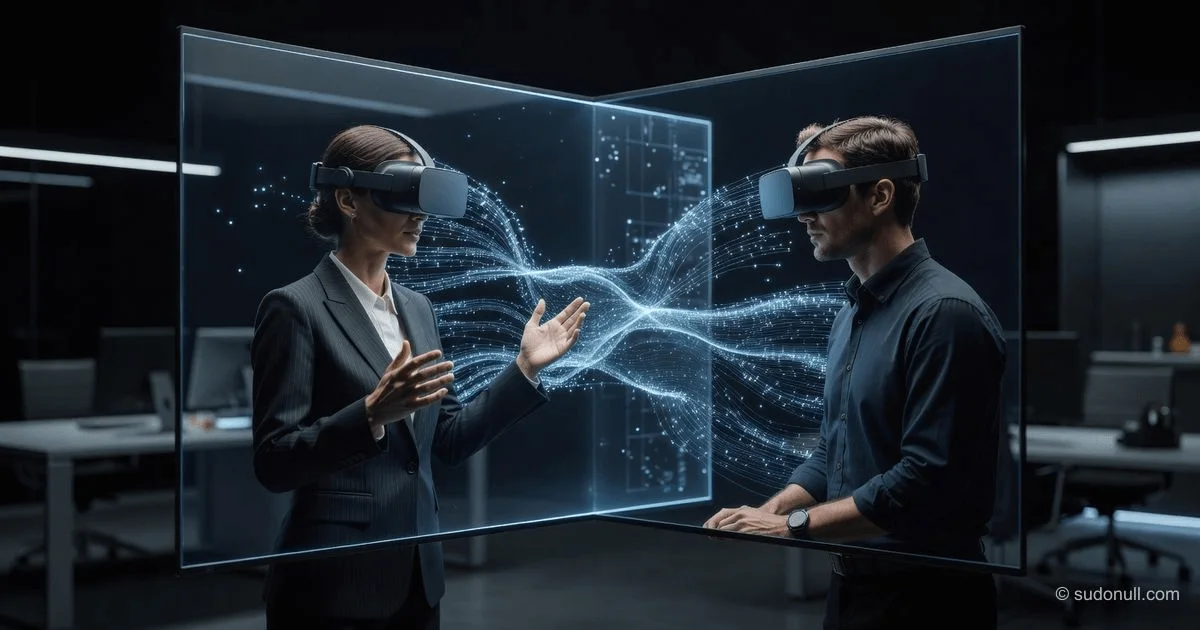
Google Unveils Project Starline Without Headsets for Holographic Meetings
Google has announced Project Starline, a technology that enables holographic video conferencing without the need for headsets or glasses.
The Paradox of Google's Holographic Meeting: Why Starline/Beam Isn't Zoom 2.0, but the Quiet Death of VR Headsets for Business
[The Core]: What's Really Happening
When Google renames Project Starline to Google Beam and announces a launch for corporate clients, the naive reader sees a "revolution in remote work" and "Zoom on steroids." But an insider sees a much more cynical picture: Google isn't building yet another video conferencing service. Google has buried the market for expensive VR headsets for business and taken aim at the very concept of presence, which until now required you to put on "headgear."
Notice the key detail that everyone comparing Starline to Meta Quest Pro or Apple Vision Pro completely ignores. Beam doesn't require you to wear anything—no headset, no glasses. It's a "hologram" on a 65-inch screen that looks at you and adjusts to your movements using light field technology. And this isn't a futuristic 2021 prototype that was forgotten. Google has refined the technology, shrunk it from dozens of cameras to six, and packed it into a device the size of a DVD player running Chrome OS.
But the real core lies in the business model. Google won't sell these booths to you en masse. Instead, they created a reference design and handed it over to HP. The strategy: Google supplies the AI model for volumetric video and cloud infrastructure, while partners handle hardware and logistics. It's a repeat of the Android trick, but in the world of video conferencing. And the new name isn't Starline but Beam, hinting at "rays" of light and possibly at transporting a "beam of consciousness" elsewhere.
Timeline and Context
The official story of Project Starline began in May 2021 at the Google I/O conference. Back then, it was a bulky booth with dozens of sensors, requiring fiber optics and powerful hardware. Google employees, including AR/VR head Clay Bavor, spent thousands of hours on test calls between offices in San Francisco, New York, and Seattle, trying to understand how "real" the sense of presence could be.
Then came silence. For years. Venture capitalists wrote off Starline as yet another "moonshot Google project" that would be consumed by internal strife. But in May 2025—note the date—Google unexpectedly revived the project at the same I/O, renaming it Google Beam. They compressed the technology into a commercial product. Instead of dozens of cameras: six. Instead of tons of server cooling: an AI model that stitches 2D images into a 3D stream in real time.
Why is this important now, in June 2026? Because the first commercial devices from HP are set to be shown at the InfoComm conference literally any day now, with shipments starting before the end of the year. Google confirmed that giants like Deloitte, Salesforce, Duolingo, and NEC have already registered interest. This isn't a test. It's a commercial launch. And it happened at a time when the entire corporate communications market is frozen in anticipation: what to do with billions invested in VR meetings?
Who Wins and Who Loses
The premium corporate segment wins. Imagine a meeting room at Duolingo where a teacher from Barcelona "sits" opposite a student in New York at life size. The light field allows seeing body language, gestures, and even involuntary micro-expressions that are lost in Zoom. Google's research shows that after using Beam, people have better recall of conversation details and reduced "video call fatigue."
HP wins. While Dell and Lenovo battle for the business laptop market with 1% margins, HP gets an exclusive contract to manufacture hardware for Google Beam. For HP, this is a chance to break out of the "just hardware" race and become a high-margin supplier of "presence devices."
Meta and its Quest for business lose. Meta sold expensive Quest Pro (and in 2026, likely Quest Pro 2) for virtual reality meetings. But that requires wearing a headset that presses on your nose bridge, runs out of battery in an hour, and cuts you off from the real world. Beam delivers the same sense of presence without those compromises. Mark Zuckerberg invested billions in a metaverse where people are legless avatars. Google offers an avatar... your real body. In high resolution. Without a helmet.
Zoom and Microsoft Teams lose. Not because they're bad, but because they're stuck in a 2D paradigm. Zoom bought Keyframe for $1 billion? Microsoft is developing Microsoft Mesh? Too late. Google jumped over the "digital avatar" stage and went straight to photorealistic transmission. Zoom will be forced to either urgently license 3D capture technology from someone else or forever remain a laptop calling app. For Microsoft, the situation is even worse—they have HoloLens, but it's a device you have to wear.
What the Media Isn't Saying
The least obvious insight concerns price and the "hidden AI tax." Beam technology requires six video streams from both sides to be constantly "stitched" in the Google cloud into a single 3D model. This incurs massive cloud computing costs. Google won't eat them for free.
Let's do the math. Logitech sells its "conference booth" Project Ghost for $15,000–20,000. Beam will cost comparably, and likely more—$25,000–30,000. But most importantly, it won't be a one-time purchase. It will be a Google Cloud subscription.
Official details haven't been disclosed, but according to indirect data, a holographic call could consume up to 50–100 GB of traffic per hour, and each minute of AI model processing costs non-zero money. Get ready for corporate contracts at $5,000–10,000 per month for "unlimited" holographic meetings. In other words, Beam is a luxury for the rich, not a mass-market product. And Google understands this perfectly, which is why they named it Beam (ray) rather than Starline (star line). The former sounds more down-to-earth, even though it's essentially still a starship.
The second omission concerns scaling. Beam currently only supports one-on-one conversations. Group calls are "in development." But imagine a meeting of five people, each sitting in their own holographic booth in different cities. This requires not just six cameras per person, but extremely complex synchronization of light sources and positioning. When five holograms sit at one virtual table, Google's algorithms might go crazy deciding where to look and whose "gaze" to prioritize. "Group mode" may not appear before 2027–2028.
And the third, most cynical point: abandonment of the mass market. In 2021, the dream was that Starline would be in every home, like Zoom. In 2025–2026, Google officially announced that Beam is for enterprises. Why? Because for home use, this device requires perfect lighting, free space, and absolutely stable internet. In a home bedroom with a cat and kids, the hologram will "fall apart" into pixels every five minutes. Google can't guarantee quality in home conditions, so they're moving to B2B, where the environment can be controlled. This isn't a revolution for everyone. It's a niche tool for top management and architects.
Forecast: Next 30 Days and 90 Days
Next 30 days (June 2026). HP will officially showcase the finished Google Beam device at the InfoComm conference. We'll see exact specifications: weight, size, bandwidth requirements (likely 50+ Mbps). Google will announce the first subscription partners and possibly reveal the price—around $25,000 for the "booth" plus $500 per month for cloud processing. Zoom's stock might dip 3-5% on speculative fear, even if Google doesn't have a single live customer yet.
Next 90 days (August-September 2026). The first real installations will begin in Salesforce and Deloitte offices. Independent bloggers and journalists will get access to the device and start comparing it to what was shown in 2021. If there's no disappointment and latency is below 50 ms, Microsoft will urgently announce its "response"—likely integrating Mesh with HoloLens 3, but again with a headset. That will be their big weak point.
By September, the first "life hacks" from users will emerge: it will turn out that Beam doesn't work in bright sunlight (overexposes cameras) and requires dark clothing (a black suit "blends" with the background and disrupts the volumetric video algorithm). Scandals will start that men with beards and women with loose hair look like "pixel mush"—algorithms struggle with fuzzy textures.
Bottom line: don't expect Beam in your home for the next 10 years. But on the office floor of some IT company in San Francisco or London, it will appear this fall. Google did what no one else could: removed the headset. The price is the cost of a small car for hardware and a subscription fee for cloud AI. The question now isn't technology. It's economics. Can businesses pay $30,000 for the ability to see their colleague from another city at life size? Possibly, if that colleague brings the company $300,000 in profit. For everyone else, there's still Zoom. And that's okay.
— Editorial Team










No comments yet.