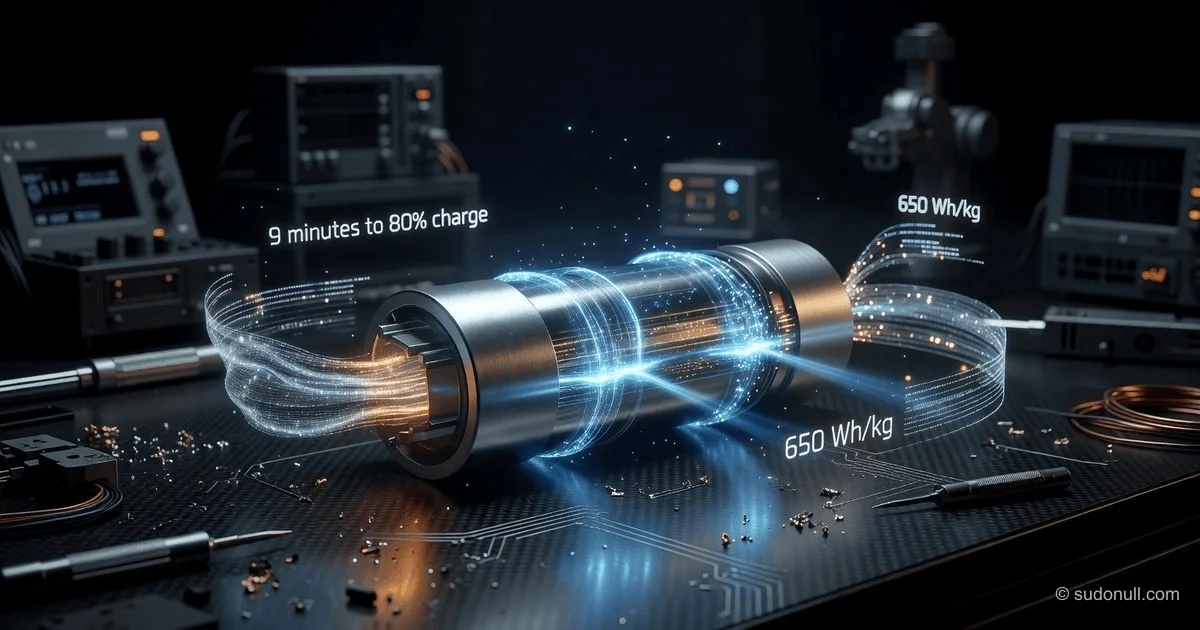
LG Energy Solution Unveils Solid-State EV Battery with 80% Charge in 9 Minutes
South Korean LG Energy Solution has unveiled a solid-state battery for electric vehicles with an energy density of 650 Wh/kg and ultra-fast charging.
The paradox of LG's solid-state battery: why 9 minutes to 80% is not what you think
[The Gist]: What's Really Happening
When LG Energy Solution showcases a solid-state battery with 650 Wh/kg density and 9-minute charging to 80% at the InterBattery 2026 exhibition in Seoul, headlines scream "EV revolution on the horizon." But insiders see three key facts that media completely ignore. First, what LG is showing is a lab prototype based on sulfides, existing as a single unit the size of a fingernail. Second, commercialization of this marvel is planned for 2030 — four years away. Third, Korean manufacturers are already losing the race to the Chinese in another type of solid-state battery and are desperately trying to catch up.
The real story here is not a technological breakthrough but a marketing response to pressure from investors and regulators. LG Energy Solution is in a tough financial spot: Q1 2026 ended with an operating loss of 207.8 billion won (about $150 million). Revenue fell 2.5%, and the company's market cap has been declining for three consecutive quarters. In such a situation, the corporation needs to show shareholders a "bright future" — and a solid-state battery with fantastic specs fits that role perfectly.
Note a critical detail: at the exhibition, LG demonstrated not a finished EV battery but a "sulfide solid-state cell and module mockup." No cycling tests, no data on capacity retention after 500 charge cycles, no information on production costs. What we see is a "technology demonstration," not a "commercial product." The gap between them is a chasm LG must cross in four years. And judging by the fact that Samsung SDI already has a pilot line and promises commercialization in 2027, LG is seriously behind.
Timeline and Context
LG's official timeline for solid-state batteries looks like this: in March 2026 at InterBattery 2026, they publicly show a sulfide solid-state cell for the first time. Company representatives state the goal is commercialization in 2029-2030, focusing on premium EVs, humanoid robots, and urban air mobility (UAM). At the press conference, they carefully avoid answering how many such batteries they have produced and what their cost is.
But the context runs much deeper. First, it's a race with Samsung SDI. Samsung launched a pilot line for solid-state batteries back in March 2023 — three years ahead of LG. They are already supplying samples to Hyundai Motor Group and promise mass production in 2027. Analysts at Shinhan Securities directly state that Samsung SDI currently leads among Korean manufacturers in solid-state technology, and this allowed their stock to break the 400,000 won mark (52-week high) in January 2026.
Second, it's a response to the Chinese challenge. CATL and BYD already have their own solid-state prototypes and, according to experts, are only 1-2 years behind the Koreans. Given that Chinese manufacturers dominate the LFP battery segment (where LG has virtually no presence), losing the solid-state race could be fatal for LG Energy Solution as an independent player. That's why they are aggressively promoting their prototype — they need to convince automakers they are still in the game.
And third, don't forget the financial context. In the first three months of 2026, LG Energy Solution's net loss was 944 billion won (about $680 million), compared to a profit of 227 billion won a year earlier. The company is forced to cut CAPEX by 47% year-over-year and convert some EV lines to produce ESS batteries, where demand is growing. In such a situation, leaking news about a "solid-state miracle" is a classic distraction from operational problems.
Who Wins and Who Loses
Samsung SDI wins — and is the main beneficiary of all the hype. While LG shows a prototype, Samsung already has a pilot line, customer samples, and a clear commercialization plan for 2027. Moreover, Samsung SDI is the exclusive battery supplier for Hyundai Motor Group (including the humanoid robot Atlas shown at CES 2026). Every day LG talks about "2030," Samsung can tell investors: "We'll be on the market three years earlier." That's a massive competitive advantage.
The humanoid robot market wins. Both LG and Samsung SDI emphasize this segment in their presentations, not EVs. Solid-state batteries are critical for robots because they need high energy density (for long operation), high peak power (to control dozens of joints in real time), and absolute safety (to avoid fires near humans). Morgan Stanley estimates the humanoid robot market at $5 trillion by 2050. If solid-state batteries solve the power issue, this forecast could materialize faster.
Consumers win in the long term. 650 Wh/kg is more than double the best current lithium-ion batteries (around 250-300 Wh/kg). This means an EV with the same weight battery will travel 2-2.5 times farther. Or, more realistically, with the same range, the battery will be twice as light and cheaper. But this won't happen before 2030-2032.
China's CATL loses. Although CATL also has solid-state developments, the political situation works against them. The U.S. administration consistently excludes Chinese companies from supply chains through the OBBBA Bill and PFE (Prohibited Foreign Entity) rules. Already, Chinese companies cannot receive subsidies for battery production in the U.S. And from 2026, restrictions only tighten. LG and Samsung SDI become the only "politically correct" suppliers for American automakers.
LG Energy Solution's current business loses. While top management talks about solid-state batteries in 2030, their core business — cylindrical batteries 2170 and 4680 — is under pressure. EV battery demand in North America is falling because tax incentives for buyers have ended. Orders for the 46-series have grown to 440 GWh, but that's just backlog, not actual deliveries. The company is forced to convert EV lines to produce ESS batteries, where margins are lower. And in this situation, they still have to invest billions in solid-state R&D without guarantees of success.
What the Media Leaves Out
The least obvious insight concerns the technological compromise LG is hiding. At the exhibition, they showed a sulfide solid-state electrolyte. Sulfides have high ionic conductivity (good), but they are extremely unstable in air — reacting with moisture to release hydrogen sulfide (very bad). Producing sulfide batteries requires a dry argon atmosphere, which is enormously expensive. LG does not say how they solved this problem. The usual solution is protective coatings, but that reduces ionic conductivity by 30-50%. If LG maintained high charging speed (9 minutes to 80%) using sulfides, they likely sacrificed either stability or production cost. The media is silent on this.
The second omission concerns the figure of 650 Wh/kg. This is cell-level density. At the pack level, density will be 25-35% lower due to packaging, thermal management, and safety systems. So the real density at the vehicle level is about 450 Wh/kg. That's still good (1.8 times better than current solutions), but not a "breakthrough from space." And of course, no one mentions that this density is achieved using metallic lithium on the anode — and lithium tends to form dendrites that can short-circuit the battery. The dendrite problem in solid-state batteries is not fully solved, despite promises.
And third, most importantly: production cost. According to internal industry estimates, the first solid-state batteries will cost over $200 per kWh — 3-4 times more than current LFP batteries ($50-60 per kWh). An EV with a 100 kWh battery would have a battery cost alone of $20,000. No one will buy such a car except collectors and tech enthusiasts. LG, of course, talks about "premium EVs," but the premium segment is 5-10% of the market. Mass adoption of solid-state batteries won't happen until the price drops to $80-100 per kWh. And that, by optimistic forecasts, will occur around 2035.
Forecast: Next 30 Days and 90 Days
Next 30 days (June 2026). We will see a wave of critical articles from tech bloggers and analysts dissecting LG's presentation at InterBattery 2026 and finding inconsistencies. BloombergNEF or Wood Mackenzie will publish a report assessing the real timeline for solid-state battery commercialization and conclude that "2030" is too optimistic. LG Energy Solution's stock, already down 15% over the past three months, could take another hit if investors realize the solid-state breakthrough won't save the company from losses in 2026-2027.
Also within the month, Samsung SDI will hold an investor day where they showcase their solid-state samples working in real conditions — possibly already installed in test Hyundai EVs. This will be a direct blow to LG's reputation: "We already have a working prototype; you only showed a picture." The valuation gap between the companies could widen.
Next 90 days (August-September 2026). By then, LG Energy Solution will publish its Q2 2026 report. According to the company's own forecasts, revenue will grow 10% thanks to ESS battery shipments, but operating profit will remain negative due to costs from starting new plants in Arizona and Michigan. If Q2 is again loss-making (which is almost certain), it will be the third consecutive loss-making quarter. Pressure on management will increase. Possible personnel changes in the R&D division — scapegoats will be those who failed to accelerate solid-state battery development.
By September, CATL's roadmap for solid-state batteries in the Chinese market will also become clear. If CATL announces a pilot line launch in 2027 (two years ahead of LG), it will be a disaster for LG's ambitions in Asia. The Chinese market is the only one where LG can still grow, but without a technological edge, they will lose to CATL and BYD, which have state support and cheap labor.
Bottom line: Don't believe headlines about a "revolutionary LG battery." This is marketing covering operational problems. The real solid-state battery race is just beginning, and Samsung SDI currently leads with their 2027 timeline. LG is hopelessly behind and trying to catch up with flashy presentations. But a battery that charges in 9 minutes is worthless if it explodes in air or costs as much as a new car. Technology will win not when shown at an exhibition, but when it appears in mass production at a price below $100 per kWh. And that won't happen before 2032, and I'm not sure LG Energy Solution will survive in its current form until then. Too many losses, too much competition, too ambitious promises. Protect your investments.
— Editorial Team




No comments yet.