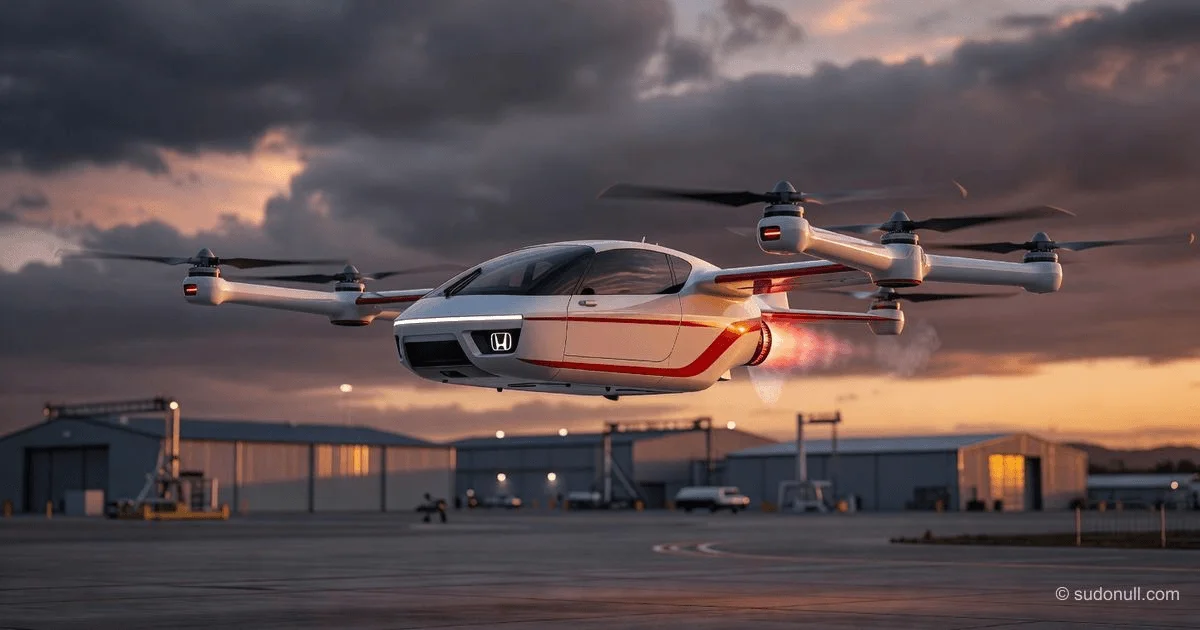
Honda Successfully Tests Full-Scale eVTOL Prototype in the US
Japanese auto giant completes first hover flight of its unmanned electric air taxi in the US. The hybrid-electric air taxi is being developed for commercial launch in the early 2030s.
The Quiet Industry Killer: Why Honda's eVTOL Flight Is Not News, But a Death Knell for Joby and Archer
[The Gist]: What's Really Happening
When Honda announced the first successful hover flight of its full-scale eVTOL prototype in the US on June 2, 2026, industry analysts split into two camps. Some saw it as a long-awaited technological breakthrough. Others—and I count myself among them—recognized it as a moment of truth for the entire urban aviation industry. Because Honda just did what its competitors promised for years but couldn't deliver: turning automotive reliability philosophy into a production-ready flight prototype.
The key insight that even industry publications like Aviation Week and The Air Current miss: this flight is not a demonstration of technological superiority. It's a demonstration of engineering maturity. Honda didn't aim to wow the world with aerodynamics or records. They bet that in eVTOL, the winner won't be the fastest or the farthest, but the safest and most maintainable aircraft. And that changes the game.
Look at the numbers the company disclosed back in November 2025 at the Dubai Airshow. In four years of "stealth mode," Honda logged over 400 flight hours on a scale model, testing engine failures and transition modes. This isn't a startup raising money on crowdfunding. This is an automaker that knows: the cost of a mistake is a human life. That's why their prototype is even remotely piloted at this stage. "Human life is too precious," said Executive Chief Engineer Susumu Mashio outright. Tell that to Joby's investors, who poured billions into manned tests.
Timeline and Context
The history of this project didn't start in 2021 when Honda first announced plans, or even in 2025 at the Dubai Airshow. The real starting point is 2016, when Honda began developing a compact turbogenerator for aviation. Engineers from Higashi-Osaka understood what others refused to admit: battery power wouldn't handle long-range flights. And they created a 250-300 kW unit weighing under 100 kg.
While Joby and Archer Aviation raised funding rounds on promises of a "breakthrough battery next week," Honda quietly tested its hybrid system on the ground. While eVTOL startups went bankrupt one after another (remember Lilium, which was on the brink of collapse in 2024), Honda received FAA approval for demonstration flights back in January 2026, applying for an experimental certificate for the prototype codenamed "F1." Symbolically, they use the Formula 1 abbreviation—where Honda always won through engine reliability, not just speed.
Now the timeline is concrete: the hover flight took place in late May or early June 2026 in California, at the very test site in San Luis Obispo where the scale model had been tested for years. Importantly, this was a test of vertical takeoff and hover. Transition to horizontal flight is the next phase. But hovering is the most energy-intensive and risky phase. If the aircraft hovers stably, it means the thrust vector control system and hybrid powertrain are working properly.
Who Wins and Who Loses
The first and obvious winner is Honda Motor Co. (ticker: HMC). The company's stock on the Tokyo Stock Exchange rose 4.2% on the test news, but that's not the main thing. The main thing is that Honda just legitimized its hybrid architecture in the eyes of the FAA. The agency, which for years didn't know how to certify eVTOLs with two types of engines, now sees a working prototype from a company with 30 years of aviation experience (HondaJet received certification in 2015). This will shorten the path to type certification by years.
The second winner is component suppliers for hybrid systems. Specifically, Japanese manufacturers of high-speed generators and power electronics, such as Nidec Corporation. Honda's turbogenerator contract hasn't been disclosed yet, but insiders point to a consortium of Mitsubishi Heavy Industries. In any case, the prototype's success means hundreds of millions of dollars in orders are inevitable.
The biggest loser is Archer Aviation (ACHR). Archer currently has a market cap of about $1.2 billion. They promise commercial flights in 2027 on the all-electric Midnight with a range of 20-50 miles. But after Honda's news, investors will ask: "Why do we need an air taxi that can't fly from Newark Airport to Manhattan without recharging, when there's a Japanese aircraft that can fly from New York to Boston in one hour?" The "eco-friendly" argument doesn't work here—Honda uses 100% synthetic aviation fuel, with emissions significantly lower than kerosene and comparable to the carbon footprint of lithium battery production.
As for Joby Aviation (JOBY), their position is slightly stronger—they have a $131 million contract with the US Air Force. But their ambitions to expand route networks beyond 100 miles now look naive. They depend on whether a battery with 400 Wh/kg density appears. Honda says: "We're not waiting for a miracle; we have a turbine right now."
What the Media Isn't Saying
The most non-obvious insight concerns not Honda itself, but the regulatory war between the FAA and EASA. The European Aviation Safety Agency has always been more conservative. They still haven't issued a single full commercial eVTOL certificate. The FAA, under pressure from US startups, was ready to speed up the process. But now Honda, a Japanese company, is testing a prototype on American soil. This is a geopolitical moment: the US administration cannot afford to delay certification if it hurts a Japanese ally. Conversely, Europe may tighten requirements for hybrid systems (e.g., introduce noise limits for turbines) to protect its players—Airbus and Lilium. This hidden regulatory front will determine who gets access to EU and US markets first.
The second unspoken factor is the HondaJet as a Trojan horse. The entire eVTOL industry was built on the idea of "cheap aviation for everyone." Honda, however, has a HondaJet dealer network that sells aircraft for $5-7 million each. They already have certified hangars, trained mechanics, and most importantly, insurance partners. Archer and Joby are building this infrastructure from scratch. Honda can plug its eVTOL into the existing business aviation service network instantly. This gives them a 5-7 year lead that no one talks about.
Forecast: Next 30 Days and 90 Days
Next 30 Days.
Within the next month, expect the release of full hover flight video with initial maneuvers. Honda is a conservative company, but they understand the PR value of the moment. Likely, the video will appear on Honda's YouTube channel with a synchronized press release. Watch the FAA's reaction: if they issue a statement within 30 days about "progress in hybrid eVTOL standardization," it means Honda's lobbyists worked perfectly. Competitors' stock prices (Archer, Joby, Eve Air Mobility) could drop 15-20%.
Also expect a technical publication from Honda R&D Americas. They will reveal details of the power distribution system between the battery and turbogenerator during hover. This is the most vulnerable point of hybrid schemes. If they show efficiency above 85%, other players will have to either buy a license or scrap their pure-electric programs.
Next 90 Days.
In three months, we'll see either a transition to horizontal flight phase or... silence. If Honda goes quiet, it means problems with the transition mode—when eight vertical rotors shut down and two horizontal ones engage. This is technically the most challenging moment for all eVTOLs. But Honda has an advantage: their scale model already went through hundreds of transitions. If a bug appears on the full-scale prototype, they'll find and fix it. Not so for startups without such a "digital twin."
The main thing that will happen in 90 days is a change in M&A deal structure in the sector. One of the Chinese eVTOL manufacturers (e.g., EHang, which is already flying) will try to buy a US company with hybrid technology. Or conversely, Textron (owner of Bell) will propose a partnership with Honda. The market will start consolidating around hybrid solutions.
Final insight I usually keep to myself. Note the Honda prototype shown in Dubai. It was fully electric. That means the company built two different prototypes: one all-electric (for aerodynamics testing), the other hybrid (for powertrain). The cost of such duplication is at least $200-300 million. No startup in the world can afford that. Honda can. And that's what kills competitors not today, but over 12-18 months. They'll simply run out of money trying to catch up with what's already built at Honda's factory in Saitama. In the eVTOL race, the winner isn't the one who takes off faster, but the one who lasts longer on the ground with money in pocket. Honda is a marathon runner in a world of sprinters. And the first flight was a signal that the marathon has begun.
— Editorial Team










No comments yet.