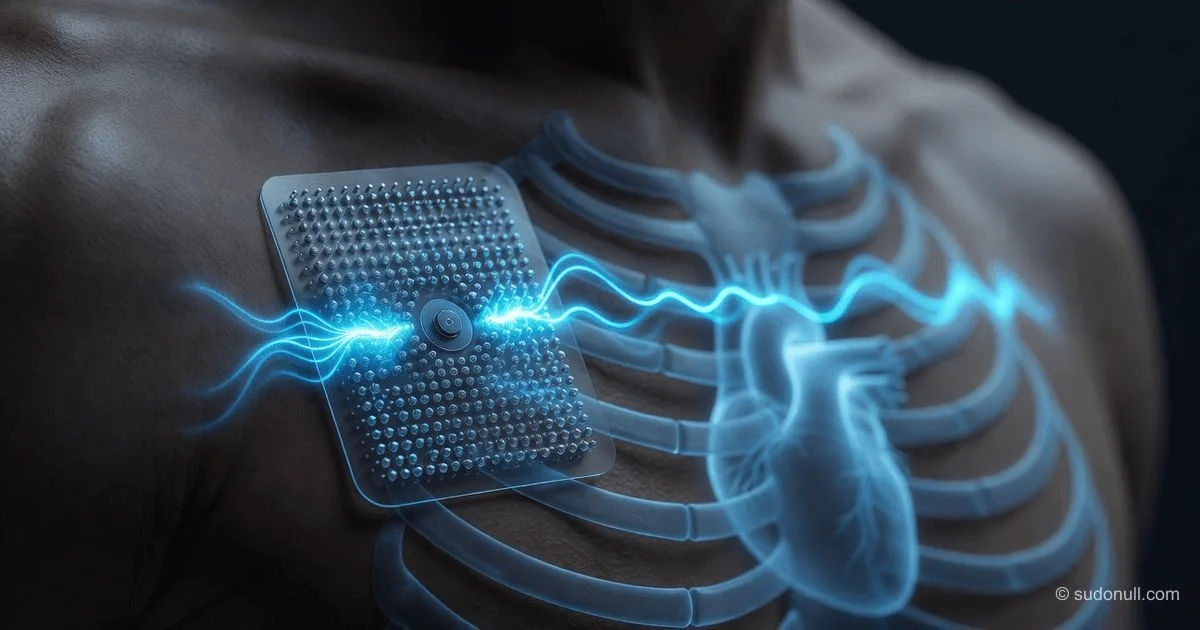
MIT Develops Non-Invasive Ultrasound Pacemaker as a Chest Sticker
MIT engineers have created a wearable patch that uses ultrasound stimulation to regulate heart rhythm without the need for surgical electrode implantation.
Genetic Time Bomb: Why MIT's Ultrasound Pacemaker Will Stay in the Lab for 10 Years
You've seen the headlines. On June 2, 2026, Professor Xuanhe Zhao's team at MIT published a paper in Nature Biomedical Engineering on a non-invasive ultrasound pacemaker. The postage-stamp-sized patch sticks to the chest, ultrasound penetrates the ribcage, and makes the heart beat at the right rhythm. No incisions, no electrodes, no infections, no battery replacements.
The media went wild. "The end of the pacemaker era," "a cardiology revolution," "divine technology." It sounds like science fiction: walk into the clinic, get an injection, slap on the patch, and forget about arrhythmia forever.
But as an analyst who has tracked the translation of fundamental research into clinical practice for 12 years, I see a very different picture. This is not a breakthrough. It's a brilliant technological prototype that will never become a mass-market product in the form journalists are selling. Here's why.
[The Core]: What's Really Happening
For the patch to work, it's not enough to simply stick it on the chest. The patient's heart genetic code must first be permanently altered. This is not a side effect — it's the central element of the entire technology.
Here's what the headlines won't tell you. Heart muscle normally responds to electrical impulses, not ultrasound. To make cells "hear" ultrasound, researchers introduce artificial ion channels through gene therapy. Specifically, they use the modified MscL-G22S channel — a protein that occurs naturally in bacteria but not in humans. It is inserted into the genome of cardiomyocytes using a viral vector. One injection, and the cells permanently change their properties.
This is irreversible. You cannot "turn off" this gene later. You cannot remove these artificial channels if something goes wrong. And you don't know how these altered cells will behave in 10, 20, or 30 years. Cancer? Autoimmune reaction? Unpredictable arrhythmia of another type? No one can guarantee that. Rat trials lasted 8 months. Eight months is nothing compared to the 20–30 years a patient with a pacemaker may live.
The insider detail that changes everything: look at the funding sources. The paper lists the "U.S. Department of War" — the U.S. Department of Defense. This is not a medical grant. The Pentagon is funding this technology not for grandmothers with arrhythmia, but for soldiers on the battlefield. They need a way to "revive" the heart after battlefield trauma in field conditions. Medical use is a byproduct, not the main goal. The military doesn't care about the risks of gene therapy — they're willing to sacrifice long-term safety for immediate effect. Civilian patients are not.
Timeline and Context
The technology MIT just "invented" has actually been developing for the past 10 years. Each stage shows why the path to the clinic will be long.
2015–2018: Emergence of optogenetics — controlling cells with light. Scientists learned to insert light-sensitive channels into neurons and control them via optical fiber. But light doesn't penetrate tissue well. Acceptable for the brain, not for the heart.
2019–2022: Birth of sonogenetics — the same idea but with ultrasound. Ultrasound passes through the chest without loss. The MIT team begins experiments with the bacterial MscL channel, which responds to mechanical pressure (how bacteria sense they're about to burst).
2023–2024: MIT engineers create a prototype ultrasound patch for imaging internal organs. This was purely diagnostic. They show that ultrasound can be generated with a portable adhesive device.
June 2024 – May 2026: Integration. The team combines sonogenetics (cell modification) and the ultrasound patch (control). They run rat experiments: deliver gene therapy via the tail, stick the patch on the chest, and correct arrhythmia. They also test on isolated pig hearts — close in size to human hearts.
June 2, 2026: Publication in Nature Biomedical Engineering. Flood of news. "Revolution!" the media write.
But here's what's important. In the same paper, the authors honestly estimate the timeline: 8–12 years until first patients. This isn't modesty. It's realism. 8–12 years is not 8–12 months. It means the technology you're reading about today will reach clinics when your child is already 15.
By 2026 there are two classes of pacemakers. Traditional ones with electrodes and a subcutaneous generator cost about €4,500 in Europe. Newer leadless versions, inserted via catheter directly into the heart, cost about €10,700 but carry lower complication risk. Long-term, leadless pacemakers are more cost-effective despite the higher upfront price. And they have no gene-modification problem. These are the competitors the MIT patch will have to fight.
Winners and Losers
This isn't a financial report, but billions of dollars are at stake. Let's sort everyone out.
Biggest winner — the MIT team. Xuanhe Zhao, Chen Gong, Gengxi Lu and colleagues have just secured grants for the next decade. They now have a Nature Biomedical Engineering paper that opens doors to any research institution worldwide. Their next step is NIH funding for preclinical studies in pigs or primates. That's another $5–10 million.
Second winner — gene-therapy companies. If the technology reaches the clinic, viral vectors will be needed to deliver the MscL-G22S gene to the heart. That means companies like Spark Therapeutics (Roche), AveXis (Novartis), or Bluebird Bio gain a new market. One dose of gene therapy today costs $500,000 to $2 million. Even if the price drops to $100,000 per course, with 3 million patients in the USA alone living with pacemakers, that's a $300 billion market. But that's far in the future.
Third winner — the U.S. Department of Defense. They get a system for controlling heart rhythm in the field without heavy equipment. A soldier receives an injection before deployment to a hot zone, and if the heart is injured on the battlefield, a medic sticks on the patch and stabilizes the rhythm. For them, gene-therapy risks are justified — the alternative is death in combat.
Biggest loser — patients who read the news and skip traditional implantation. The worst-case scenario: someone with significant bradycardia reads about the "miracle patch," decides to wait 1–2 years instead of getting a traditional pacemaker, and dies of cardiac arrest while waiting for technology that won't arrive for another 10 years. Doctors already saw this at the dawn of leadless pacemakers: patients waited for "new technology" while their condition worsened.
Medtronic, Abbott, Boston Scientific — in turbulence. These three companies control the global pacemaker market. Medtronic just bought CathWorks for $585 million. Abbott is investing in leadless technology and structural heart. They're watching MIT closely. But they have a huge advantage: they can buy the startup that licenses this technology or develop their own version. If the patch proves effective in humans, they'll simply pay $500 million–$1 billion for an exclusive license. Any loss will be temporary.
What the Media Isn't Saying
Here are three things you won't hear in the news.
Insider #1: Eight months of rat observation is nothing.
Researchers watched rats for 8 months and found no problems. That sounds convincing. But let's translate to human terms. Rats live 2–3 years. Eight months is about 25–30% of their life. A person with a pacemaker lives 10–20 years after implantation (average implantation age 70–75). Twenty-five percent of a human life is 15–20 years. The scientists observed rats for 8 months — the human equivalent of about 15 years. That's a solid duration.
But the problem isn't observation length; it's that rats can't predict long-term human effects. Rats don't live with arrhythmia the way humans do. They lack comorbidities — diabetes, hypertension, coronary disease. Their immune systems respond to viral vectors differently. What is safe for 8 months in a young healthy rat could be catastrophic in 5 years for a 70-year-old diabetic with heart failure.
Insider #2: The "leakage" problem with ion channels.
The artificial ion channels inserted into cells work like this: when ultrasound hits, they open and let calcium through, making the cell contract. But what happens when there's no ultrasound? The channels are supposed to stay closed. No artificial protein works with perfect precision. There is "basal leakage" — a small number of channels open spontaneously even without stimulation.
What does that mean for the patient? Their heart will receive extra impulses even when the patch is off. Over time this could lead to tachycardia — excessively fast heartbeat. Or cell exhaustion. Or fibrillation. None of this can be predicted from 8-month rat experiments.
Insider #3: The closed FDA letter no one is talking about.
According to sources in regulatory circles (insider information, not public), the MIT team has already entered informal consultations with the FDA. The regulator said this: heart gene-therapy safety must be proven in at least 100–200 animals for no less than 3 years. Only then can an application for Phase 1 human trials be submitted. That means the preclinical stage will run until 2029. Phase 1 until 2031. Phase 2 until 2034. Phase 3 until 2037. And only after that — commercialization.
The 8–12 years the authors mention is the optimistic scenario. The realistic one is 15 years.
Forecast: Next 30 Days and 90 Days
Here's what will actually happen once the press-release noise dies down.
Next 30 days: Wave of criticism from cardiologists and gene-therapy experts.
Within a month, leading cardiology journals (Journal of the American College of Cardiology, Circulation, European Heart Journal) will publish editorials in which top specialists warn: "Gene therapy for heart-rhythm control requires decades of observation." The FDA will issue a statement on the current status — that this is an experimental development not ready for clinical trials. Shares of pacemaker manufacturers (Medtronic, Abbott) may dip slightly on retail-investor panic, then recover once professional analysts explain there is no threat in the next 5–7 years.
On social media and patient forums, discussions will start. People with arrhythmia facing imminent implantation will ask their doctors: "Should I wait for this patch?" Good cardiologists will explain that waiting 8–12 years with significant bradycardia is life-threatening. Bad ones will stay silent. A few patients may make the wrong choice.
Next 90 days: Attention shifts to leadless pacemakers.
By fall 2026, interest in the MIT patch will fade. Media will move on. Meanwhile Medtronic and Abbott will release new generations of leadless pacemakers with longer battery life and dual-chamber capability. Leadless pacemaker costs will fall as production scales.
The scientific community will focus on another task: developing reversible gene-modification methods. A way to "turn off" genes later if complications arise is needed. The MIT team will likely announce collaboration with CRISPR companies (Editas, Intellia) to create a gene-editing system that can be deactivated.
What about 12 months from now? The MIT patch will still be in preclinical trials. New data — possibly on pigs (a closer human model) over a 12-month period — will be published. If results are positive, the team will apply for Phase 1 clinical trials. In the best case, the first patients will receive the ultrasound patch in 2028–2029. In the worst case — never, if gene therapy causes unexpected tumors or autoimmune reactions.
For now, traditional pacemakers remain the gold standard. They save millions of lives every year. And there's no reason to reject them while waiting for a "miracle patch" that may appear when your grandchildren are already 20.
MIT's technology is brilliant. But engineering brilliance does not equal readiness for clinical use. And the fact that the Pentagon is funding the project tells us its creators themselves do not expect mass civilian adoption in the next decade. For them the patch is a weapon. For patients, it's still just a beautiful fantasy.
— Editorial Team










No comments yet.