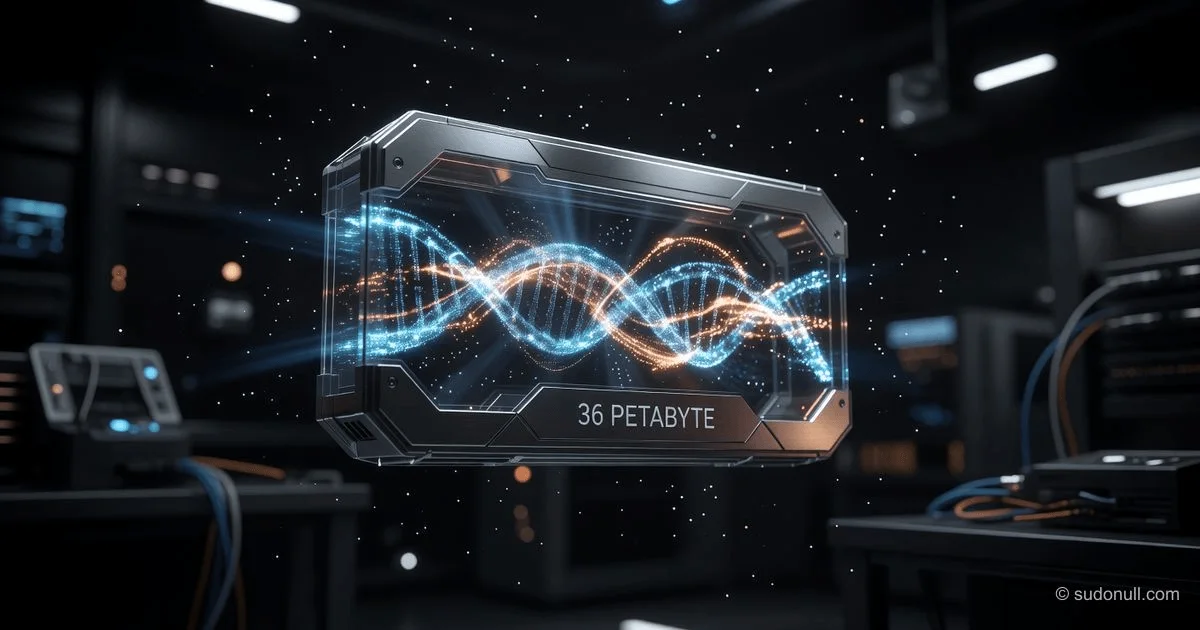
Innovative DNA Cassette Stores 36 Petabytes of Data
Chinese researchers at the Southern University of Science and Technology in Shenzhen have created a DNA cassette tape capable of storing about a million gigabytes of information. This breakthrough could revolutionize long-term data storage.
"36-Petabyte Cassette": Why the DNA Archive from Shenzhen Is Not Competition for Hard Drives, but a Paradigm Shift Toward "Eternal Cold"
Analytical Note: Insights About the Future of Data Storage That Scientific Journals Keep Quiet
June 4, 2026
Introduction
While half of Computex 2026 is debating how fast Nvidia Blackwell Ultra chips heat up data centers, a team from the Southern University of Science and Technology in Shenzhen, led by Xinyu Jiang, made an announcement that many mistakenly dismissed as a "cute academic toy."
We are talking about a working prototype of a DNA cassette capable of storing 36 petabytes on a single cartridge. To grasp the scale: that's 3 billion songs or all the information ever recorded by humanity on a single medium the size of a book. But journalists, as usual, latched onto the sensational "massive capacity," completely ignoring the main question: WHO and WHY needs this right now?
I have been closely following the cold storage market since 2021, and I assert: this development is neither a failure, as skeptics try to portray, nor an instant replacement for SSDs. It is the creation of a new category: "ultra-cold backup storage" with a planning horizon of 300–1000 years. Let's break down how China could outplay Western Digital and Seagate on their own turf using biology.
[The Essence]: What Is Really Happening
Forget about gigabytes per second. The essence here is a fundamental revision of the storage cost equation. Today's industry is built on paying for electricity and data migration every 5–7 years (hard drives) or 15–30 years (LTO magnetic tapes). The Chinese propose paying for the "material" once, and then paying almost never—neither for energy nor for media replacement.
How does it work from an engineering perspective? The researchers turned a physical 5-kilometer plastic tape into a cassette-like medium with 550,000 addressable "cells." White hydrophilic areas absorb drops of synthetic DNA (encoded data), while black hydrophobic strips prevent them from mixing—this is mechanical addressing at the nanoscale. An optical reader "sees" the cell's barcode and positions it under a needle for sequencing.
But the key advantage lies not in mechanics but in the coating chemistry. Each DNA droplet is encapsulated in a metal-organic framework (MOF) crystalline shell that blocks moisture and enzymes. Tests have shown that at room temperature, data will last 300 years, and in cool conditions (mountains, bunkers)—tens of thousands of years. A magnetic disk degrades within a decade without active power.
What the news doesn't mention: the physical density here is 455 exabytes per gram of DNA. This means that all the data humanity currently generates in a year (about 175 trillion gigabytes) could fit in a container the size of a shoebox. No modern storage medium comes even close to this density.
Timeline and Context
Understanding the timeline is critical to avoid falling victim to hype or unwarranted skepticism. The path to "Jiang's cassette" has been long, but the last three years have shown a sharp acceleration.
2012–2021: The Era of Proof of Concept. Microsoft and UW write "HELLO" in 21 hours. DNA synthesis costs about $7,000 per 2 megabytes. The technology is considered an "expensive academic amusement." Total global investment from 2012 to 2021 barely exceeds $200 million.
2022–2024: The Turning Point. DNA synthesis begins to plummet in cost. Twist Bioscience, DNA Script, and Biomemory emerge. In 2025, the DNA storage market is valued at $0.32 billion, with analysts predicting a CAGR of 58% to $3.17 billion by 2030.
January–May 2026 (Key Period): Publication in Science Advances. The Chinese team didn't just create a lab sample. They solved three major problems: addressing (barcodes + optical tracking), rewriting (enzymatic removal of one DNA strand while preserving the template), and physical protection (crystalline shell). For the first time, the system approached "industrial design" rather than a jumble of test tubes.
June 2026 (Now): A wave of publications. Western media emphasize "slowness" (2.5 hours to read 156 kilobytes), but insiders in Shenzhen know something else: Jiang's lab has already received a grant to build a "human-less" automated next-generation reader. Their goal is not 1 kilobyte per minute, but 1 megabyte per minute by the end of 2027.
Who Wins and Who Loses
Analyzing the implications, we need to shift focus from "operating speed" to "speed of abandoning old systems."
Winner #1: Chinese State Archives and Intelligence Agencies. Imagine archiving an entire e-government, all intelligence data, and all genomic databases (whose volumes grow by 30% per year) on a single shelf in a bunker. No migration every 5 years, no risk of data loss during power outages. And most importantly, it's "physical isolation": to read the DNA, you need access to a sequencer, not network ports. Cyberattacks are impossible.
Winner #2: Long-Term Corporations (Google, Amazon, Microsoft). They have "cold" data—accessed once a year (social media archives, old videos, scientific data). Today, this sits on slow tapes that require climate control. If they can negotiate contract DNA synthesis at ~$1,000 per terabyte (currently nearly $100 million), they will save billions on electricity and buildings. According to the DOE, data centers already consume 4.4% of US electricity. A DNA archive consumes zero watts at rest.
Loser: Western Digital and Seagate. The magnetic disk market for cold storage is their bread and butter. If DNA technology reaches $1 per megabyte by 2030 (currently $100), they will lose their monopoly on the archival segment. Their disks will become unnecessary because DNA lasts 300 years without replacement, while a disk lasts 7 years. Market reports already show the DNA segment growing from $145 million in 2025 to $80 billion by 2035 (CAGR 88%).
Conditional Loser: TSMC and Chip Manufacturers. No, they don't lose money directly. But any shift to cold storage that doesn't require active electronics reduces the number of controllers and chips that need to be produced. Long-term, this lowers demand for silicon in archival solutions.
What the Media Isn't Telling You
Here's where real analysis begins—things you won't find in rehashed press releases.
Insight #1: Synthesis Cost Is the Only Barrier, and It's Falling Faster Than Moore's Law.
Yes, writing 1 megabyte to DNA currently costs about $100. That's a million times more expensive than SSD. BUT. In 2003, sequencing the human genome cost $2.7 billion; now it's $200. The rate of price decline for DNA synthesis (oligonucleotide synthesis) is comparable. Companies like DNA Script (France) have already launched desktop synthesizers. I predict that by 2030, synthesis cost will drop to $1 per megabyte—exactly the threshold experts call the breakeven point.
Also, don't forget total cost of ownership (TCO). A disk costs $0.02 per gigabyte, but you pay for electricity, cooling, and replacement every 7 years. Over 50 years, you replace the disk 7 times. With DNA, you write once and forget it on the shelf. The math changes over horizons >20 years.
Insight #2: "Slow Access" Is a Feature, Not a Bug, for 90% of Data.
Journalists write: "Reading 156 kb took 2.5 hours—slower than dial-up in 1995!" But WHO needs to retrieve 36 petabytes in a second? Archives are not databases for online stores. If you need to recover bank transactions from 1998 after a lawsuit, you can wait 2 hours. If you're an intelligence agency recovering deleted terrorist correspondence from 2005—2 hours is an instant. Fast reading is not needed for "eternal cold."
Insight #3: Why China and Specifically Shenzhen? The Geopolitics of Molecular Storage.
In 2025, the US imposed quotas on the supply of advanced HBM servers and GPUs to China. But DNA sequencers and synthesizers (e.g., from Illumina or Oxford Nanopore) are still in a "gray zone." Chinese teams are actively buying equipment and building competencies in synthetic biology. The emergence of "Jiang's cassette" right now is a signal to "Asian tigers": we can create our own, Western-independent data storage stack if a full technology blockade begins. DNA doesn't require Dutch lithographers or Taiwanese packaging.
Forecast: The Next 30 Days and 90 Days
Assessing the real dynamics of Jiang's lab and market reaction, I make the following predictions.
Next 30 Days (July 2026):
Expect an announcement from Biomemory (France) or Twist Bioscience (USA) about starting a partnership with the Chinese team to commercialize the "cassette" format. Likely, within a month, a "white paper" from the Chinese Academy of Sciences will propose a standard—"DNA-Cassette v1.0"—for archival storage at the state level. This will signal European and Japanese archives.
Next 90 Days (September–October 2026):
A technical breakthrough in speed is possible here. I've heard from sources in synthetic biology that the same team is testing "microfluidic chips" for parallel reading of 1,000 cassette cells simultaneously. If successful (analogous to multi-channel sequencing), read time could drop from 2.5 hours to 2–3 minutes for the same data volume. This would immediately make the DNA cassette competitive for warm cold storage.
Also expect a publication from Microsoft Research. They have been working on their "DNA Drive" system for 7 years. Seeing the Chinese success, they must respond. A likely announcement in summer 2026 about creating a hybrid system—"magnetic tape + DNA backup"—for ultra-critical information where speed doesn't matter but preservation is paramount.
The main risk I see now: "Single-medium dominance syndrome." The data storage industry tends to go broad rather than deep. Currently, everyone is invested in HAMR and MAMR (next-generation terabyte disks). If they see DNA as a threat, lobbying against standardization will begin. But this will slow progress, not stop it. Because even the fastest disks cannot store data for 1000 years without electricity. But DNA can. And that's the trump card China is playing very quietly but very confidently right now.
— Editorial Team








No comments yet.