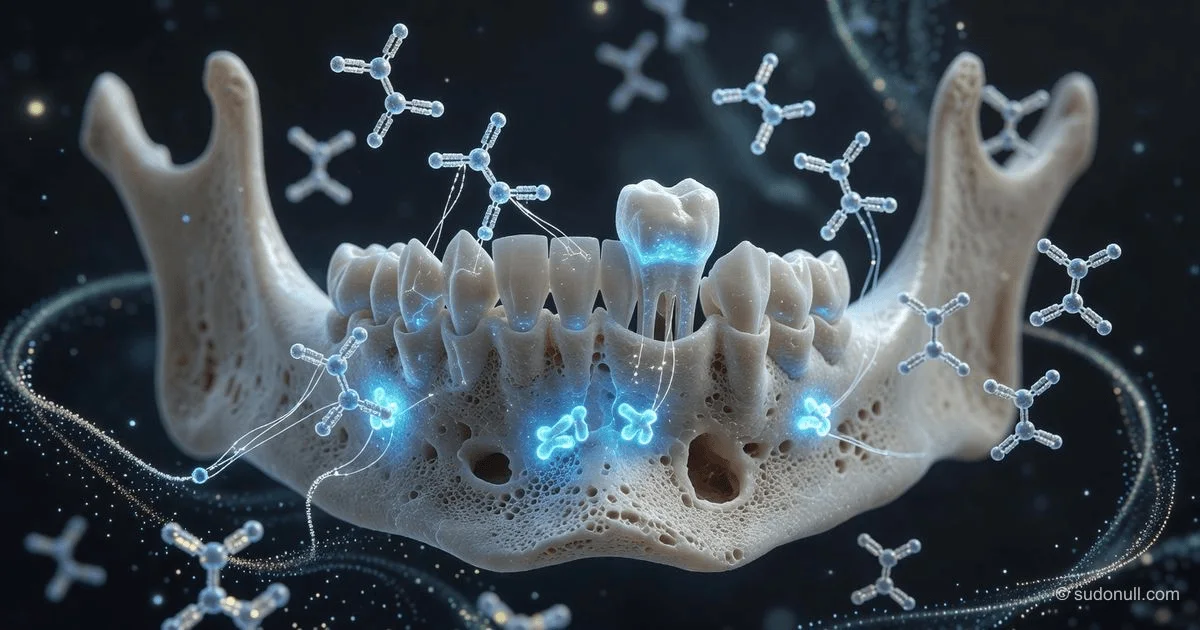
Japanese Startup Begins Trials of Drug for Growing New Teeth
Biotech company Toregem BioPharma from Japan has announced the start of clinical trials for TRG035, a drug that can stimulate the growth of new teeth in humans. If successful, the therapy could become an alternative to implants.
'Third Teeth' from a Test Tube: Why Toregem's TRG035 Is Not Dentistry but a Paradigm Shift in Regenerative Medicine
Analytical Note: The Insights Hidden Behind the 'Tooth Injection' Announcement
June 4, 2026
Introduction
While global media headlines are buzzing with news about the latest quantum chips and 'Nvidia killers,' a quiet event in Kyoto has occurred that I consider the most underrated technological breakthrough of the year. Japanese startup Toregem BioPharma has announced the start of Phase II clinical trials for TRG035—an antibody that prompts the body to grow new teeth in place of lost ones.
If you think this is just 'another dental innovation,' you are as mistaken as those who called CRISPR 'an interesting academic experiment' in 2010. Toregem is not offering an alternative to implants—it is offering a fundamentally new concept: 'molecular surgery' instead of mechanical repair of the body. This is the first time in history that a monoclonal antibody is used to reactivate embryonic growth programs in an adult human.
I have been closely following the Japanese biotech scene since 2022, and I must say: what is happening in the laboratories of Kyoto University deserves far more attention than it gets. Let's break down why the $5.3 million funding announced recently is just the tip of the iceberg, and what forces are actually behind the 'tooth revolution.'
[The Core]: What Is Really Happening
Forget about teeth for a moment. The essence here is a fundamental shift in treatment philosophy: we are moving from prosthetics to regeneration. An implant is a foreign body (a titanium screw) that the body never fully accepts, only tolerates. TRG035 is a biological 'key' that disables the genetic brake preventing us from growing endless sets of teeth, like sharks.
The underlying mechanism was discovered back in 2007 by Dr. Katsu Takahashi from Kyoto University. He identified the protein USAG-1 (Uterine Sensitization-Associated Gene-1), which in mammals suppresses the growth of a third set of teeth. It turns out that in our jaws, 'tooth germs' lie dormant throughout life, ready to develop into full teeth. Nature simply placed a lock on them. TRG035 is a humanized anti-USAG-1 antibody that removes this lock.
Why is this brilliant? Modern tissue engineering has tried to grow teeth by seeding stem cells onto scaffolds. This is expensive, complex, and risky (tumors, immune response). The TRG035 antibody is a 'cell-free molecular therapy.' You simply inject the drug, it travels through the bloodstream, finds the right receptors in the jaw, and turns off the 'stop' mechanism. The body does everything itself. It's like not rebuilding a house from scratch but just flipping a switch in an existing but de-energized substation.
A key point often overlooked: the drug is initially aimed at treating congenital anodontia (absence of 6 or more teeth from birth). This is a rare disease (about 0.1% of the population), but it served as a 'Trojan horse' for regulators. The Japanese Ministry of Health granted TRG035 orphan drug status, providing accelerated reviews, tax breaks, and government grants. This is a clever legal maneuver: bring the technology to market through the 'loophole' for orphan diseases, then scale it to the mass market—ordinary tooth loss due to cavities or trauma.
Timeline and Context
The history of TRG035 spans nearly two decades—this is not hype but the result of long and painstaking science. Understanding the chronology is critical for risk assessment: we are not at the starting line but already on the home stretch.
- 2007: Takahashi's team first publishes work showing that mice with a knocked-out USAG-1 gene grow extra teeth. This was a purely academic curiosity—no one believed in clinical application.
- 2020: Toregem is officially founded in Kyoto. CEO is Honoka Kiso, a young ambitious entrepreneur who risked everything for this technology.
- 2021: Key experiment on ferrets. These animals have a dental system closest to humans. They were injected with the antibody—and new teeth grew in place of extracted ones. This experiment made pharma giants take notice of the startup.
- 2022: Collaboration with Chinese giant WuXi Biologics for antibody manufacturing technology (CMC). This was a pragmatic step: Toregem has no own factories and needed a powerful contract manufacturer to scale the process.
- 2024: Launch of Phase I on 30 adult men. Goal: safety only, not efficacy.
- June 2026 (now): Completion of Phase I (safety data apparently good) and announcement of a Pre-Series C round of $5.3 million. Cumulative funding (including AMED grants) exceeds $29 million. Launch of Phase II, which will be conducted on children (2-7 years old) with congenital anodontia.
Note the speed: less than two years between Phase I and II. Such a pace is impossible in the US. Japan has created ideal regulatory conditions for regenerative medicine, and Toregem is using them 100%.
Who Wins and Who Loses
When analyzing such a breakthrough, you always need to see whose business models it destroys and whose it creates.
Winner #1: Children with congenital anodontia. These are the obvious beneficiaries. Previously, a child missing half a dozen teeth had no options other than ugly removable dentures that hinder jaw growth and cause psychological trauma. TRG035 gives them a chance to grow their own real teeth in childhood.
Winner #2: The Japanese biotech ecosystem. The state agency AMED (Agency for Medical Research and Development) has received confirmation that its strategy works. This will attract new investments into other regenerative projects (liver, skin, cartilage). The venture fund JIC Venture Growth Investments, which just invested in the round, already considers this deal its flagship case.
Loser: The global dental implant market ($5.65 billion in 2026). Yes, for now TRG035 only threatens a niche (congenital anodontia and possibly extracted wisdom teeth). But everyone sees which way the wind blows. If the drug reaches the mass market in 2031 (tooth loss in the elderly), demand for titanium screws will collapse. Companies like Straumann and Dentsply Sirona must diversify now, or they will face Kodak's fate.
Loser: Traditional orthodontics and prosthetics. Braces and crowns are crutches. TRG035 treats the cause. Of course, a tooth won't grow perfectly straight on its own, but the very concept of 'replacing parts' is becoming obsolete.
What the Media Isn't Saying
Now—what you won't be told in press releases and popular science articles.
Insight #1: The problem of oncogenicity hasn't gone away.
Yes, it's officially stated that everything is safe in animals. But disabling the USAG-1 gene affects BMP and Wnt signaling pathways. And Wnt is one of the main regulators of cell division, which when hyperactivated can lead to colon cancer and other neoplasms. Toregem claims their antibody acts locally, only in the jaw. But Phase I had no long-term follow-up (11 months) to rule out distant effects. Imagine that 10 years later, a patient who 'grew' a tooth at age 7 is found to have a liver tumor caused by systemic antibody exposure. This is the 'black swan' no one talks about openly at conferences but is discussed behind the scenes.
Insight #2: The drug is not for the elderly (yet, technically).
All enthusiastic articles say: 'Finally, grandmothers can grow teeth.' Don't be fooled. The current protocol is designed for children aged 2-7. In adults, 'tooth germs' atrophy or ossify (ankylosis) with age. For the antibody to work, there must be something alive there. Likely, adults will first need surgical 'refreshment' of the socket, initiating inflammation and stem cell influx, then the antibody injection. This is more expensive and complex than a simple shot. The mass market for the elderly is a horizon of 2035-2040, not earlier.
Insight #3: Price war with the state.
It is claimed that the drug price will be around 1.5 million yen (approximately $10,000 at current exchange rates). This is more expensive than a simple implant in Japan. But Toregem is lobbying for inclusion in the National Health Insurance (NHI) system. If that happens, the state will pay but will reduce the price to $3,000-4,000. Margins will drop. However, for the startup, this is a matter of survival: without insurance, no one can pay $10,000 out of pocket, even in wealthy Japan. Negotiations with MHLW (Ministry of Health) will be tougher than any clinical trial.
Forecast: Next 30 Days and 90 Days
Based on analysis of Japan's regulatory environment and financial signals, I make the following predictions.
Next 30 Days (July 2026):
Expect the official opening of patient enrollment at Kyoto University clinics. These will be children aged 2-7 with severe anodontia (absence of 6 or more teeth). I predict recruitment will take only a couple of weeks—parents of such children are desperate and will agree to anything. Also expect shares of Japanese biotech company Rohto Pharmaceutical (which has options for distribution in Asia) to rise 5-7% on expectations.
Next 90 Days (September-October 2026):
Two scenarios are possible here.
Scenario A (Positive): Early interim Phase II data show that 70% of children have started erupting new teeth within 3 months. This will trigger an avalanche of interest from Big Pharma. I've heard unconfirmed rumors that Novartis and Bayer already conducted due diligence on Toregem in early 2026. A deal to buy the startup for $500-800 million could be announced as early as fall. Toregem's founders would get their exit, and the technology would gain resources for global research.
Scenario B (Negative): Reports emerge of serious side effects—local angioedema, uncontrolled bone growth (exostoses), or worse, first suspicions of tissue dysplasia. In this case, shares will plummet 60%, but this will be temporary. The Japanese government won't let the project die—too much reputational and financial investment (AMED, JIC). They will allocate an emergency grant to fix the protocol.
The main risk I see now: Naivety of Western investors. Everyone sees tooth regeneration as a 'cute story.' In reality, this is a battlefield for standards of gene regulation. If TRG035 proves that 'genetic brakes' can be safely disabled locally, it will open the door to treating amputations (limb regeneration), heart scars, and even Alzheimer's (disabling neurogenesis brakes). Toregem is not a dentistry startup. It is a biblical sling that launches a stone capable of toppling the Goliath of conservative medicine.
— Editorial Team






No comments yet.