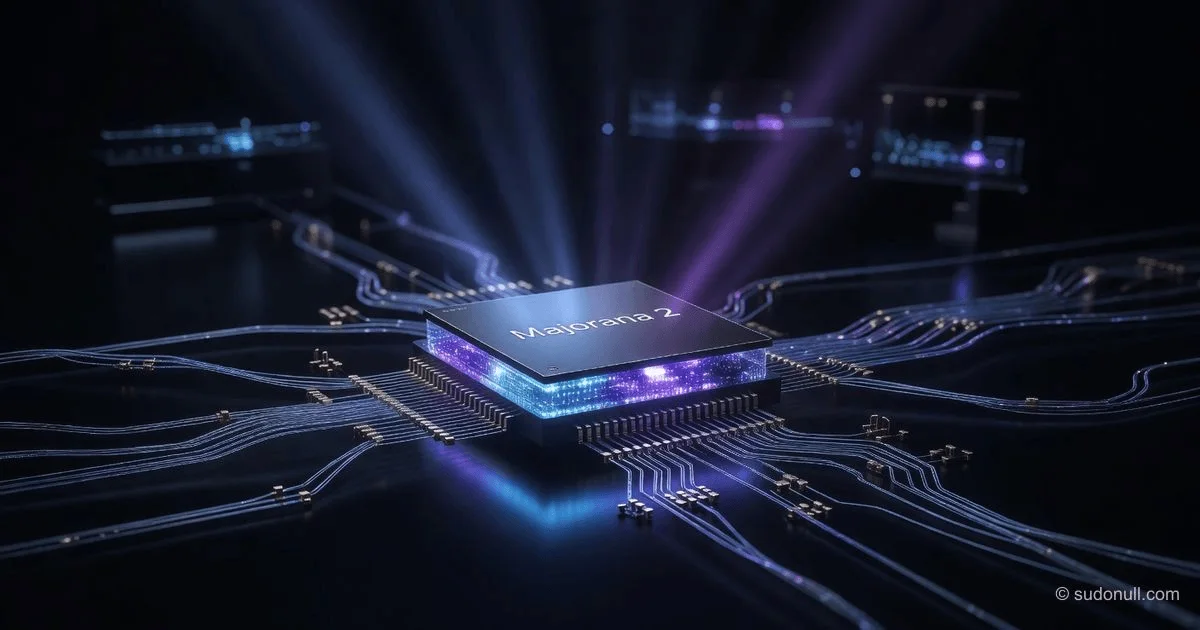
Microsoft Unveils Majorana 2 Quantum Chip, 1000x More Reliable Than Predecessor
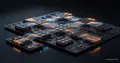
The new topological processor, built using Microsoft's AI platform Discovery, demonstrates qubit lifetimes of up to 20 seconds (in some cases, up to a minute). This has led the company to advance its timeline for a commercial quantum computer to 2029.
Headline: Inside Scoop: Microsoft's Majorana 2. A 1000x Leap That Rewrites the Rules of the Quantum Race
You may have read the headlines: "Microsoft created a quantum chip 1000x more reliable." It sounds like another flashy press release from Redmond. But if you rewind five years, you'll recall that Microsoft was the laughingstock of the quantum world. In 2021, they retracted a Nature paper, admitting their "discovery" of Majorana fermions was a mistake. Experts said the topological approach was a dead end, and Microsoft was just burning grants.
Today, June 5, 2026, the situation looks different. What Microsoft showed at the Build 2026 conference on June 2 is not just a new chip version. It's the moment when "quantum hype" turned into engineering reality, and it reshuffles the deck for IBM, Google, and the entire industry.
[The Essence]: What's Really Happening
The official story: Microsoft used the AI platform Discovery to replace aluminum with lead in the superconducting layer, boosting qubit lifetime from milliseconds to 20 seconds (and in some cases, up to a minute). That's the 1000x improvement.
But the real essence runs deeper. Microsoft didn't just make a "long-lived" qubit. They proved that the topological approach is not science fiction, but the only path to scaling without exponential error growth. Why is this critical? All competitors (Google, IBM, Chinese projects) are pursuing "raw qubit scaling." Google's Willow has 105 qubits, and they celebrate being "below the error threshold." But for real computation, millions of qubits are needed, and each new qubit requires an army of "ancilla qubits" for error correction.
Microsoft, through topological protection (the "knot in a rope" effect that cannot be undone by local disturbances), creates a qubit that is inherently more stable. This allows them to think not in terms of "how many qubits," but "how to connect them into an array." The Majorana 2 chip contains only 12 qubits, but Microsoft claims that on this architecture they will build a useful quantum computer by 2029 — twice as fast as their previous forecast.
What's the catch? 20 seconds of qubit lifetime is six orders of magnitude better than competitors (whose lifetimes are measured in microseconds and milliseconds). It's the difference between "we can do one operation before the qubit dies" and "we have a minute to perform complex calculations."
Timeline and Context
Microsoft's quantum history is 20 years of pain. They started first, declaring in 2005 that topological qubits were the Holy Grail. But for decades, they couldn't show a working prototype. In 2018, they published a Nature paper on "evidence of Majorana mode existence," and in 2021 they retracted it. The industry joke was: "Microsoft is the company whose quantum computer is always five years away."
The turning point came in February 2025 with the announcement of Majorana 1 — the first chip that proved topological conductors could be created. It was a "proof-of-concept" prototype: qubits lived 1-12 milliseconds. That was enough to say "we can," but not enough for commercialization.
Now, in June 2026, we see Majorana 2. The difference between generations is not cosmetic. Replacing aluminum with lead doubled the "topological gap" — the protective barrier that cuts off noise. And here, AI played a key role: Microsoft Discovery analyzed data from 20 years of experiments, modeled atomic structures, and proposed a solution that humans would unlikely have found in a reasonable time.
Important context: Microsoft was selected by DARPA for the final phase of the US2QC (Utility-Scale Quantum Computing) program. This means the U.S. defense agency is not just watching — it's verifying every Microsoft claim on a national security polygraph. And they confirmed: it works.
Who Wins and Who Loses
Winner #1: Microsoft. Obvious, but the scale of victory is not. Microsoft has transformed from an outsider with a tarnished reputation into a leader that IBM and Google fear. Their stock (MSFT) got a boost, but more importantly: Microsoft now dictates quantum error correction standards. This gives them a seat at the table where only IBM (with their transmon qubits) and Google (with superconducting qubits) sat before.
Winner #2: Nvidia. Paradoxically, yes. Microsoft made it clear: the future is hybrid systems where a quantum processing unit (QPU) works alongside CPU and GPU. Classical supercomputers are needed to manage quantum computations. Nvidia has no competitors in this niche. Every new QPU sells a few more racks of H100/B200.
Winner #3: European startups like Quobly ($115M Series A from STMicroelectronics). The Majorana breakthrough shows that "alternative architectures" can suddenly become mainstream. Investors who feared putting money into "weird" physics approaches are now opening their wallets.
Loser #1: IBM. IBM plans to spend $10 billion on quantum by 2029. They also promised to achieve "quantum advantage" by the end of 2026. IBM's problem: they are playing someone else's game. Their qubits require millions of error correction qubits. If Microsoft can scale 12 qubits to 1 million without exponential error growth, IBM will be left with expensive but useless hardware.
Loser #2: Google Willow. Willow is a brilliant engineering feat, but it belongs to the same class as IBM. Google tries to solve the error problem through software and redundancy. Microsoft solves it through materials physics. History teaches: physics always beats software in the long run.
Unexpected Loser: Chinese quantum projects. China has photonic and superconducting computers (Zuchongzhi, Jiuzhang). But the topological approach is a Western "privilege" because it requires ultra-pure materials and decades of R&D. Now Western governments (U.S. via DARPA, Europe via national grants) will pour billions into scaling topological systems. China risks falling behind.
What the Media Isn't Saying
There are three levels of omission, and the first is critical.
Level 1: No independent verification. Microsoft has not published results in a peer-reviewed journal. Microsoft's quantum CTO Jason Zander says: "We are keeping trade secrets." Physicists like Sergey Frolov (University of Pittsburgh) and Henry Legg (St. Andrews) have publicly stated: Microsoft has not provided independent data to prove they actually control Majorana zero modes. Given the history of the 2021 Nature retraction, skepticism is warranted.
Level 2: The "four-terminal" scaling problem. The Majorana 2 architecture uses "tetrons," which require four electrical contacts per qubit. If you want a million qubits, you need 4 million control wires, each isolated and operating at 10-20 millikelvin. That's an engineering nightmare. Microsoft is silent on how they solve this wiring problem.
Level 3: AI Discovery is not a "magic wand." Microsoft Discovery is indeed a powerful tool that helped find the lead formula. But the problem is that Discovery generates hypotheses, not proofs. Insider rumors: Discovery proposed 47 different material combinations, of which Microsoft engineers manually tested 4, and only 1 worked. It's not "AI did everything itself," it's "AI helped narrow the search from 100 years to 5 years." But in the press release, it looks like magic.
Hidden political insight: Note Microsoft's phrase: "We received confirmation from DARPA and Los Alamos National Laboratory." In bureaucratese, this means: "The Pentagon has already classified our technology. You won't learn the rest." This explains why Microsoft isn't publishing in Nature — they are now under a "classified" or "for official use only" label. Microsoft's primary quantum computer customer is not oil companies or pharma. It's the Defense Threat Reduction Agency (DTRA) and the NSA. 20 seconds of qubit life is enough time to break RSA encryption if you have Shor's algorithm. And DARPA confirmed it.
Forecast: Next 30 Days and 90 Days
Next 30 days (June 2026).
Expect a massive buying spree of quantum company stocks. D-Wave (QBTS) and Rigetti (RGTI) shares have already risen 15-20% after the news, and growth will continue, even though their technologies are unrelated to topological qubits. The market is irrational: "Microsoft made a breakthrough → the whole industry will grow."
More interesting: IBM will be forced to respond. They will either announce an acceleration of their roadmap or, more likely, release a "white paper" explaining why topological qubits are a dead end and why their transmon approach is better. This is classic FUD (Fear, Uncertainty, Doubt). Watch the date: mid-June — IBM will hold a press conference.
Also expect news from Amazon. Their Ocelot chip (based on "cat qubits") now looks pale. Amazon has 30 days to prove their alternative architecture can also compete on qubit lifetime.
Next 90 days (by September 2026).
Main event: Microsoft will announce a 50-qubit prototype based on the Majorana 2 architecture. They have the team, funding, and DARPA backing. If they show 50 stable topological qubits, that will be the moment investors realize scaling is possible.
In parallel, a "headhunting war" will begin. Chinese and European labs will try to poach Microsoft engineers who worked on the lead technology. Chinese state media have already started a campaign: "Topological qubits are an overhyped myth," a sure sign of panic in Beijing.
Technically: At Microsoft's lab in Lyngby, Denmark, construction will begin on a production line for lead chips. Lead is toxic, and standard semiconductor fabs (TSMC, Intel) don't know how to handle it. This means Microsoft will build its own quantum factories, requiring an additional $2-3 billion investment. Watch for capital expenditure announcements in Microsoft's Q4 2026 report (expected in July).
The main takeaway I want you to remember: June 2, 2026 is the date when quantum computing stopped being "science for science's sake." Now it's an arms race between Microsoft's topological approach and everyone else's "dirty" approach. Microsoft has theory, a small prototype, and huge money. IBM and Google have scale but no stability. By 2029, we'll know who was right. But already it's clear: the stakes have risen to hundreds of billions of dollars and Western national security. And Microsoft, unexpectedly, has emerged as the leader.
— Editorial Team






No comments yet.