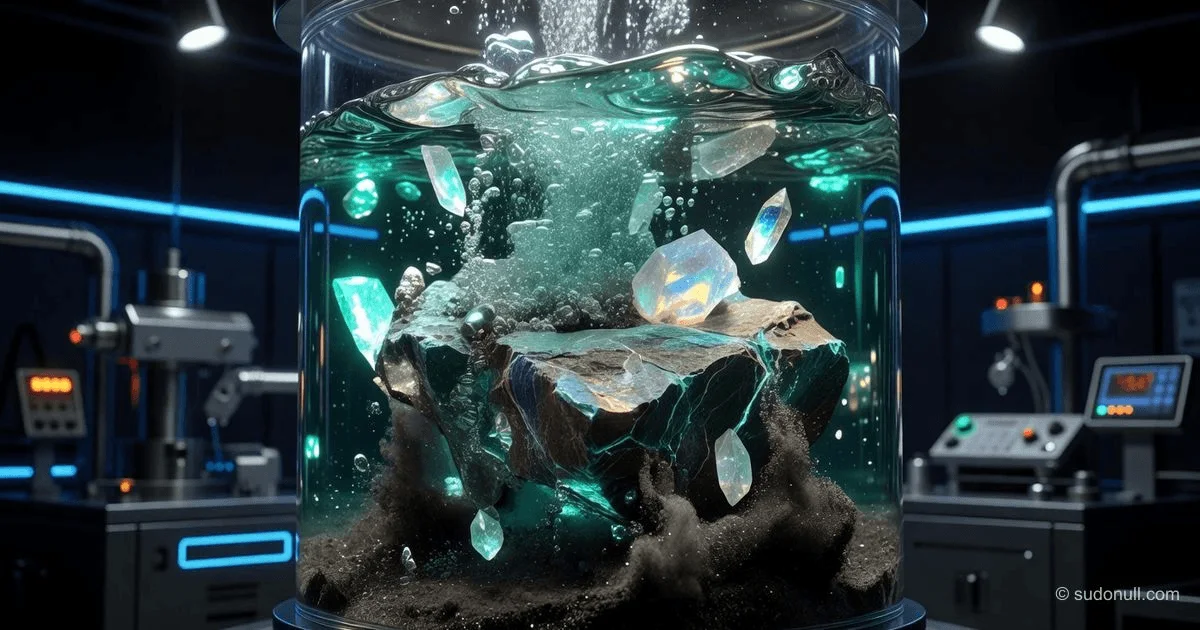
MIT Scientists Find Cheap Way to Extract Lithium from Hard Rock
Researchers at the Massachusetts Institute of Technology have developed a low-temperature process to extract lithium from the mineral spodumene using a liquid reagent. The technology yields battery-grade lithium with lower energy costs and less waste.
'Acid Bath' vs 'Kitchen Mixer': Why MIT's Rock Zero Technology Is a Time Bomb Under China's Lithium Monopoly
Analytical Note: Insights into the True Significance of 'Reverse' Lithium Extraction from Hard Rock
June 4, 2026
Introduction
While everyone is talking about humanoid robots and space shield contracts, an event occurred in the academic journal Science that I call 'the most underestimated geopolitical shift of the year.' A group of MIT researchers led by Professor Yet-Ming Chiang published a technology that extracts lithium from hard rock at room temperature, costing half as much.
If you think this is just another 'lab breakthrough that will never make it to the field,' you are sorely mistaken. First, this is not abstract science—the researchers tested the method on 17 different spodumene samples from around the world. Second, they already have a startup, Rock Zero, based in MIT's incubator The Engine, which promises to launch a demonstration plant by the end of 2026 and industrial production in 2027.
I have been closely following the raw materials market and battery supply chains since 2021, and I assert: what MIT showed is not an 'improvement' of existing processes. It is a paradigm shift, comparable to the transition from a steam hammer to a hydraulic press. And the main question now is not 'will it work,' but 'who will be first to build a plant and democratize global lithium production, breaking China's monopoly on refining.'
[The Core]: What Is Really Happening
Forget about 'green energy' for a second. The essence here is a fundamental revision of the law of energy conservation in mining. Traditional processing of spodumene (the most common lithium ore) requires heating the rock to 1000-1100°C, followed by sulfuric acid leaching. This is a hellish process: high temperatures, toxic waste, and, more importantly, about 70-80% of the original rock ends up in tailings.
The MIT team applied 'reverse logic.' Instead of melting everything and picking out the lithium, they decided to dissolve the 'cage' that holds the lithium. They use ammonium fluoride (NH₄F)—the same glass-etching paste you can buy at a hardware store. When heated to just 70-95°C, this reagent breaks the strong silicon-oxygen bonds that hold the rock together.
From a chemistry standpoint, it's brilliant: they don't leach out metals leaving a silicon skeleton, as was done for centuries. They dissolve the skeleton itself, releasing all contents. It's like not picking raisins out of a bun, but dissolving the dough itself, leaving pure raisins, nuts, and sugar. The output yields three streams: lithium fluoride (goes directly into electrolytes or converts to carbonate/hydroxide), aluminum oxide (98% purity—for the aluminum industry), and silicon dioxide (for cement).
The numbers no one discusses, but they are key: The researchers estimate the production cost per ton of lithium via this method at just over $5,000, compared to traditional nearly $9,000 for hard rock. And selling by-products (aluminum and silicon) could push the price even lower, making it competitive with South American brines.
Timeline and Context
The path to this technology began not in a lab, but in Professor Chiang's bathroom 25 years ago, when he was etching glass to make it frosted. But the real timeline unfolded rapidly in recent months.
Key milestone—May 28, 2026, when the paper was published in Science. But for insiders, the signal came earlier. A few weeks before publication, MIT announced grants through ARPA-E (Advanced Research Projects Agency-Energy) and the National Science Foundation. This means the US government is already in the game.
Next stage—May 31 to June 2, when the news spread through global media. Note the synchronicity: almost simultaneously with announcements at Computex 2026 and SpaceX contracts, the 'civilian' sector got its dose of disruptive news.
Now, on June 4, 2026, we are in the 'gold rush' phase of initial commentary. But I want to highlight a detail reported by German and French colleagues: the spin-off Rock Zero has already hired engineers, and their goal is to cut reaction time from lab-scale 12 hours to industrial parameters by year-end. If they succeed, 2027 could be the year the old lithium economy collapses.
Who Wins and Who Loses
Analyzing the consequences of this publication, we must stop thinking of lithium as a metal and start thinking of it as a standard.
Winner #1: USA, Europe, and Australia (countries with spodumene deposits). These are the main beneficiaries. They have mountains of ore but lack cheap energy for roasting and refining technologies honed for decades in China. Now they have a 'compensation technology.' If Rock Zero can build plants in Nevada or Western Australia, the 'ore-to-battery' supply chain closes within the Western bloc, bypassing China.
Winner #2: Electric vehicle manufacturers (Tesla, BYD, VW, GM). The projected 40-50% reduction in lithium concentrate cost could directly lower battery prices. In a context where lithium price remains a key volatility factor for automakers, the ability to sign long-term contracts with Rock Zero, rather than depending on weather in Atacama or Beijing's politics, is a strategic advantage.
Winner #3: Professor Yet-Ming Chiang and the Rock Zero team. For them, it's a Nobel Prize in Chemistry in the bag and a billion-dollar startup valuation. If the technology scales, Rock Zero could become the Intel of the battery world.
Loser: China's refining monopoly. China controls over 60% of global lithium refining. This monopoly was based not on cheap labor, but on a willingness to tolerate colossal energy costs and toxic roasting waste. MIT's technology knocks out that argument. Moreover, ammonium fluoride used in the process is mass-produced in the West. Beijing's resource dictatorship gets a serious crack.
Conditional loser: South American brines (Chile, Argentina, Bolivia). While these countries enjoyed the lowest extraction costs, but with a terrible water footprint. If hard rock with the new method approaches $5,000, and its by-products cover costs, the price gap between 'brine' and 'ore' disappears. This strips the 'Lithium Triangle' of its main competitive advantage.
What the Media Isn't Saying
As always, the most interesting details remain off the press release radar. Things even tech blogs are silent about, but that are discussed in Boston venture circles.
Insight #1: The hydrogen fluoride problem—'the devil in the details.'
Ammonium fluoride is not sugar. Upon decomposition, it releases hydrogen fluoride (HF)—an extremely corrosive and toxic gas. Yes, the process is closed-loop, and the reagent is regenerated. But on an industrial scale, working with HF at 95°C under pressure is an engineer's nightmare. One micro-leak at a flange, and the entire plant becomes an environmental disaster zone. In the lab, it works on a flask. At a plant, it requires space-grade sealing costing billions. Rock Zero got funding from MIT, but can it handle chemical safety at the level of Dow Chemical? Big question.
Insight #2: 'Kitchen magic' vs 'Factory conveyor.'
Journalists write about a 'kitchen mixer' as a metaphor for simplicity. But the process includes a stage of heating aluminum to 700°C after separation. Yes, it's not 1000°C for the whole furnace, but it's still a high-temperature stage. Energy doesn't disappear; it just shifts to another step. And if you can't sell the resulting alumina at a good price, the process economics may fall apart. The aluminum market is overheated and volatile.
Insight #3: Geopolitical sabotage—China's next move.
As soon as Rock Zero announces construction of its first US plant, China will likely try to dump lithium prices to kill the competitor at the start, as they did with solar panels. State-owned Chinese companies could temporarily sell lithium at a loss to make the new American process unprofitable. This is called a 'scorched earth strategy,' and it will be deployed as soon as the technology approaches market readiness. Rock Zero's financial cushion must be huge to survive this price war.
Forecast: Next 30 Days and 90 Days
Events will unfold rapidly because time is money, and lithium is war.
Next 30 days (July 2026):
Expect shares of existing lithium companies like Albemarle (ALB) and SQM to enter a correction phase. Investors will start shifting from 'old' technologies to 'new.' Also, expect an official announcement from the US Department of Energy awarding Rock Zero a grant under the Loan Programs Office (LPO). Biden (or his successor) needs wins in supply chain localization before the elections. Without government support, scaling this process is unrealistic.
Next 90 days (September 2026):
Key moment—demonstration of Rock Zero's pilot plant. They promise to launch it in Q4 2026. If in September we see a video of a machine processing tons of rock per day, not grams, it will cause an explosion in the raw materials market. Follow news from Boston. This will be the year's biggest industrial story.
Also, expect Chinese companies Ganfeng Lithium or Tianqi Lithium to make a 'knight move'—either offer to buy Rock Zero for $1-2 billion, or announce their own 'similar' technology. The Chinese cannot afford to fall behind in this race. A patent war is inevitable.
Main risk I see: 'Scaling syndrome.' History knows hundreds of brilliant lab technologies that crashed against the harsh reality of scaling. Rock Zero's process uses chemistry very sensitive to the purity of the original ore and impurities. In real mines, spodumene is rarely pure. If the first industrial attempt fails due to reactor clogging from impurities or reagent loss, it will set the industry back years. But the stakes are too high not to try.
Summary: MIT just announced that the lithium monopoly is no longer backed by physics. What once required blast furnaces can now be done in a 'pot' at tea temperature. Everyone who owns lithium ore in the US, Australia, or Europe should now be calling Rock Zero. And everyone who owns a lithium plant in China should now be counting how many more years their equipment will pay off. The tipping point has arrived. And it smells not of sulfur from furnaces, but of hydrogen fluoride from a lab bench.
— Editorial Team










No comments yet.