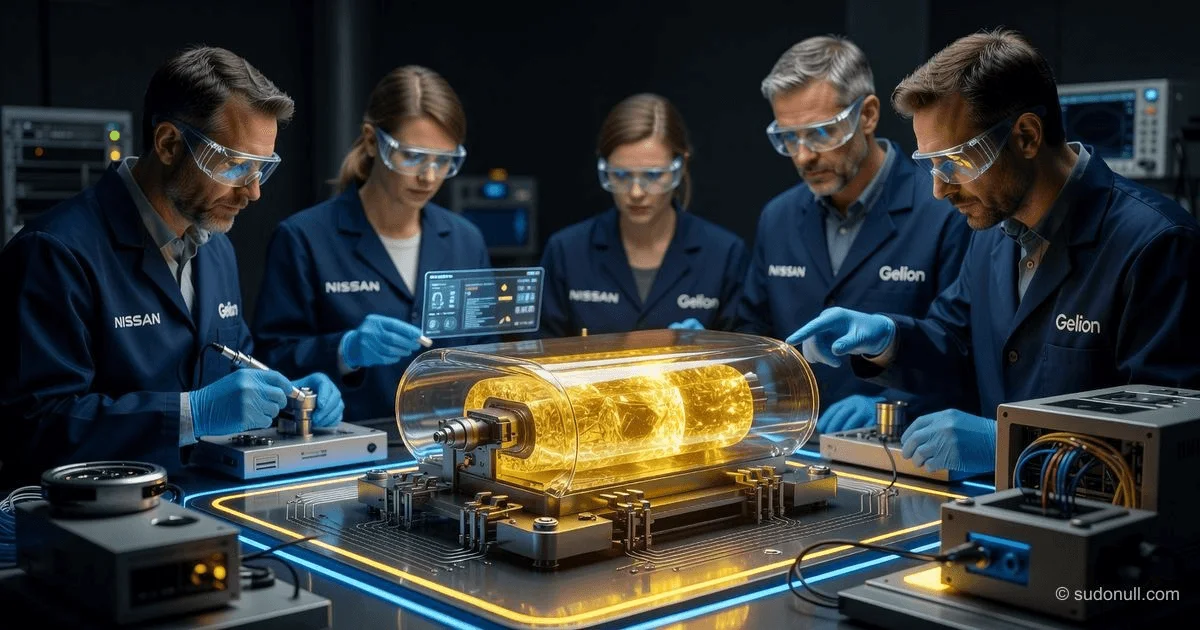
Nissan joins solid-state battery project to undercut China on price
Japanese auto giant has teamed up with Gelion and the University of Oxford in a three-year project to develop lithium-sulfur solid-state batteries. The sulfur-based technology aims to create cheaper and safer batteries to compete with Chinese manufacturers.
Insight: The £3.4 million Nissan-Gelion deal. It's not about batteries—it's about a geopolitical 'reset' of Chinese dominance
When you read headlines like 'Nissan joins solid-state battery project,' your mind automatically paints a picture: a giant automaker, multi-billion-dollar investments, a breakthrough lab. But the reality of the deal between Nissan, British startup Gelion, and the University of Oxford looks different. The total budget is £3.4 million (about $4.56 million). That's less than the cost of one minute of Nissan's Super Bowl ad.
And it's this microscopic check, at first glance, that makes the deal brilliant. This is not an attempt to build a factory. It's a 'reconnaissance mission' and a geopolitical joker. Officially, the project is called CoRe-SoLiS (Cost-effective, Resilient Solid-state Li-S). Unofficially, it's 'Operation Sulfur vs. the Dragon.' And there's much more hidden here than simply replacing cobalt with cheap sulfur.
[The Essence]: What's really happening
Let's face the facts: the classic lithium-ion industry is a Chinese game. China controls 87% of the global anode material market and 65% of the cathode market. CATL and BYD have won the game on nickel, cobalt, and manganese. The West is late. So the essence of the Nissan-Gelion deal is not a 'new technology'—it's a new global resource map.
Gelion offers a cathode based on nano-encapsulated sulfur (NES). Sulfur is a waste product of oil refining. In Texas, Alberta, and the North Sea, there are billions of tons of it. Unlike cobalt (Congo, price risks, child labor) or nickel (Indonesia, environmental issues), sulfur in Western jurisdictions is lying at your feet. The essence of the deal: turn China's strategic weapon (control over rare earth supply chains) into a useless artifact.
But why Nissan? The company is in deep crisis. In 2025, Nissan's sales in China collapsed to 653,000 units—almost half of the peak of 1.5 million. They have nothing to lose. Betting on solid-state batteries with a sulfur cathode is not just a battery improvement. It's an attempt to create a product that physically cannot be quickly copied in China because China doesn't have cheap access to Western sulfur in the same volume.
The media writes about 'safety' and 'cheapness.' In reality, it's a technology of sovereignty. Nissan is using the British Innovate UK grant of £2.4 million not for science, but to create a precedent: 'We can build batteries without looking to Beijing.'
Timeline and context
To appreciate the audacity of this deal, you need to look at the timeline. June 1, 2026—announcement. June 4, 2026—a report from Longspur Capital with the headline 'Cheaper Than China.' This is no coincidence. It's a planned information campaign.
The context of the last 30 days is critical. Throughout May 2026, Chinese manufacturers (SAIC, Gotion Hi-Tech) actively promoted their semi-solid batteries. The SAIC MG 4X has already hit the roads. The Chinese are moving from words to action, creating a standard for cheap electric vehicles. Europe and Japan are panicking.
Meanwhile, Western analysts from CRU predict that in 2026, Chinese battery prices may not fall but rise due to China's 'anti-involution' policy and stricter standards. This creates a window of opportunity. If Chinese batteries rise to $100 per kWh, and Gelion's sulfur solid-state battery can reach $75-80 per kWh, the race is over.
Nissan is acting as a 'testing ground.' They already have a solid-state battery production line in Yokohama. The deal with Gelion is not R&D from scratch. It's an attempt to insert a 'sulfur cartridge' into Nissan's existing solid-state architecture. The 3-year goal (the project runs until 2029) is to prove that a sulfur cathode works in harsh automotive charge-discharge cycles.
If we look at history, Toyota has 1,300 patents on solid-state batteries. Nissan has always been second. But Toyota is stuck with expensive sulfide electrolytes. Nissan, through Gelion, gets access to a cathode that costs pennies. It's a 'guerrilla tactic': we don't attack head-on, we flank through material costs.
Who wins and who loses
Winner #1: The UK. The country lost autonomy after Brexit. Nissan's Sunderland plant (EV36Zero) is Britain's main automotive asset. If Gelion proves the technology, the UK will get not just a battery factory, but a full cycle: sulfur from the North Sea, cathodes in Oxford, assembly in Sunderland. This is a restoration of industrial sovereignty.
Winner #2: Gelion. Before this deal, few outside Australia had heard of them. Now they have Nissan, Oxford, and TDK grants in Japan. Gelion's shares jumped 18% on the announcement day. But the main thing is that their NES technology becomes the de facto standard for Western solid-state projects. They are not selling sulfur; they are selling hope to the West.
Loser #1: CATL and Chinese giants. While they lead in volume, their vulnerability is raw materials. If the West switches to sulfur, demand for nickel and cobalt (which China buys worldwide) will collapse. China has invested trillions in controlling metal supply chains. Sulfur breaks this logistics. It's an existential threat to their 'own the resources' business model.
Loser #2: Traditional chemical concerns (BASF, Umicore). They built empires on the complex chemistry of NMC cathodes (nickel-manganese-cobalt). A sulfur cathode is technologically simpler. It doesn't require high-temperature calcination or complex precursors. If NES wins, cathode manufacturers' margins will collapse because processing sulfur is 10 times cheaper.
Unexpected loser: Elon Musk. Tesla bet on LFP and its high-nickel 4680 cells. LFP is safe but has low energy density. A sulfur solid-state battery potentially offers 2,600 Wh/kg—a fantastic figure. If Nissan and Gelion succeed, the Cybertruck fleet will become technologically obsolete before Tesla ramps up mass production of its batteries.
What the media isn't saying
The main insight missing from press releases is the problem of polysulfide 'shuttling'. Conventional lithium-sulfur batteries die quickly because sulfur dissolves in the electrolyte. Everyone says, 'We've solved this with a solid electrolyte.' But the truth is that the interface between the solid electrolyte and the sulfur cathode is an engineering nightmare.
Gelion is betting on 'nano-encapsulation.' They hide sulfur in a shell. But combining this with a solid electrolyte (which doesn't flow like a liquid) means creating mechanical stress at the interface. The battery will swell during charging. The media doesn't write about this, but the 3-year project timeline is so long precisely because the first year will be spent just trying not to kill the cell by the 100th cycle.
The second silence is about humidity. Solid-state batteries (especially sulfide-based ones, which Nissan uses) require production in dry rooms with a dew point of -60°C. Sulfur is also hygroscopic at the nanoscale. Building such lines cheaply won't work. The claim 'cheaper than China' is marketing. Sulfur itself is cheap, but the cost of producing a quantum dot with sulfur in a sterile environment could wipe out all savings.
The third and most important: intellectual property. Toyota's patents on solid-state batteries strictly block the use of sulfur with lithium anodes. Gelion and Nissan have no choice but to use a silicon anode or lithium-metal with a special interlayer. The media says 'solid-state' but doesn't specify who owns the rights to this configuration. The legal risks are colossal. If Toyota sues in 2028 when Nissan releases a commercial product, the game is lost.
Forecast: The next 30 days and 90 days
Next 30 days.
Expect a reaction from Volkswagen and PowerCo. Europeans can't afford to fall behind the Nissan-Gelion duo. Within a month, VW will either invest in a similar startup (look at Theion in Germany, also sulfur) or offer Gelion a joint venture bypassing Nissan. Additionally, Samsung SDI may issue a rebuttal or criticism of sulfur technology to defend its nickel battery lineup.
On the stock market, a correction will occur: shares of American QuantumScape (QS) will dip 3-5% because investors will see money flowing into alternative chemistries, not just ceramics. Gelion's own shares (GELN) will continue to rise, but expect profit-taking at +25-30% from current levels.
Next 90 days.
By September 2026, Gelion will have to show the first charge-discharge cycles of a prototype cell. If they show fewer than 500 cycles with 80% capacity retention, the hype will collapse. If more, a new wave of investment will begin, and Toyota may try to buy Gelion outright to close the gap in its patents.
Political track: Biden or Trump (whoever is in the White House) will announce a support program for 'silver-sulfur' batteries under the CHIPS Act. Sulfur is Texas. Expect a loud announcement from ExxonMobil (they have a lot of sulfur as waste) that they are joining the consortium with Gelion. Oil companies hate electric vehicles, but if EVs buy their waste (sulfur), they'll become best friends.
The main takeaway: what happened on June 1, 2026, is the moment when the West and Japan said, 'We will not play by China's rules in the lithium-ion era. We will rewrite the rules on sulfur.' And this game has just begun. At stake is not just a $200 billion battery market, but control over the West's energy sovereignty. And while the Chinese build factories, Europeans and Japanese are quietly buying up sulfur patents. A smart move. Let's see if they have the nerve.
— Editorial Team




No comments yet.