
 October 13, 2011 at 14:31
Intel HD Graphics P3000 in Workstations - Comparison and Application
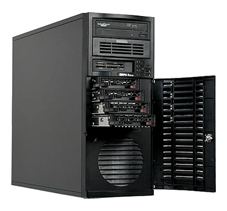 Company DEPO ComputersLaunches New DEPO Race G650S Graphics Station Model Designed for CAD, 3D Modeling and Digital Content Processing. The model is based on the Intel C206 chipset, which gives users a number of advantages over Sandy Bridge desktop chipsets. The first of the significant differences from the desktop platform is support for second-generation Xeon processors and memory with an error correction function, which allows to increase the fault tolerance and efficiency of the system when working with demanding applications. In addition to professional 3D video cards, when working in professional 2D / 3D applications, you can use the Intel HD Graphics P3000 graphics controller built into the core of the Intel Xeon E3-1275 processor. Thus, you can get the necessary performance when performing tasks of an initial level of complexity.
The model has 2 integrated Intel 82574L gigabit controllers, which will free up the PCI or PCI-E slot if two network connections are needed. Among the shortcomings, the model does not support SLI. But this will not be a big loss, given that the graphics station is more focused on professional graphics, and Quadro Fermi does not support SLI mode. The DEPO Race G650S disk subsystem is built on the basis of a RAID 5 array of four disks with hot swappability. This will allow you to quickly, without turning off and not opening the workstation, replace a failed disk without losing important data.
Although the model does not support dual power supplies, which would provide greater fault tolerance, the standard power supply is very reliable - the power is 500 W, the efficiency is 85%, the unit is certified according to the 80 Plus Bronze standard.
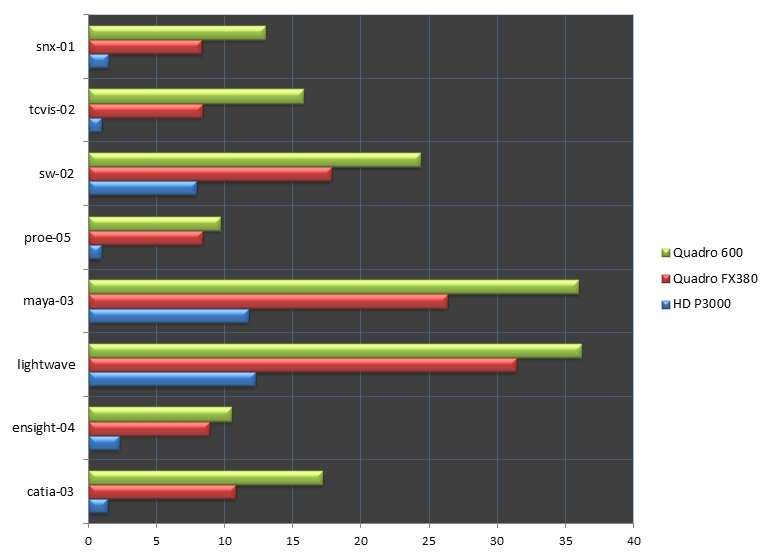
The SPECviewperf11 test package showed the advantage of this model over a similar configuration on the Intel X58 platform using Quadro graphics cards. And what is the Intel HD Graphics P3000 controller? First, we tested the integrated controller with the SPECviewperf11 test suite. For comparison, we did the same tests with the NVIDIA Quadro FX380 and Quadro 600. Synthetic tests showed a significant gap between the younger Quadro of different generations from the HD Graphics P3000:
But in reality it does not always happen as in synthetic tests. Therefore, we decided to test the operation of the HD Graphics P3000 in real tasks on 3ds Max - a manual test revealed a completely different alignment of forces. By the maximum number of polygons in the scene, which is acceptable for comfortable work (20-25 frames per second), the HD Graphics P3000 showed a result similar to the Quadro 600 - about 10 million polygons. But the maximum number of individual objects in a scene that supports the HD Graphics P3000 controller, while maintaining stable performance during animation, was 3000 units. This is already a result similar to that of the Quadro 6000 graphics card. And all this considering the fact that a specialized driver for 3ds Max was installed for Quadro from the NVIDIA website.
How will integrated graphics behave when anti-aliasing is turned on? We know from experience that the inclusion of this feature on NVIDIA cards led to a serious drop in performance: for Quadro by 10 times, and for GeForce - by 50! This was reflected in a decrease in the maximum number of polygons that a video card can process without a drop in performance. We present the data obtained when testing video cards in two modes - with and without antialiasing:
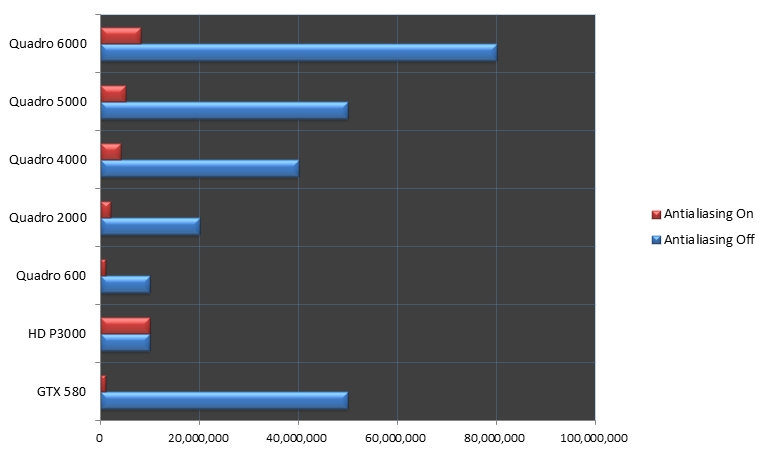
Studies have shown that the Intel HD Graphics P3000 integrated into the core of the Intel Xeon E3-1275 processor did not show any performance degradation when Antialiasing was turned on. The only thing that can be noted not in his favor is that the lines in this mode were displayed thicker than that of Quadro, which can lead to inconvenience when modeling. It was also interesting that the Intel HD Graphics 2000 integrated into the core of the Intel Core i7-2600 processor showed exactly the same results as the P3000. Given the real differences between the two video controllers, this suggests that the performance was limited by the capabilities of the driver, not the hardware. I would like to believe that Intel optimizes drivers and allows you to take full advantage of the capabilities of the new video core.
What follows from all this? We think it is premature to consider the Intel P3000 integrated graphics controller an adequate replacement for the younger Quadros in professional 3D applications. But in any case, there will be application for the controller - Intel HD Graphics P3000 can be used in computational applications where the graphic load has an initial level of complexity.
We will be glad if someone shares their experience in using HD Graphics P3000 with other professional CAD applications.
Usikoff ,
DEPO Computers Technical Specialist