August 12, 2011 at 14:07
Let's talk about the vocabulary of a foreign language
How many words are in English? The Oxford English Dictionary contains about 500,000 entries, not taking into account specific scientific words and phrases (of which there are about 500,000). And what do you think, what average vocabulary of a foreign language gives you high school during your studies? The correct answer is about 2500 words. Is this kit not enough? Here it is already necessary to proceed from your goals. For communication with foreigners on business topics - definitely not enough. To read simple texts on the Internet is more than enough. To be more precise:
400-500 words - an active vocabulary for language proficiency at a basic (threshold) level.
800–1000 words - an active vocabulary for explaining oneself; or passive vocabulary for reading at a basic level.
1,500–2,000 words- an active vocabulary, which is quite enough to ensure everyday communication throughout the day: or a passive vocabulary, sufficient for a confident reading.
3,000-4,000 words - in general, enough for almost free reading of newspapers or literature in the specialty.
About 8000 words - provide full communication for the average European. There is practically no need to know more words in order to communicate freely both verbally and in writing, as well as read literature of any kind.
These data came the famous Swedish polyglot Eric Gunnemark, founder of the International Association `Amici Linguarum` (` Friends of Languages`). Moreover, he compiled a set of the minimum number of words and phrases that you need to know for the threshold level of language proficiency, calling them Minilex and Minifraz.
It’s interesting, and what is the average vocabulary level for an average network user and for you personally? I’ll talk about this later.
As a result of a study conducted by a joint US-Brazilian group, interesting results were revealed. For example, the graph below shows how vocabulary increases with age among native speakers (in this case, English).
The survey involved 200,000 people, which indicates its high accuracy. It can be seen from the graph that between 3 and 16 years, our vocabulary is growing at a rate of 4 new words per day (to be more precise, 3.8 words). At the age of 16 to 50 years, the growth rate is reduced to 1 per day (more precisely 0.85). And finally, after 50, vocabulary remains at roughly the same level.
And what is the average supply of English words among Internet users for whom English is not native? The chart below will answer this question.
It does not include users with a vocabulary lower than 1000. As we can see, the majority of users learning English (4.7%) have a personal vocabulary of 4,500 words. You can check the level of your knowledge in just a couple of minutes (link at the end of the article) and compare it with these indicators.
Let's look at some other interesting findings. The following diagram shows the activity of students in classroom activities (answers to questions, communication) from the level of vocabulary.
As expected, students with the best knowledge of words participate most actively in the lesson, but this is not a fundamental factor.
The following diagram answers the question: how often do you use English in life (when watching TV, traveling, listening to songs, etc.)
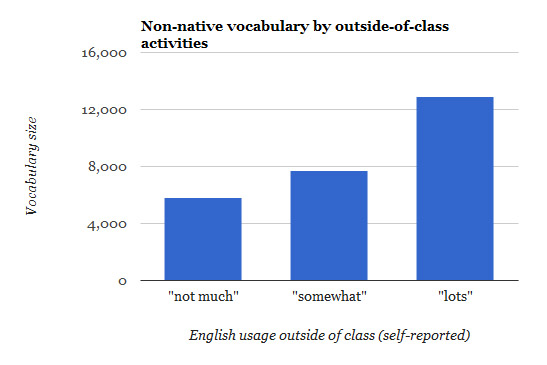
Again, with an increase in vocabulary, students more often begin to use the language in everyday life, and those who come across with English often, has twice as much vocabulary.
If you traveled to English-speaking countries, how long have you been there?

From the diagram, we see that people with a stock of 7,000 to 10,000 words are abroad for a total of less than a year. Each subsequent year of your stay in an English-speaking country on average adds 850 words to your initial vocabulary, which corresponds to 2.35 words per day (compared to an American teenager whose vocabulary increases by 0.85 words per day).
• Exercise regularly. Better a little daily, than once a week for several hours in a row.
• Carry printed word cards with you, or use the appropriate mobile apps.
• Read as much as possible, even if the text is poorly perceived (I recommend reading a book by Nikolai Zamyatkin about this method, which advises you to read texts without using a dictionary).
• Learn as much as possible by heart.
• Stick stickers on various objects in the room with the English meaning and translation.
• Repeat words regularly, preferably speaking them aloud. Even Russian words are forgotten if they are not repeated for a long time and not used.
• For associations that are difficult to remember, use associations. The brighter the image created by the association, the better the word will be remembered.
• Language is a fortress, and it is necessary to storm it from all sides and by all means, so any practice is the basis of success, so use the slightest opportunity to speak, read, write in the language you are learning.
• Do not be afraid of mistakes. Learn from them! Excessive modesty does not help here, and some self-confidence does not hurt.
• Use time that is usually hopelessly lost - travel in public transport, waiting for admission, etc.
• The material of the vocabulary check website was used for the article: http://testyourvocab.com
• An example of a good-quality dictionary of the main vocabulary is the dictionary published by E. Klett in Stuttgart, 1971, under the name “Grundwortschatz Deutsch” (“The main vocabulary of the German language "). It contains 2000 of the most necessary words in each of the selected six languages: German , English, French, Spanish, Italian and Russian.
• The book of E. Gunnemark, in which he talks in more detail about the study of words, is called “The Art of Learning Languages”. It is difficult to find for sale (in the Moscow Biblio-Globe has been missing since 2005). Therefore, I recommend downloading the electronic version .
•The Minilex and Minifraz Gunnemarka course , as well as 2000 of the most used English words , can be taken on the WordSteps vocabulary replenishment site
• N. Zamyatkin’s book: “ You Ca n't Teach a Foreign Language ” is recommended for reverence for beginners to learn the language.
400-500 words - an active vocabulary for language proficiency at a basic (threshold) level.
800–1000 words - an active vocabulary for explaining oneself; or passive vocabulary for reading at a basic level.
1,500–2,000 words- an active vocabulary, which is quite enough to ensure everyday communication throughout the day: or a passive vocabulary, sufficient for a confident reading.
3,000-4,000 words - in general, enough for almost free reading of newspapers or literature in the specialty.
About 8000 words - provide full communication for the average European. There is practically no need to know more words in order to communicate freely both verbally and in writing, as well as read literature of any kind.
These data came the famous Swedish polyglot Eric Gunnemark, founder of the International Association `Amici Linguarum` (` Friends of Languages`). Moreover, he compiled a set of the minimum number of words and phrases that you need to know for the threshold level of language proficiency, calling them Minilex and Minifraz.
It’s interesting, and what is the average vocabulary level for an average network user and for you personally? I’ll talk about this later.
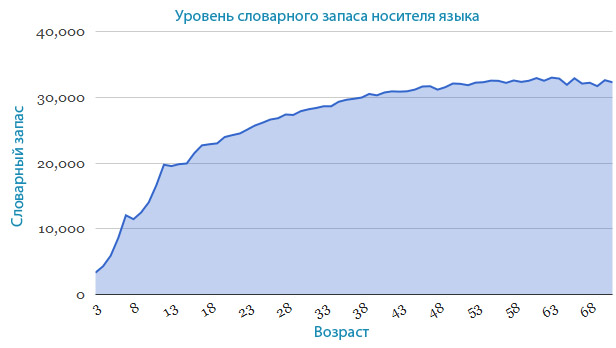
As a result of a study conducted by a joint US-Brazilian group, interesting results were revealed. For example, the graph below shows how vocabulary increases with age among native speakers (in this case, English).
The survey involved 200,000 people, which indicates its high accuracy. It can be seen from the graph that between 3 and 16 years, our vocabulary is growing at a rate of 4 new words per day (to be more precise, 3.8 words). At the age of 16 to 50 years, the growth rate is reduced to 1 per day (more precisely 0.85). And finally, after 50, vocabulary remains at roughly the same level.
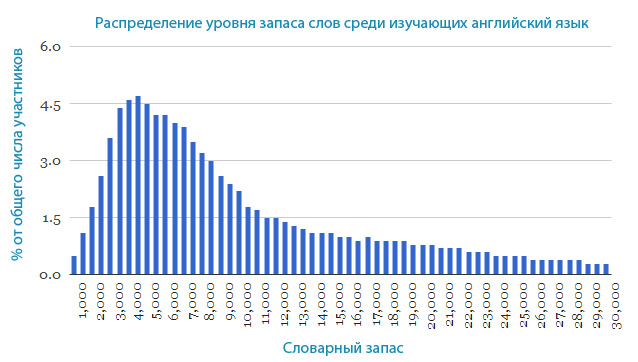
And what is the average supply of English words among Internet users for whom English is not native? The chart below will answer this question.
It does not include users with a vocabulary lower than 1000. As we can see, the majority of users learning English (4.7%) have a personal vocabulary of 4,500 words. You can check the level of your knowledge in just a couple of minutes (link at the end of the article) and compare it with these indicators.
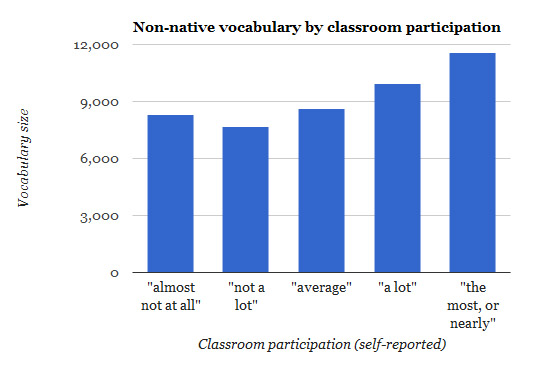
Let's look at some other interesting findings. The following diagram shows the activity of students in classroom activities (answers to questions, communication) from the level of vocabulary.
As expected, students with the best knowledge of words participate most actively in the lesson, but this is not a fundamental factor.
The following diagram answers the question: how often do you use English in life (when watching TV, traveling, listening to songs, etc.)
Again, with an increase in vocabulary, students more often begin to use the language in everyday life, and those who come across with English often, has twice as much vocabulary.
If you traveled to English-speaking countries, how long have you been there?
From the diagram, we see that people with a stock of 7,000 to 10,000 words are abroad for a total of less than a year. Each subsequent year of your stay in an English-speaking country on average adds 850 words to your initial vocabulary, which corresponds to 2.35 words per day (compared to an American teenager whose vocabulary increases by 0.85 words per day).
Some effective word learning tips
• Exercise regularly. Better a little daily, than once a week for several hours in a row.
• Carry printed word cards with you, or use the appropriate mobile apps.
• Read as much as possible, even if the text is poorly perceived (I recommend reading a book by Nikolai Zamyatkin about this method, which advises you to read texts without using a dictionary).
• Learn as much as possible by heart.
• Stick stickers on various objects in the room with the English meaning and translation.
• Repeat words regularly, preferably speaking them aloud. Even Russian words are forgotten if they are not repeated for a long time and not used.
• For associations that are difficult to remember, use associations. The brighter the image created by the association, the better the word will be remembered.
• Language is a fortress, and it is necessary to storm it from all sides and by all means, so any practice is the basis of success, so use the slightest opportunity to speak, read, write in the language you are learning.
• Do not be afraid of mistakes. Learn from them! Excessive modesty does not help here, and some self-confidence does not hurt.
• Use time that is usually hopelessly lost - travel in public transport, waiting for admission, etc.
Useful to pay attention
• The material of the vocabulary check website was used for the article: http://testyourvocab.com
• An example of a good-quality dictionary of the main vocabulary is the dictionary published by E. Klett in Stuttgart, 1971, under the name “Grundwortschatz Deutsch” (“The main vocabulary of the German language "). It contains 2000 of the most necessary words in each of the selected six languages: German , English, French, Spanish, Italian and Russian.
• The book of E. Gunnemark, in which he talks in more detail about the study of words, is called “The Art of Learning Languages”. It is difficult to find for sale (in the Moscow Biblio-Globe has been missing since 2005). Therefore, I recommend downloading the electronic version .
•The Minilex and Minifraz Gunnemarka course , as well as 2000 of the most used English words , can be taken on the WordSteps vocabulary replenishment site
• N. Zamyatkin’s book: “ You Ca n't Teach a Foreign Language ” is recommended for reverence for beginners to learn the language.