August 3, 2011 at 15:26
Together more fun. How to establish effective collaboration of creative people
- Transfer
- Tutorial
I present to you the translation of an article entitled " Better together; the practice of successful creative collaboration " by Stefan Klocek . Translated specifically for users of Habrahabr with the approval of Cooper .
A rock star and a brilliant scientist are necessarily loners. That is how we are accustomed to imagine the work of a creative person. However, creative work can also thrive on things like differences, perseverance, exchange of ideas, and collaboration. Two (or more) creative people can use these virtues if they play well in a team. The practice of “pair design” used at Cooper has matured for more than ten years and is developing along with the growth of the company, forming new pairs in which designers learn from each other every day. Although there is no magic formula, but most of the most successful collaborative work of such a plan in our memory had surprisingly similar characteristics.
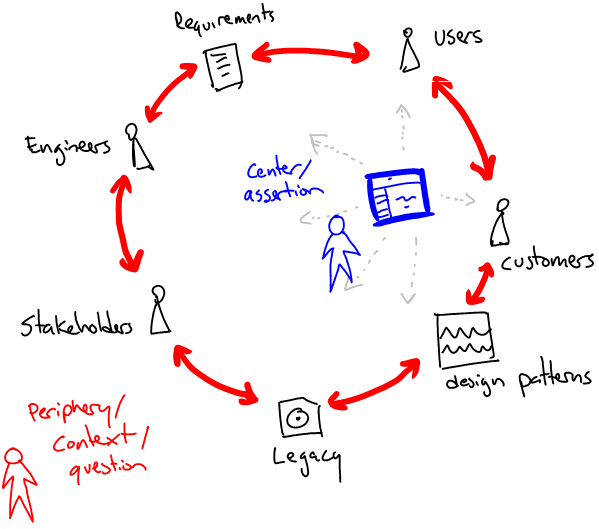
We play by the same rules.
People can collaborate with each other in a thousand different ways, but when they start to play by the same rules, they immediately notice that everything around is becoming much simpler and easier. The freedom to invent your own rules on the go , on a whim, creates a chaotic, unstable and unpredictable system. It is difficult to do your job when the basics are constantly questioned.
Social media journalist David Bornstein described the game in a recent article for the New York Times : “A game requires a sophisticated set of skills. This is not just an opportunity to train and let off steam. The game means that you need to agree with people like you, enter into an imaginary structure, and accept it, even if everything goes wrong, as you would like. ”

At Cooper, we use an unfixed set of conventions that give us the system by which we play and create together. We are all consultants involved in user-oriented design following the archetypal process (a process that is adapted to the limitations of this project), and we fulfill certain roles in working together. All this serves as our accepted system of rules of the game.
But how to play is decided by the players themselves. We work quite independently within spacious borders. Each team is free to decide how to work together and carry out daily work. All this happens in an informal setting - we roughly determine the time frame and superficially discuss what we want to get as a result. Then we decide exactly what we must achieve during the time of teamwork, as well as during the time of working alone.
Everyone appears at work at the right time, ready to go. We quickly discuss goals, which allows us to focus on important things during meetings and brings clarity to discussions. Everyone understands each other correctly, which allows organizing an effective discussion and postponing for later problems that cannot be resolved. At meetings, everyone actively contributes and moves the project forward. Playing by the rules, we remove internal tension and feel mutual trust.
We make the most of our differences.
We really appreciate our differences. Our idea of pair design (a couple consisting of a person who generates ideas and the person who is responsible for their synthesis) appeared when we began to notice and formalize certain differences in skills and approach to design.
A single designer is forced to do all the work himself, alternately switching between generating ideas and having to stop to synthesize them. Together we do this at the same time: while one designer formulates the details, the second goes in a different direction, evaluating how the ideas of the first fit into the overall picture of the project. Everyone sees and promotes the same idea in their own way, which results in more effective cooperation resulting in a more thoughtful design.
By focusing on different skills, we support and complement our partner - instead of doing the same job twice. Our method of collaboration encourages a versatile view of things, a way of thinking and knowledge.
Work and responsibilities are divided equally and fairly. This encourages differences and helps to avoid unnecessary conflicts. However, this does not mean that we are afraid of conflicts. Part of the value of our differences lies in the disagreements necessarily present where there are several different points of view. Different opinions contribute to useful questions and discussions.
From time to time we encounter significant and sometimes painful disagreements, but the tension from them acts like a crucible, helping us to separate the important from the unimportant, promising from a dead end. Complementary roles and responsibilities make it possible to challenge each other's decisions, while keeping controversy under control to achieve the best result.
When you have your own role and responsibilities, your creativity is completely released. You no longer stomp on the spot, you devote yourself to your specialization and count on the fact that your partner will correct you if something happens.
This unity of “opposites” creates productive differences and facilitates the synthesis of ideas. When hiring people, we pay special attention to their strengths and innate tendencies, and try to understand whether they can fulfill one of the roles. There are no people who are ideally suited, but we believe that certain tendencies (like the tendency to think visually or in words) usually portend that a person will get along in a certain role.
We do homework
In order to release a successful product, we prepare ourselves before we begin to put forward solutions: we study the scope of the project, the existing problem and the users who make up the target audience. Two little-informed designers are of little use - multiplying zero by something, you can not get more.
The better prepared you are, the more confident you will solve the problem. Creative people without the necessary knowledge of the subject have to rely only on their subjective opinion and theory. This complicates collaboration with another designer and can create unproductive conflicts between partners.
Without proper preparation, it is difficult for a team to gain momentum and enter a streaming state. The study provides the team with objective information, helping with complex systems. When both partners have all the information necessary to solve the problem, they reach the flow .
We try to ensure that both team members have a working understanding of the scope of the project and the problems we are trying to solve. If one of the team members has more experience in this field, we try to help the second to catch up with him. Everyone needs to be familiar with the scope of the project, the users that make up the target audience, and business goals in order to move smoothly and confidently to the right decisions.
We use the right tools.
If creative couples relied on subjective opinions and desires during the creation of the product, they would simply be mired in conflicts. We get rid of most subjective opinions by using the right tools in time:
- Research instead of guesswork.
- Characters instead of personal preferences.
- Scenarios instead of “what if?”
- Sketches instead of elaboration of details (for early ideas).
- The development of parts instead of sketches (in the later stages).
- Patterns instead of single decisions.
We try not to be distracted
There are too many distracting factors, and the main project is suffering. There is significant time loss when switching from one project to another. Successfully working on more than one project at the same time is quite possible, but when designers work together, the ability to switch between different projects does not bode well for the accumulation of unnecessary stress.
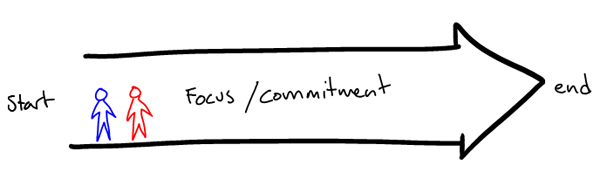
One team we get one project. It’s more enjoyable to work this way, so we can better concentrate on working together — productivity is growing, and there is less conflict and tension. Without distractions, it’s easier to concentrate. If you immerse yourself in the project as a whole - success is hard not to achieve.
We do not create design alone
In many companies, joint work consists in the fact that one person works independently at his workplace, and then offers to evaluate the work done to another person. This approach makes your partner more an editor than a co-author.
For us, working together means solving big issues with a partner. It is very important that both designers feel that they are working in a team. They both need to understand and perfect the design of their design. Working on the project, we gradually switch between working together and working alone.
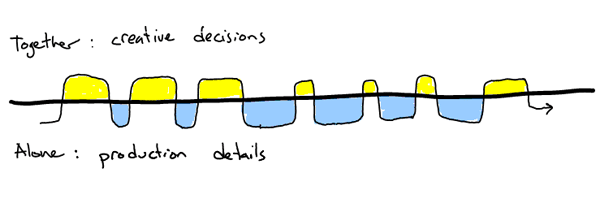
In the early stages of the project, we mainly work on it together. As the work on the project moves forward, we spend more time alone to work out the details. When we think about the details, questions and problems arise that we did not know about before. When this happens, we get together again and solve difficult moments together. We do not make important, critical changes without a partner.
We voice our thoughts
Many designers know that if you think through everything in your head, you can find and fix all the more or less obvious flaws of the idea. However, this approach does not work in tandem - doing all the work in your head does not allow a partner to your ideas. He cannot touch them, add something, or improve them.
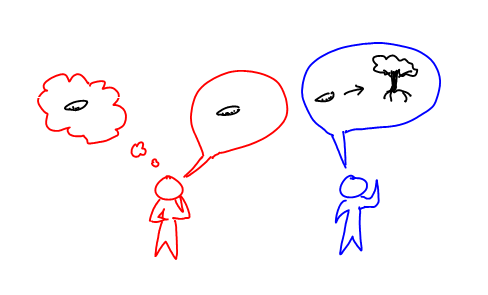
Collective creativity makes you think out loud. By sharing raw, conceptual ideas you give your partner food for thought and inspiration. Ideas spoken aloud mean that the team will have the necessary information earlier, and also make possible a closer and thoughtful cooperation. This is important both during the generation of ideas, and during their development.
Both partners need to try to share quick unfiltered thoughts. In order to work this way became comfortable, it takes time. This requires trust between partners. Trust arises in an atmosphere where you can safely share ideas and develop them. This approach to work allows you to really use the maximum efforts of two people.
Two different points of view, two minds, two creative processes working on the right ideas flow into faster, more complete and more correct decisions.
We assume that every idea carries value, even if it does not seem so at first glance
The first attempts to explain your idea are rarely elegant, clear and detailed. A negative reaction to a badly expressed idea is usually perceived as fair, but rarely helps your partner improve his idea. The fact that the first attempt to express an idea occurs with hesitations does not mean that the idea is bad.
Most likely, the thought of your partner is important, even if he expressed it poorly. Identification of the main idea or objection of a partner always leads to a new look at what you are currently doing.
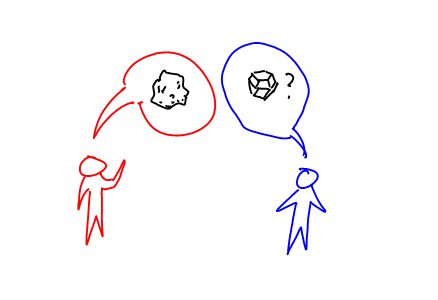
This only works if partners have created an atmosphere in which they are not shy about sharing ideas that they have not yet completed forming. They are trying very hard to understand the intent of the partner. When one designer proposed an idea, the second can say what he thinks about it, improve it, or ask for clarification on some points.
This principle of work helps to get rid of self-censorship and premature correction, making a deeper flow possible, and encouraging the exchange of ideas and trust. Nevertheless, we reject many ideas, but only after we consider them at least to a small degree.
We build, not raise obstacles
Shooting ideas and feedback slows down the pace of work and the favor of team members. When working together, you consider and try to improve what your partner has proposed. You develop ideas by adding something to them, improving or clarifying details for yourself, building your own ideas based on them.
Of course, sometimes many of the ideas suggested by a partner seem crazy, and discussing them seems like a waste of time. However, if you start immediately rejecting the partner’s proposals, it is unlikely that this will advance the work, but rather completely stop the creative process.
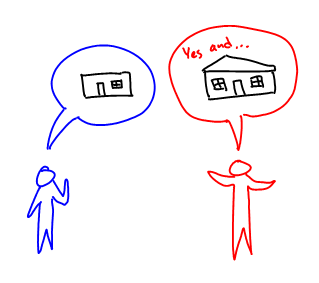
It is also important to receive feedback. If your idea is useless, someone should tell you about it. You cannot develop an idea without receiving or ignoring feedback. By fencing off your teammates, you are not letting them improve your work. A negative reaction to a thrown idea does not help it move forward.
An idea develops when you add something to it or change it in such a way that it better matches the business goals or the goals of users. Then the work will progress and everyone will feel that they are on the same team.
Sometimes we understand that we cannot reach an agreement, and then we accept that in this situation there is no decision that would satisfy everyone. In this case, we will take a cautious decision in any direction, remain impartial to this decision, and move on to another task.
At times, working on the rest of the system adds clarity. We can come to an agreement afterwards when we see how the other problems are solved.
We strive for progress, not perfection
As a design consulting company, we work with clear schedules under the pressure of high expectations. We try to do the work of the best quality possible in the allotted time. We strive for cool ideas, but they do not always appear the first time. We move towards such ideas through a fast iteration system. You can spend a lot of time, banging your heads against the wall together, trying to give birth to a perfect design, and not do anything.
You must have feedback from the customer and users. When you receive them, you will have to review and revise the solutions that seemed “perfect” or “complete” to you. First, we outline the picture as a whole, making sure that the proposed system works. Then we meet with the client and bring the idea to the user.
We find out that we thought wrong, and accept this. We will improve the product based on feedback and more deeply exploring the details and nuances in successive iterations.
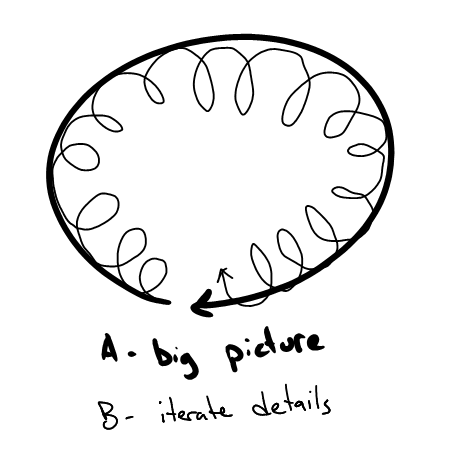
We manage to think about a lot in a short period of time, because first we try to get a general idea about the product, and think through the details later. This approach brings coherence and consistency to our design. Trying to chase perfect solutions not only slows down the work; if we rush about too long, the creative process is deprived of enthusiasm, pleasure and inspiration. When we get stuck on a problem, we set it aside and return to it later.
We leave our ego behind the door
Differences in views can lead to painful conflicts, in the worst cases, splitting the team, stopping work and killing enthusiasm. How do we manage to ensure that disagreements benefit instead of harm? It's just that in disputes we are not trying to be right, but instead we are trying to understand what exactly causes doubt in our partner.
When your closest and most respected colleague does not agree with what you are proposing, most likely you have missed something important in your idea. We look at the partner’s comments as advice and practical suggestions, and not as aggressive attacks.
This does not mean that we are just such knights on blue unicorns. Sometimes criticizing or getting criticism is unpleasant. Even when your partner has the best motives, it’s hard to hear that your idea is not working. In order to object to a partner about an idea of which he is one hundred percent sure, courage is needed.
We leave our ego behind the door because we understand that the product will become better if we find out which of our decisions were actually wrong. We do not seek consensus, but we understand that if our partner does not agree with us, it is better to understand his point of view. Often new innovative solutions come out of disagreement, which no one at first knew about.
We get rid of competition within the team
Although polarity can be helpful, continued competition with a teammate is not useful. When the discussion of the project moves from finding the right solutions to the struggle to choose one of the competing ideas, this does not bode well. Such situations rarely lead to a better solution, but some of them unjustifiably come out the winner, and some - the loser.
We believe that competition can be reduced if all participants adhere to certain roles (for example, as in a pair consisting of a person who generates ideas and a person who is responsible for their synthesis). These roles are not forever issued as shortcuts, it is only important that during one specific meeting both designers do not try to play the same role.
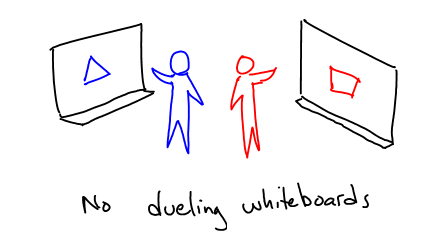
In the early stages, we try to put as many ideas on the table as possible - everyone generates. Then we evaluate the results, determine the strengths and weaknesses of each idea. Then we allow the person responsible for generating ideas to lead the team. Roles may change temporarily. The goal is not to clearly follow these roles, but to eliminate unnecessary, unnecessary competition.
We say “There are no duels on the board for drawing!” Or “One pen - one idea.” While your partner uses a pen to draw an idea, you try to understand it and give some feedback. While your partner is evaluating your idea, give him the opportunity to understand and improve it, do not go on to something else until he finishes and is ready to move on. If at the moment your role is to synthesize, believe that your partner is trying his best to offer worthy ideas and solutions. If the idea is promising, try to refine it further.
If the idea is bad, show your partner why and help find the best solution. If at the moment you, on the contrary, are generating ideas, rely on the fact that your partner will screen out all bad ideas. He keeps you short and sees the whole picture. You rely on each other. This is balancing, work on an equal footing. You do not give in and do not give up, you are not trying to push your decision or to win against your partner. Only both can win - when they try their best, play by the rules and rely on each other for continuous balance.
We limit time for disputes
Differing points of view can lead to a very good understanding of the topic. They can also lead to a large number of differing ideas and incompatible solutions. We value different points of view, however, we know that if the disagreement is not resolved for a long time, nothing good will come of it.
There are times when two reasonable people cannot agree. We have approximate time limits for decision making. If in 15 minutes we have not reached an agreement, we call a person who is not involved in the project. We explain who our users are, what goals we are trying to achieve, and what ideas we are considering.
We are not looking for a judge, but rather a person with an unbiased opinion who can take a step back and see the circumstances of the disagreement. We are looking for a point of view that would allow us not to cling so much to our own idea and would bring a fresh look at the problem, which generally eliminates the conflict from which it all began.
We crave feedback
Unexpressed objections are not the best help in creative collaboration. We strive to create a culture in which everyone can safely say that in his opinion something will not work. In an ideal world of misunderstanding, resentment and speculation would never threaten the joint creative work.
If someone thinks any decision is wrong, it is very important that the team settle this issue. We think that the working atmosphere can be improved through constructive feedback and regular self-tests.
It is difficult and may be initially inconvenient, but with experience, trust grows and interaction improves. You may not be able to build perfect friendships (however, this sometimes succeeds), but perfect working collaboration is easy.
Trust takes time
Freshly created teams need to make an effort to start working together. A new partner comes with its own unique style, habits and characteristics. The integration of the views, experience, skills and methods of a partner takes time and effort. Meetings may seem tense at first, and the discussion is a bit awkward. After all, while you are learning to dance, you are constantly stepping on a dance partner on your feet. To create a trusting relationship, you will need time and energy, however, overcoming a difficult initial period, the interaction will become easier.
Trust comes through the realization that you play according to the same rules: share ideas that you will then improve, feel the value of different opinions from your own experience, pay attention to the idea, and not the one who proposed it, come to work on time, meet expectations and honor arrangements.
We work in a complex and ambiguous creative space. Building trust ensures productive work in a chaotic environment. Confidence creates an opportunity for more deliberate cooperation, mutual understanding, respect and faith in the commitment of a partner. You look forward to a new opportunity to work shoulder to shoulder and appreciate the fact that there is always someone who will help you.
You get closer, you accept the challenge together, and try to make the best use of the contribution of a partner. This is usually fun, sometimes difficult. However, when your working relationship has developed sufficiently, most likely you will never want to return to work alone.
.
PS from translators: I hope you enjoyed the article. We will be glad if you indicate to us errors in the translation, so that we can quickly correct them. Write to me in PM, please :)