A female mathematician who loved mathematical analysis and God
- Transfer

Anezi was an Italian mathematician, philosopher, theologian and philanthropist.
I may disappoint you, but the “witch Agnesi” is a curve that students of mathematics usually learn in the course of mathematical analysis. She is not like a witch, nor a hat, nor even a broom. This is just a sloping, smooth curve.
If modern math textbooks mention Agnesi, after which the curve is named, they usually write that Maria Gaetana Agnesi was a 18th century mathematician who became the first woman to write a serious textbook on mathematical analysis. Also there may add that the name of the curve is a wrong translation of the Italian versiera- a term coined by the mathematician Guido Grandi on the basis of a Latin word for “turning curve”. Translator John Colson confused him with the word "avversiera", meaning "demoness" or "witch."
It is ironic, to say the least - a pious Catholic woman who has devoted decades of her life to serving the poor has become associated with the witch thanks to a curve that she didn’t even think of. But in a sense, this seems appropriate. According to science historian Paula Findlandfrom Stanford University, it looks like a mathematical “Freudian clause” - the Italian word “curve” has turned into an Italian word meaning devil-obsessed woman. Wonderful math joke. Whether it was a deliberate pun, or not, but Colson's erroneous translation perpetuated Agnesi's place in the teaching of mathematical analysis.
Reading the biography of Anezi, you catch yourself thinking that she constantly lived in the shadow of the expectations and demands of society and her own family. However, if we avoid the temptation to interpret her way of thinking through the prism of our perception, then we will begin to understand this woman from her own point of view.
Born in 1718, Agnesi was the eldest child of a wealthy Milan-based silk merchant Pietro Agnesi. Probably, her training began by chance, after the teachers began to teach her younger brothers. She was a precocious student, especially in studying languages, and Pietro quickly recognized her talent. In an effort to raise the social status of the family, he forced her and sister Maria Teresa, a musical prodigy, to perform in front of guests in the salons of Palazzo Agnesi. Gaetana, in several languages, talked about various scientific and philosophical topics, and her sister played music, often in her own composition. Pietro used his talented daughters to make his home an important place for the high society of Milan.
The sisters Anezi were among the few girls geeks in northern Italy of that time. Laura Bassi (1711-1778), a physicist from Bologna, who became the first female professor at a university in Europe, was also a wunderkind. The historian of science from the University of California at Berkeley, Massimo Matsotti , who wrote the book "The World of Maria Gaetan Agnesi, a Mathematician of God, " calls this the strategy of "adapting and curbing the phenomenon of an educated woman." Rich families gave their daughters a limited education - literature, French, religion - but women could not attend school outside their home.
The phenomenon of the wunderkind girl "was one of the ways in which outstanding talent and abilities were given a socially acceptable form in a world where, strictly speaking, women had no place in places where they received and studied knowledge."
Nonetheless, Matsotti notes that the status of a “girl prodigy” combined with the father’s wealth and ambitiousness revealed Agnesi a “small window of opportunity” that allowed her to get an education and make a greater contribution in the chosen field than many women of that era.
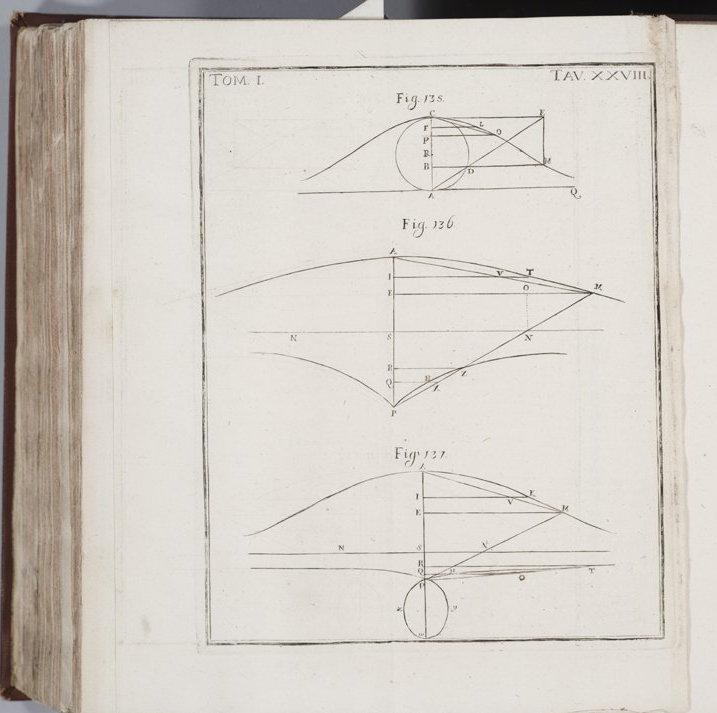
The top drawing is a curve known as the “Witch of Agnes”, from Agnes's own textbook. (Maria Agnesi, Instituziioni Analitiche, MIlan: 1748. David Eugene Smith Collection, Rare Book & Manuscript Library, Columbia University)
When her mother died in childbirth in 1732, Agnesi managed to reduce the number of public speeches, which allowed her to spend more time caring for her younger brothers and sisters, and also to influence her own education more and more. In 1739, she told her father that she wanted to become a nun. He resisted, but allowed her to study mathematics and theology more. According to Findland, "she managed to break free from the shackles of the stereotype of an educated woman from Milan speaking to the public." Anezi never went to the monastery, but she also never got married and did not give birth to children, choosing a different path - a modest Catholic who devoted her life to charity.
In just 30 years, Agnesi completed her most important mathematical work:Instituzioni analitiche ad uso della giovent italiana (“Analytical Structures for Italian Youth”) - a textbook on mathematical analysis, published in 1748. This impressive two-volume work was devoted to differential and integral calculus. The first volume outlined the algebraic apparatus necessary for understanding the mathematical analysis of the second volume. Probably the first Italian youth to whom her work was dedicated were her younger brothers and sisters: Pietro had 21 children from three wives, but few survived to adulthood.
If a modern student studying mathematical analysis of a student opens the Analytical Structures"Marie Agnesi, the language will seem a bit old-fashioned to him, but the general approach will be familiar. In fact, because of this comprehensibility, modern mathematics students find it difficult to realize the importance of Anezi’s work. At that time, most people considered mathematical analysis important in the context of physics, and modern books on mathematical analysis are, to a greater or lesser extent, collections of problems in applied mathematics.Agnesi was interested in mathematical analysis by itself, as an intellectual puzzle and a method of sharpening its own logical concepts Swarming. Her book was one of the first in which there was no emphasis on the application of physics.
According Matsotti, this book was born with a different conception of useful and interesting mathematics.
In addition, the book was written in Italian at a time when training was mainly conducted in Latin. Annezi wrote it in a generally accessible language because she wanted the book to be understandable to less educated students. Despite this, as well as the fact that the work was written by a woman, she deserved the respect of mathematicians throughout Europe thanks to an unusually clear approach to the topic. Decades after its publication, mathematician Joseph Louis Lagrange recommended the second volume as the best way to study mathematical analysis.
Since " Analytical Structures"were translated into English and French. In the preface to the English edition of 1801, the editor wrote that these volumes are" well known and highly valued on the continent, "and that the previous translator of the work, the late Reverend John Colson, a Lukasovian professor of mathematics at Cambridge University," in old age, he painfully tried to learn Italian only in order to translate this work into English, so that the British youth could use it as much as the youth of Italy ”.

Portrait of Marie Agnes by French artist Jean-Baptiste Francois Bosio.
Agnesi lived to 1799. However, the authors of some articles on Agnesi, according to Findland, “treat her as if she died at the moment when she ceased to be interesting as a scientist.” After the publication of the Analytical Structures , she gradually began to move away from the life of the mathematician. SometimesShe is spoken of as the first woman professor of mathematics, but she never taught or even visited the city of her professorship. Pope Benedict XIV, who helped Bassi get a position, also offered an Aesi post at the University of Bologna, and for many years she had an honorary position there. After her father died in 1752, she finally felt free and was able to devote herself to the study of theology and charity. Later, she became director of the women's home for the poor and sick Pio Albergo Trivulgio.
Annesi is difficult to adjust to any stereotypes. On the one hand, her religious zeal may seem a little alarming in the modern view. Although today we often think of science and religion as opposing forces, many important figures in the history of European science, especially before the 19th century, were Jesuits or members of other religious orders. Isaac Newton himself, along with the invention of mathematical analysis and the revolutionary discoveries in physics, wrote treatises on alchemy and religion, including the secret messages in the Bible. In the era of Anezi, it was believed that mental exercises could be a form of zealous service to God. Anezi was interested in the work of Nicolas Malbranche, who wrote that "attention is the natural prayer of the soul." In-depth study of topics such as mathematical analysis was like prayer to Agnes.
According to Matsotti, she believed that “the mind is necessary to be a good Christian. If you work on strengthening your intellect, then you are doing work to improve your spiritual life. ” In her old age her religious works became closer to mysticism, but at the peak of her mathematical activity, her attitude to religion was more intellectual and rational. And even when her religious practices became more mystical, she still considered the mind and passion as two complementary parts of religious life. “The human mind contemplates [the virtues of Christ] with admiration, and the heart imitates them with love,” she wrote in an unpublished mystical essay.
On the other hand, Agnesi’s decision to leave mathematics can confuse those who would like to make an icon of the history of women in science out of it. “She became one of those rare women who managed to do science, but what did she want to do when she had all the opportunities? She just gave up everything, ”says Findland. “We do not want to see our scientists doing interesting things, and then abandon them for the love of God. It does not fit into modern ideas. ”
“Her biography is divided, as it were, between those who see her almost as holy as the Catholic Church, especially next to her native Milan, and who study the history of mathematics and women in science. Often these two groups of people barely intersect, ”Matsotti says. He notes in the introduction to his book: “I first learned of Agnes as a child, running along the nave of San Nazaro [Milan Basilica]”. She was so famous for her piety and charity that she was portrayed in church pamphlets. Later, studying the history of mathematical analysis, Matsotti wondered what connects the woman, whom he learned in the church, with one of the mathematicians of the past.
Reading her story, you can decide that the conditions of a society that was not able to accept the scholarship and free will of women were put under pressure in Aniezy. But in the tightly limited framework of her position in the world she managed to pave her own path. She did not become a nun, nor a wife or mother. She was respected in society both as a mathematician and as a Catholic who was involved in charity. One at the same time and submitted, and rebelled against the demands of her own family. “It seems to us to be so conservative, outdated and completely non-radical, but perhaps this is just our limited understanding of the world,” says Findland.