April 20, 2011 at 14:01
Iceberg Project
 The third of July marks exactly 20 years of the movie "Terminator 2". He was remembered not only by high-quality directing and a generous smile of Arnie, but also by special effects breaking through for that time. Computer graphics, which were created in the first, not yet fully finished version of Adobe Photoshop, look good today. Technology has changed dramatically since then, but whether the films themselves have improved is a big question. Now the entertainment industry is actively developing three-dimensional image technology: films are made in tri-de, and now they can even be watched on a laptop screen. The entertainment industry is well promoting promising developments to the masses. And how effectively can they be used in a few more serious tasks?
We will talk about such tasks. The picture on the right is not a render, nor a frame from a computer toy. This is the result of serious work on modeling real environmental conditions, taking into account all the smallest details - from weather at a given latitude and up to the characteristics of sea water. Antarctic researcher Georges Mougins together with Dassault Systemes specialists tried to answer a rather complicated question: is it possible to “drag” an iceberg to where there is an acute shortage of drinking water? I want to talk about how they tried to solve this problem with the help of CATIA and SIMULIA solutions.
According to the UN, only 42% of the world's inhabitants have access to clean drinking water. Even in Europe, up to 20% of the population lack water. At the same time, water is the same non-renewable resource as oil or coal, and alternative methods of water production simply do not exist. Existing desalination projects are criticized for severe enough environmental damage. At the same time, a huge amount of fresh water (68.7% of world reserves) is literally frozen. Part of the ice cover in the form of icebergs is constantly dissolved in salty sea water, and it could be used.
How? The obvious answer is to drag the iceberg to where the lack of water is especially acute. It is easy to say, but no one has set up such experiments; preliminary preparation will cost too much. Georges Mougins founded Iceberg Transport International in 1975. Despite the solid financial support of Prince Mohammed Al-Faisal, a native of the Saudi Arabian royal family, it was not possible to implement the daring plan. In 2009, Mougins met with a representative of Dassault Systemes, who proposed using the technology and experience of the company's specialists for the experimental transport of an iceberg in virtual reality.

In order to at least slightly limit the amount of source data, it was decided to take an iceberg of a certain volume and shape. As an example, we used a real table-shaped iceberg drifting off the coast of New Foundland Island, about here . The parameters of the iceberg are as follows: dimensions are 163x236x189 meters, weight is 7 million tons. This is enough to provide water to 35,000 people during the year. An iceberg of this shape is quite stable, respectively, there is less chance that it will split closer to the end of the path. The Canary Islands ( Google Maps ) was chosen as the final point , where there are big problems with drinking water: they actively collect rainwater, desalinate sea water and pump the last reserves out of the ground.
And then, in fact, the fun began. Once the shape and size of the iceberg was determined, about a million factors remained in the task, one way or another influencing the development of events. How fast does the glacier melt? How fast can you drag it? In one tug or ten? And if there is a storm? Under what conditions can it fall apart? And how, in the end, to fix it in the absence of any towing eyes?
Let's start with the towing method. It was proposed by Georges Mougins and is this:

First, with the help of tugs, the iceberg is surrounded by a floating fence.

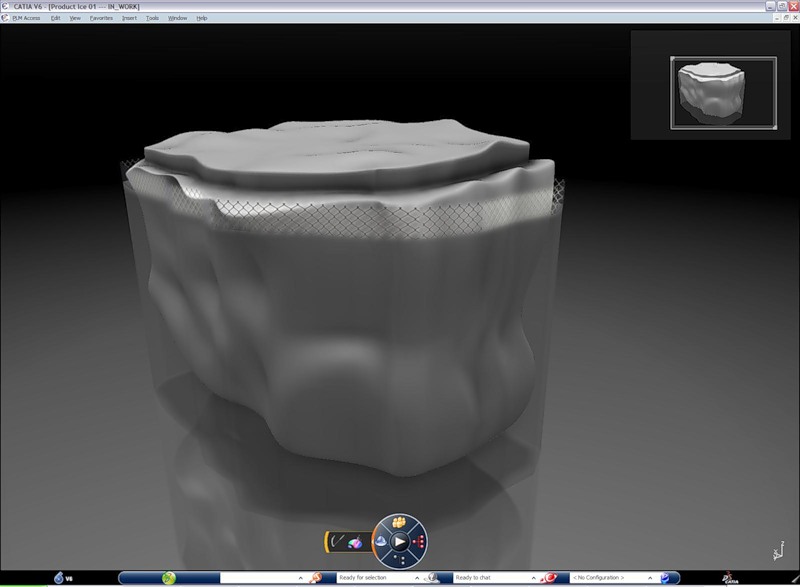
This is how this “fence” looks under water. The “bags” in the lower part of the structure are actually another element of the fence, which is still folded up.
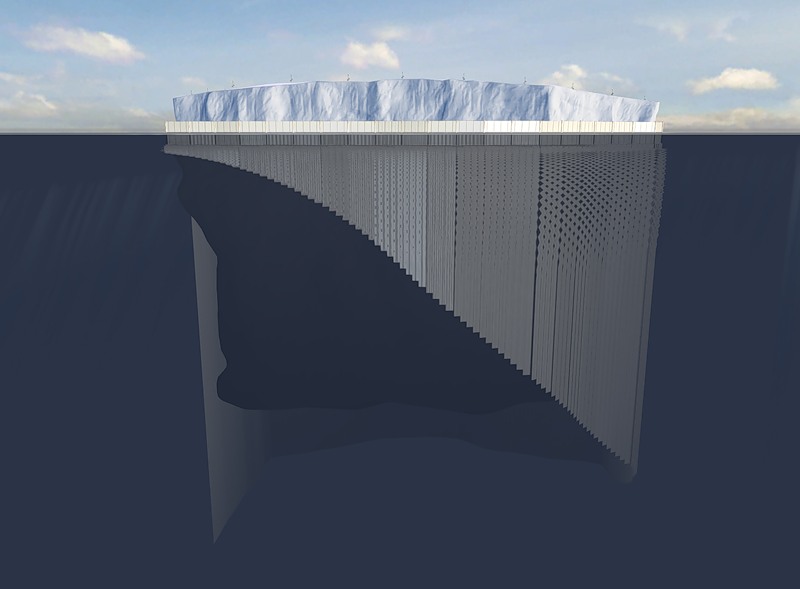
The length of this "skirt" allows you to completely close the underwater part of the iceberg.
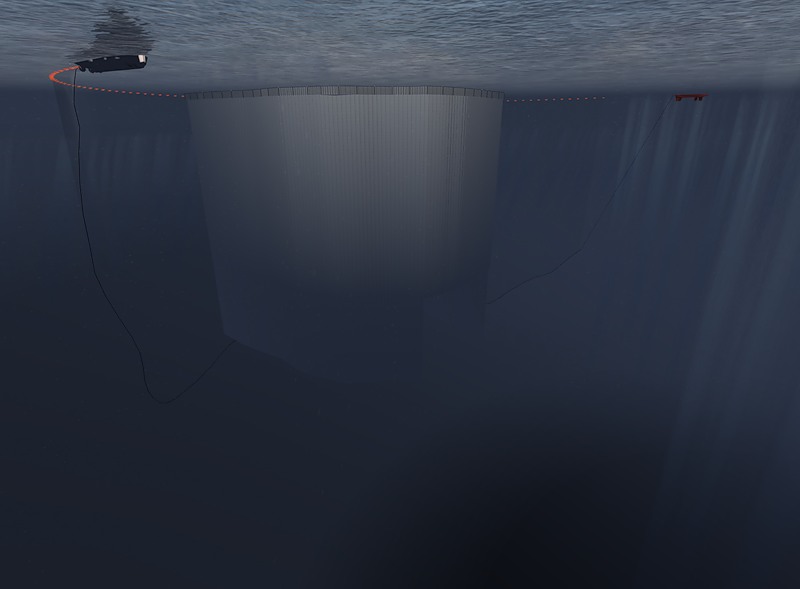
One more fence is planted, this time in the form of a light but strong mesh.
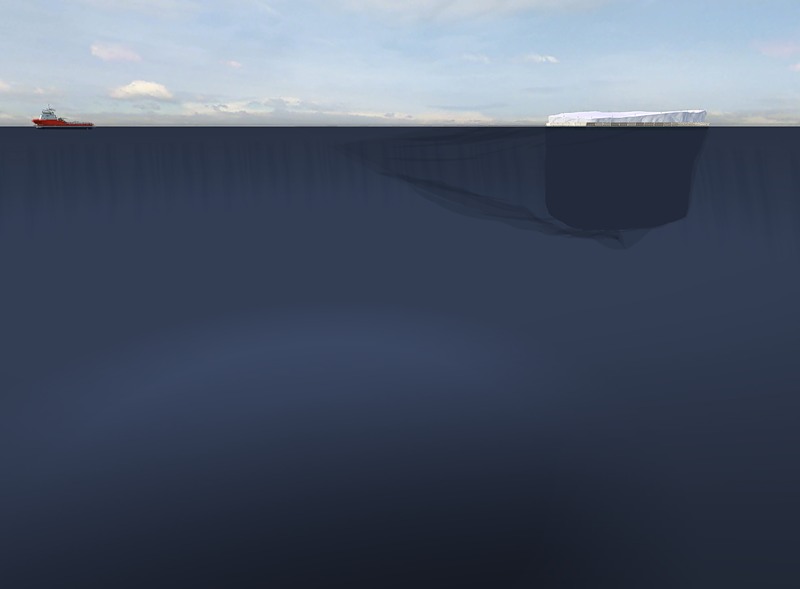
And it is this network that clings to the tow rope. After several experiments, it was found that it was most effective to use a single (though very powerful) tugboat, and to maximize the use of sea currents to save fuel. True, for this, the flow parameters, water temperature, etc., also had to be added to the "equation". By the way, all these parameters were calculated in the CATIA CAD system, exactly the same as in our previous articles.
Now, I think, it’s clear why Dassault Systemes is taking up such projects with interest. This is not only a matter of advertising or environmental responsibility. Such complex tasks force us to use the maximum capabilities of 3D-design and visualization systems. Well, and besides, it's just interesting :)

What you see in the screenshots above are the visualization frames from SIMULIA. And this is how the fence system looks in CATIA.
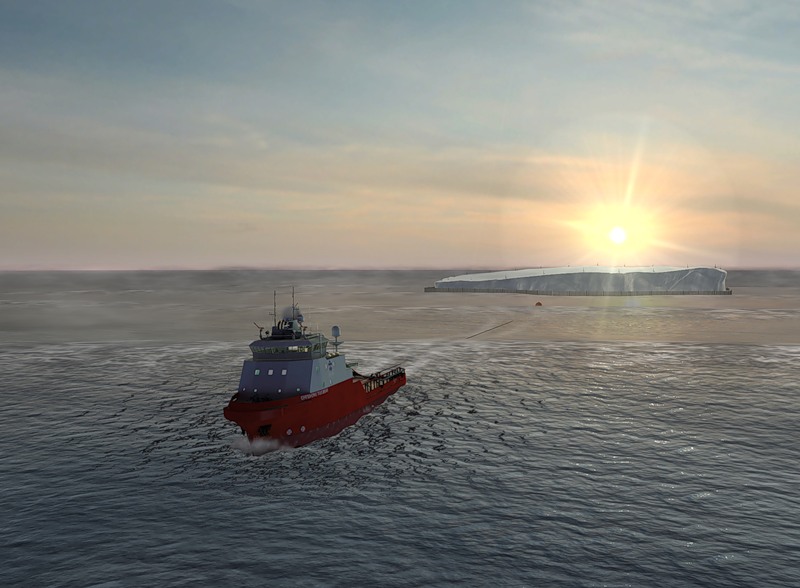
It is also necessary to simulate all environmental conditions. The weather, for example, is clear, with the sun becoming more active as it approaches the equator ...
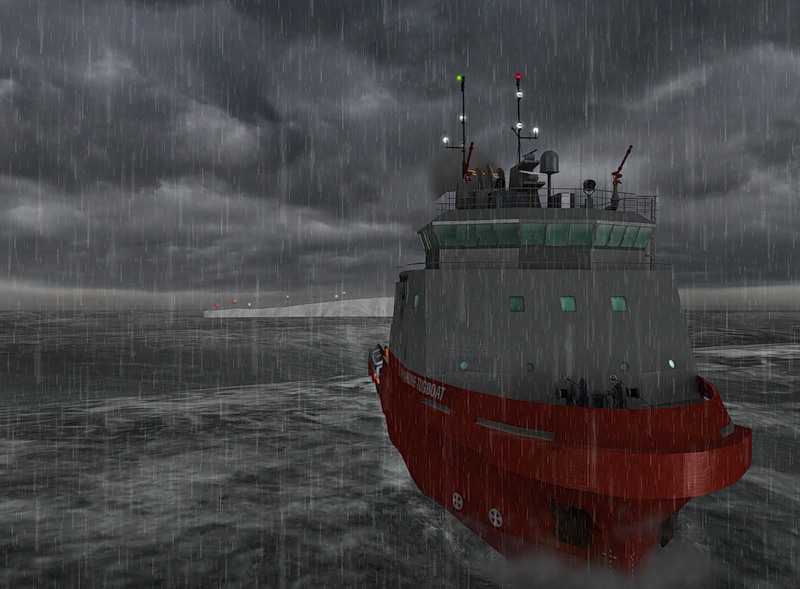
Or a strong storm, testing the strength of the entire transportation system.
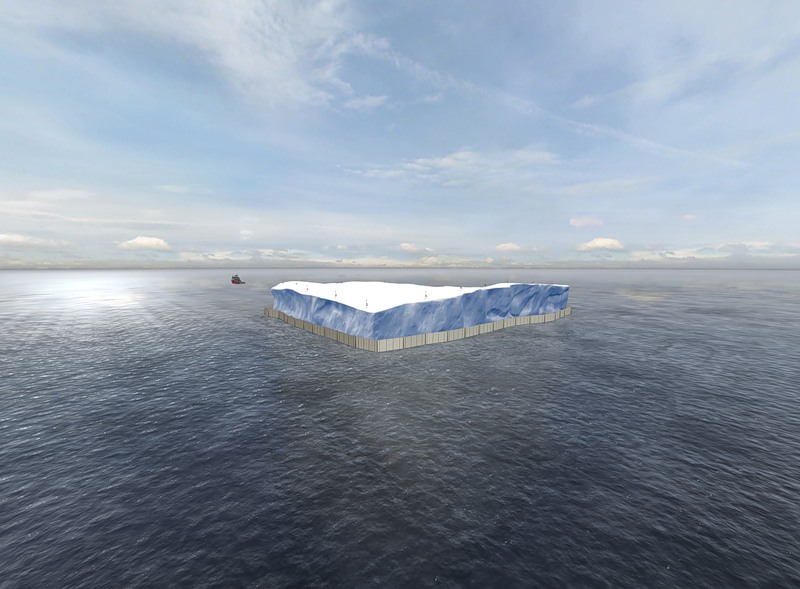
Program climate change as you move south.
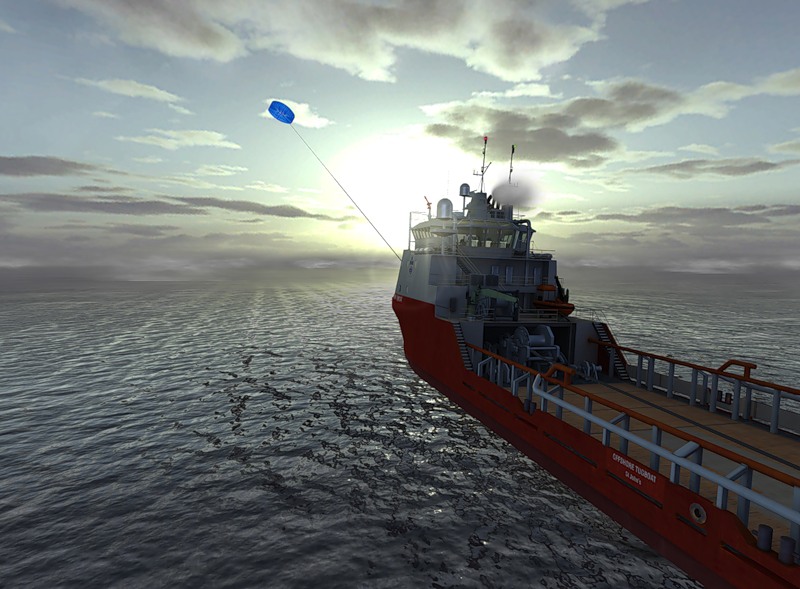
It is even possible to use wind power to save fuel (or time - the iceberg is melting).
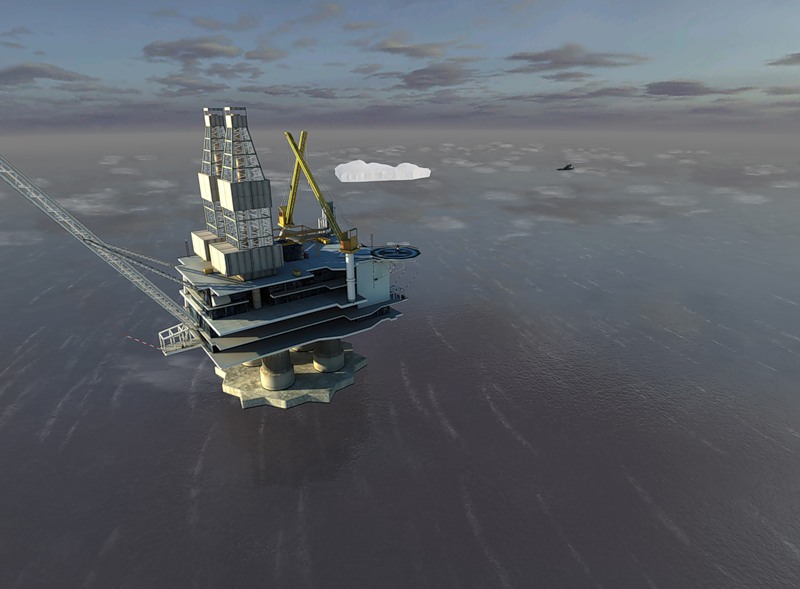
It is assumed that a radar will be installed in tow, which will allow you to maneuver and bypass the obstacle in time. For example, another iceberg. By the way, the design of the fence also protects the iceberg from pollution: if the tug gets through an oil spill, only the protective dome will suffer.
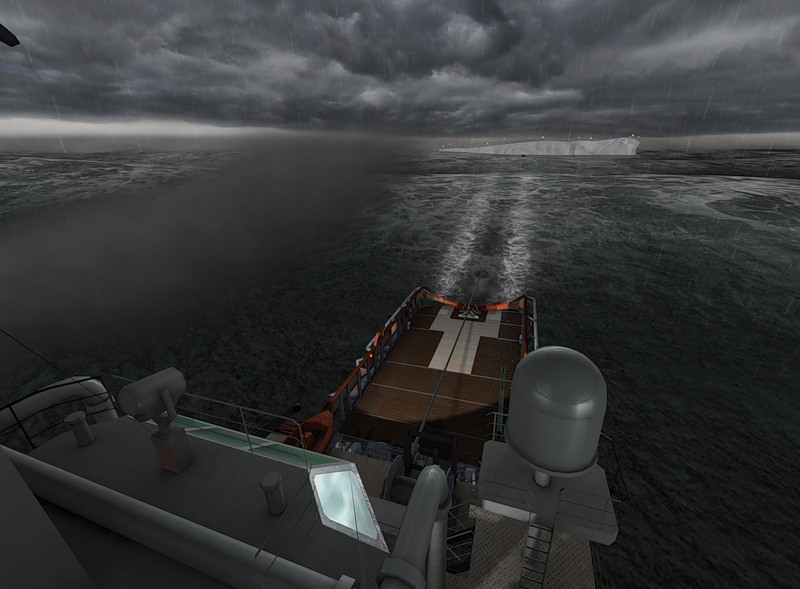
Well, and so on :)
This is a truly difficult and interesting job, but it is only part of the entire project. The final figures are important for Georges Mougins, the author of the idea and the potential executor, as well as for potential investors of the project. How many days will the transportation take? How much fuel will it take? Which season is best for you? And, most importantly, which part of the iceberg can be brought to the end point. As a result, Dassault Systemes engineers upgraded the computer model of the iceberg to the level of “captain’s bridge”. It is enough to enter the starting and ending coordinates, and the system automatically considers all the necessary parameters.
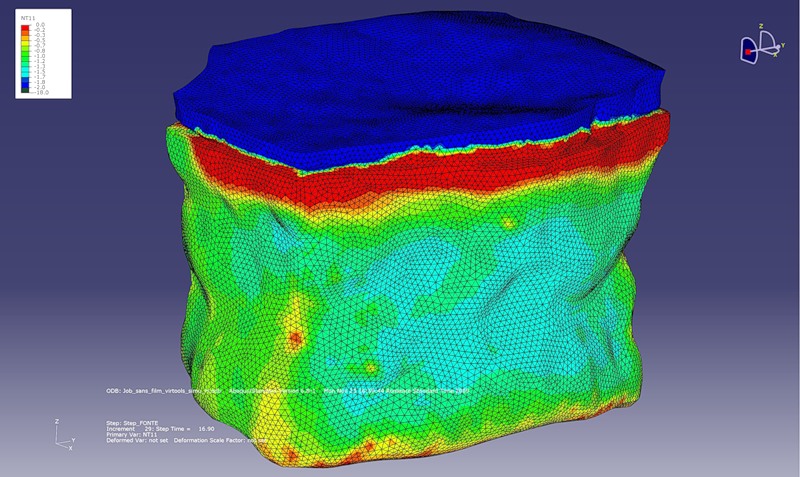
At the same time, at any time of transportation, you can get just such a three-dimensional projection of an iceberg, indicating temperatures.
This video shows an example of the SIMULIA program: the results of complex calculations are demonstrated in "natural conditions"
In the main office of Dassault Systemes there is a special 3D room where the result of the work of many people can be, so to say, “touch”. It provides not only a realistic image with a 3D projector and special glasses. The picture can be controlled by "moving" in virtual space.
Let us return to the question posed at the very beginning of the article. Is it possible to use 3D technology not for entertainment purposes, but for serious tasks? Dassault Systemes offers its own answer.
On the one hand, such a visualization may seem redundant. On the other hand, a realistic view of the virtual world helps in solving at least two serious problems. The first, and quite obvious: the presentation of a precisely designed project in such a way as if the trip with the iceberg had already taken place is the most real way to get financing. The second problem also lies on the surface. You can calculate thousands of parameters with maximum accuracy, create the most realistic theory, but it can never be compared with the real experience of a specialist. Georges Mougins is just such a person, he has been organizing expeditions to Antarctica all his life, and his experience can seriously help the project. You can show him kilometers of numbers, but in some cases it’s more useful to see how it really happens: with real waves, a real tugboat and a real iceberg. Or as close to reality as possible.

Previously, Dassault Systemes already participated in a similar project: it helped to prove the theory of the construction of the Cheops pyramid by building an accurate 3D model. In that case there was no guarantee that the theory would be confirmed, just as in the Iceberg project no one promises to translate the idea into reality. We can only say with confidence that the real numbers obtained during three-dimensional modeling of the problem will increase the likelihood of such an embodiment. In short, the results of the work are as follows:
• Transportation of an iceberg weighing 7 million tons to the Canary Islands will take 141 days
• During this time, the iceberg will lose 38% of its original weight.
• Optimum towing speed - 1.8 km / h. The issue of achieving optimal fuel consumption when towing at low speeds remains open. It is possible to use a larger number of tugs, but initially it was decided to calculate the option with the minimum fuel consumption.
The project is not yet completed, Georges Mougins, his team and Dassault Systemes specialists continue research. Mougins also has plans for the further use of the iceberg “on the spot”. A huge mass of frozen water can be used for air conditioning systems, and even for electricity production. A film about the Iceberg project will be released shortly. Movie trailer can be seen here . You can read more about the project in a special section of the Dassault Systemes website. On theOn this page of the site you can download the images used in the article in high resolution.