Jack Eisenmann's Unusual Computers
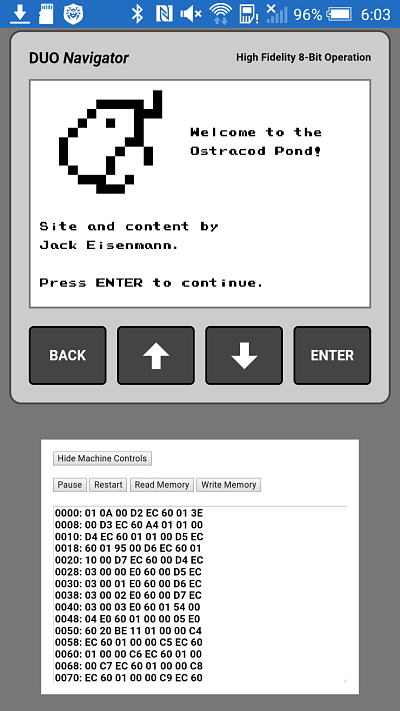
The title was in the spirit of "Technology - the youth", and it is completely in line with reality. “The stranger, the better” - this rule guides this author when developing his electronic and relay computers. Even the menu of his site is a JavaScript-emulator of the abstract computer DUO Navigator, controlled by four keys. Emulation can be paused and removed from it, reset, change the code and see what happens. Before that, there was another, inconvenient menu, requiring the polar coordinates of a section, then a subsection, and so on, to be pointed out with a finger (or mouse). All the other 16 (at the moment) computers of the DUO series are not abstract, but actually manufactured, very different from each other. Many of them can also be tested in action, without repeating, using JavaScript emulators.
For example, in the computer DUO Mega multitasking is provided with multiprocessing. It uses 16 microcontrollers. One of the cores, called the manager, distributes tasks to the others, called processors. All of them can access the total 32-kilobyte static RAM. Also here is implemented the similarity of splitvt. The machine is so unusual that even the use of a ready solution, MicroVGA, as a terminal does not make it any less self-made.
DUO Adept is a machine on a TTL chip, having a specially developed system of commands for it. It has a PS / 2 keyboard input and a composite video output.
Just one instruction, which can be executed with different arguments, consists of a set of commands from the DUO Compact computer . 64 kilobytes of its address space are divided between ROM, static RAM and I / O ports. Other developers use larger capacity ROM-like machines for storing truth tables in addition to programs. It also managed to do without it.
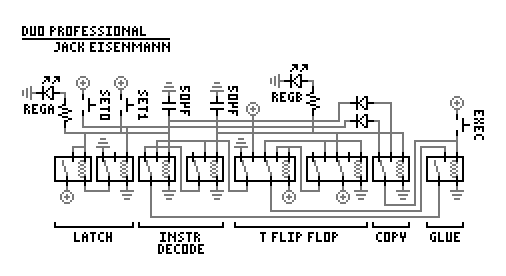
Relay computers are represented by two models of varying complexity: Turing-incomplete DUO Professional on just eight relays (strictly speaking, this is not a computer, but registers and a simplified ALU in its pure form) and a fairly large DUO Premium .
Computer DUO portable , at first glance, does not stand out with anything: a keyboard, a microcontroller and a display. This is not only doing lazy today, and lazy doing two pieces a day. It turns out that the input language is unusual in it: it is not a RYAMK, not a BASIC, not a Fort, and not Brainheye, but a DPCL (DUO Portable Command Language) developed from scratch. The user program can communicate not only with the keyboard and screen, but also with seventeen I / O ports. Other microcontroller machines of the same author are also programmed in custom languages.