March 23, 2011 at 15:15
New HP Servers with AMD Processors: SL165s G7 and SL335s G7
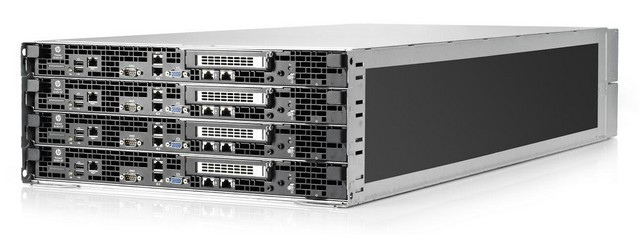
It is gratifying to see that such a large and reputable company like HP does not adhere to one “party line” regarding processors for its servers. The opportunity to measure their strengths to the benefit of the company and users of its products is provided to both major vendors, Intel and AMD.
The alignment of forces in this case is approximately the same as on the market as a whole, Intel processors prevail, but sooner or later products on AMD processors appear in almost all popular lines. AMD Opteron was especially vivid in the hot summer of last year at the BL465c blade server. Apparently, now it’s the turn of servers of other form factors: HP developed and already presented to the general public high-density SL335s G7 with a width of 0.5U and more familiar externally SL165s G7 with a width of 1U.
Both models are installed in separate 4-unit chassis, and not directly in the rack, and are designed for configurations that require easy and transparent scalability. They differ, by and large, in the level of performance of one server and the possibility of a thinner step to increase system power in the case of the SL335s G7, which can be installed up to eight pieces in the chassis, unlike the SL165s G7 - there are only four of them in the chassis. Both servers are installed in the SL6500 chassis.

Deploying serious web applications is mentioned as one use case for the SL165s G7. Four SL165s G7 can be installed in the SL6500 chassis. Given that you can put one or two Opteron twelve-core processors and 256 GB of memory in each server, the overall power of the chassis can turn out to be sky-high, at the level of very decent blade baskets. But this is still a different segment, so for less money the user gets high performance, but more narrow backup capabilities. This is reflected in the number of power supplies, ventilation modules and expansion modules. They can be used together on several servers, which, on the one hand, can seriously save money, but it also slightly reduces the overall system reliability in case of failures. But the chassis can work with an arbitrary number of servers of different configurations, which gives the user ultimately an unprecedented level of flexibility. An affordable minimum configuration allows you to lay the "cornerstone" of the chassis, then expanding the system, both at the level of each server and the chassis as a whole.

The same goes for the older and more concentrated SL335s G7. This server at HP focuses on comparable tasks - high-performance computing, grinding powerful databases and the like applications. Up to eight servers are installed in the chassis, with each of them carrying one or two six-core AMD Opteron and up to 128 GB of DDR3 memory.

Due to design limitations, disks in hot-swap servers do not support; for all manipulations with them, you will have to turn off and remove the server. This is one of the tradeoffs associated with the high density of servers in the chassis and the general concentration of elements.
Perhaps in the future, HP will also release disk modules for installation in the SL6500 chassis, which will further bring the system closer to blade solutions. But even if this does not happen, the SL165s G7 and SL335s G7 will remain a very attractive solution in those situations where high power is needed, concentrated in a small volume and available at a relatively low price. And data storage issues can be solved with the help of inexpensive external shelves. The joint use of power supplies and ventilation modules seriously reduces the cost of building a really powerful system worthy of a large company or service provider, which in our time is worth a lot of global savings.