486th from the Republic of China
The struggle in the modern market of x86-compatible processors has long been waged solely between Intel and AMD. But it was not always so. Back in the days of Pentium III, VIA competed (albeit not very successfully) with the two giants, and in the time of the first Pentium and 486x, the zoo of x86 processors was very diverse. Many, probably, will remember the name of a company such as Cyrix, whose processors were also sold under the names IBM, Texas Instruments and ST Microelectronics. Someone may recall the IDT, which, along with Cyrix, was later acquired by VIA, or Rise Technology, with their rather interesting mp6 chip. Often, geeks from the 90s also recall NexGen, whose developments formed the basis of the very popular AMD K6 processor at the time. But there was another name, by the way, quite common in eastern Europe,
UMC introduced a clone of the 486th processor shortly before the first Intel Pentium appeared in 1993. In 1994, Intel sued UMC for patent infringement on a 486 processor, which is why the sale of UMC processors in the United States was banned, which was noted directly on the processor case. As a result, after not too long disputes, UMC refused to further manufacture x86 compatible processors, and the U5 processor in a few modifications remained the only x86 UMC chip in history.
The processor itself was extremely interesting. Unlike the clones from AMD, which are practically indistinguishable from Intel 486 in performance, and the slower ones from Cyrix 486, the UMC processor was faster than Intel 486 at the same frequency. According to Wikipedia, UMC engineers focused on optimizing the microcode (although I can hardly imagine how it is possible to optimize the microcode as much as indicated in the article without touching the pipeline itself. Probably some new execution units were added, nevertheless) and achieved certain successes. But more interestingly, UMC provided assemblers with a “comprehensive” product. At a time when AMD and Cyrix released only the processors themselves, and Intel only recently started producing chipsets for its processors, UMC released almost everything that was needed to build the computer.
Somehow long ago I wanted to build a UMC computer. And here is what came of it:

The processor itself, UMC U5S-SUPER33. The processor contains 8 KB of cache in the first level and does not contain a built-in block of operations with a floating point, which had not yet become the standard in those years, but already present in expensive models of competitors. The processor worked without problems at a frequency of 40 MHz, also at a reduced voltage, 3.45 Volts instead of 5 Volts. In addition to this processor version, there were others: U5SX was no different from U5S, U5SD had a 486DX pinout, although, like U5S, it did not contain a floating point unit, unlike the 486DX and U5D from UMC itself. U5SF, U5SLV and U5FLV were produced in a QFP package for non-removable mounting, the last two were officially designed for a 3.3 V supply voltage. They say that rare U486DX2s with a multiplication of the bus frequency are found in nature, however, this statement cannot be verified.

The UMC UM8498F chipset motherboard has ISA and VLB bus connectors, supports up to 128 MB EDO memory, while the rest of the chipsets for 486 processors (with the exception of the late revisions of the SIS chipsets for the PCI bus) only supported FPM. The board has 256 KB of L2 cache, also typed in UMC chips. With the cache, the story is funny, although quite typical for inexpensive motherboards under the 3rd socket. At that time, the SRAM chips used for the cache were very expensive, and dishonest manufacturers were selling boards with a "dummy" cache. Dummies of microcircuits were installed on the board, and the BIOS of the computer always showed the presence of a cache. Some motherboards, especially often manufactured by PC Chips, didn’t even have tracks connecting the cache with the processor and chipset, so it was impossible to understaff such motherboards with a cache. Others

The video card is based on the UM85C408AF chipset, reports about 512 KB of on-board memory, although judging by the soldered DRAM chips, it is 768 KB there. The card is designed for the ISA bus and is rather slow, its speed is sorely lacking 486mu. When installing a more modern card for the VLB bus, for example, on the Cirrus Logic 5428 chipset, everything (games) works much more fun, however, Cirrus Logic is not UMC. There are in nature video cards based on the UMC chipset for VLB (on the UM85C418F chip), and are even found on Ibei, but they ask a lot for them and often they are not working. I don’t have such a card.
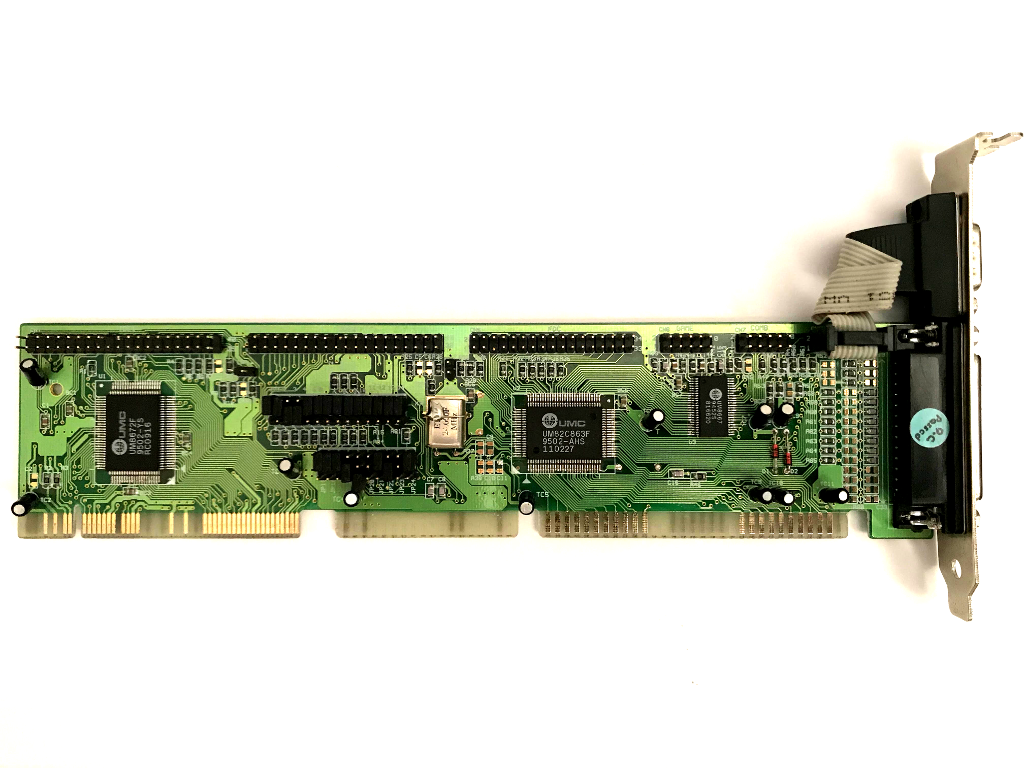
The boards for the 486 processor rarely had I / O controllers on board, and my board is no exception. Therefore, to connect disks, I use a multicard based on the UMC UM8672 / UM82C863 chipset. This card contains controllers for all the main ports (RS232, IEEE 1284, a port for connecting a joystick, as well as controllers for floppy disks and 2 IDE ports) and has very strange delays in operation. So, a similar Winbond-based card detects a CD-ROM when loading MS DOS in about 3 seconds. This board needs more than 10 seconds. In steel, there are no complaints about the board. The board is designed to connect to the VLB bus and supports 32-bit disk access, but does not work in DMA mode.

The network board is based on the UM9003AF chipset. NE2000-compatible, 10 Mbps, thin ethernet. A popular choice at the time, and it works pretty well. There are versions of the board for twisted pair.
There is no sound card in the computer. I found a mention of the UMC synthesizer chip, a clone of some ancient Yamaha, but I personally did not see the chip itself, or even the datasheet on it. However, datasheets on UMC chips are a separate and rather sad story.
To understand whether the UMC U5S was as fast as they say, we need competitors. Unfortunately, I didn’t find any competitors without a floating-point operations unit, so the U5S will fight against the Intel 486DX-50, which will be slowed down to 40 MHz:
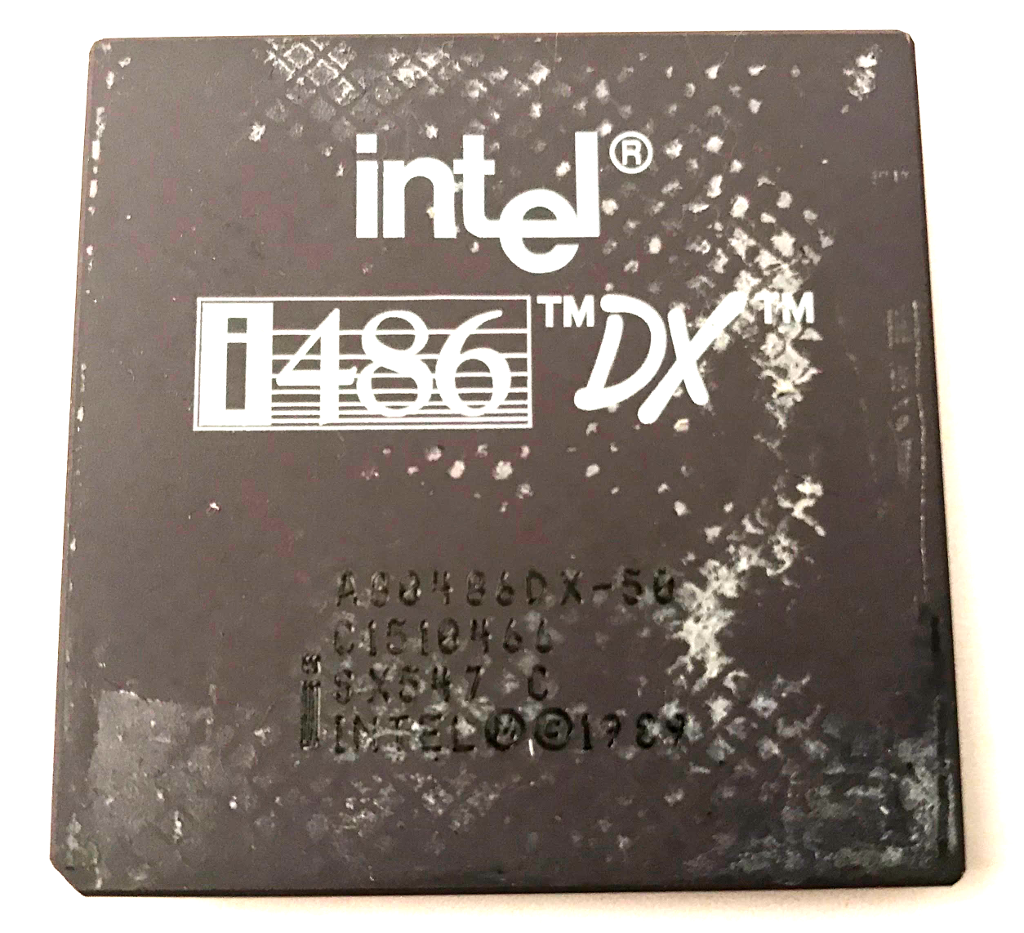
AMD 486DX-40:
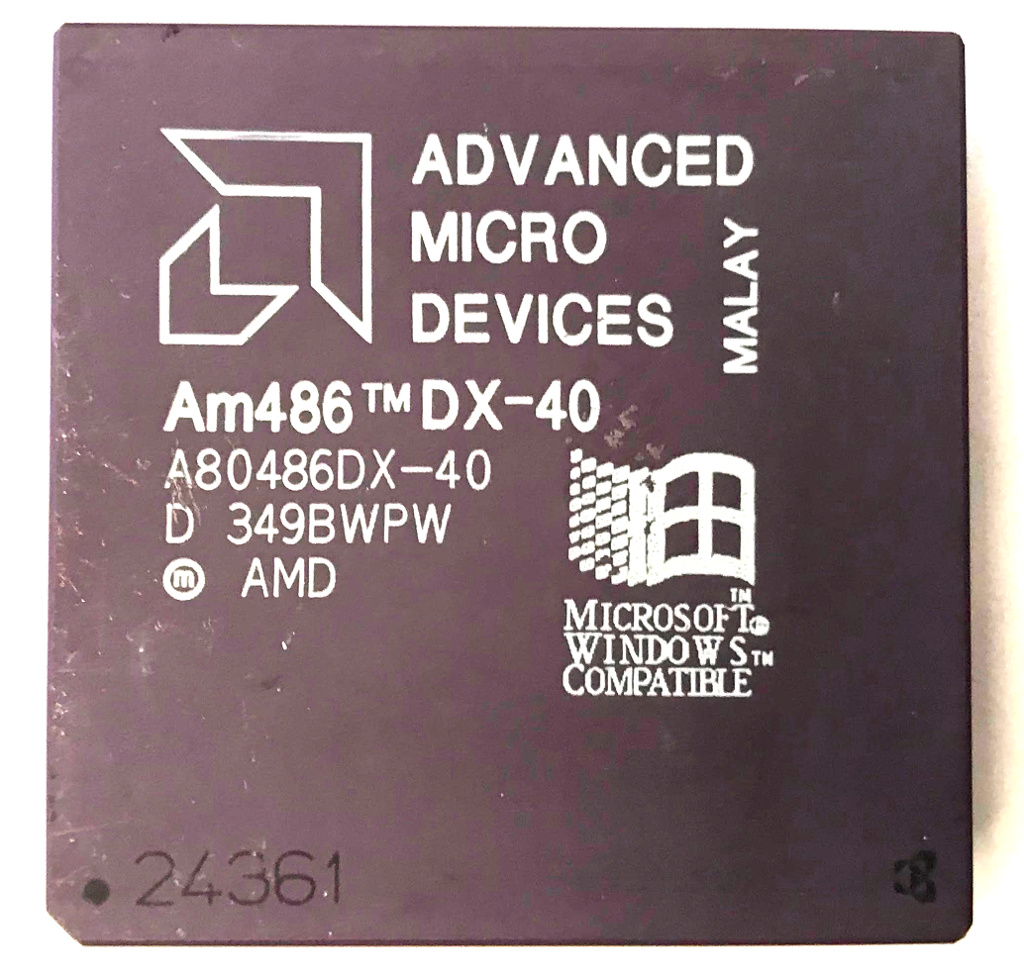
Cyrix 486DX-40:

In the case of Intel and AMD, the presence of a mathematical coprocessor does not affect the performance of integer operations in any way (however, the SuperPi test cannot be used, at least I could not turn off the coprocessor under Windows), but in the case of Cyrix the situation is different: Cx486S-40 is different from Cx486DX-40 also the size of the cache of the 1st level, and in general, it is simply a “re-locked” Cyrix 486DLC, an upgrade processor for 386x motherboards.
Such a 486DLC, also at 40 MHz, albeit under the TI brand, will also take part in the “battle”:

However, it will work on a motherboard with another chipset, the OPTi 495SX. OPTi chipsets were a very reliable solution (even Intel released motherboards with these chipsets for OEMs), but rather slow, so the 486DLC initially loses a little, especially since the 386 system has a different cache management: there was one cache in the 386x , and located on the board itself.
Well, for completeness, let's take the most ordinary 386 processor at 40 MHz:

So it will be possible to understand at the same time how much the 486DLC justified the name “486”. The role of the "usual 386go" will be AMD 386DX-40. The processor was very popular at the time of the "early" 486x. They said that he could compete on an equal footing with the 486SX-25, being much cheaper (not only the chip itself, but also the motherboards for it were much cheaper). The 486th processor at 25MHz will not be in the test, but suppose that with an increase in frequency in those ancient times, when there were no frequency multipliers in the processors, productivity also linearly increased. Thus, if the 386th shows more than 60% of the speed of 486 operating at the same frequency, we will assume that they were telling the truth.
There will be few tests, more precisely 3. Synthetic benchmarks are opened by the cachechk test, which tests the volume and speed of processor caches, and also demonstrates the speed of working with RAM:

This clearly shows the superiority of the UMC processor over competitors. In terms of exchange rate with any memory level, it is the fastest. Also, this is the only processor for which the benchmark was able to accurately determine the presence and speed of the 1st level cache. Although, perhaps, the UMC chipset "plays along" with the UMC processor. But this is only an assumption, especially since motherboards based on UMC chipsets at the time of 486x were still considered one of the fastest, despite the processor. And UMC processors then were, nevertheless, in a global minority. Cx486DLC-40 works very well with the 2nd level cache located on the board, however, paired with the OPTi chipset, it loses much to the “real” 486m in speed when working with RAM. But his “elder brother” behaved strangely: the difference in the speeds of RAM and the 2nd level cache is so low that cachechk did not “see” the cache.
In addition, only in U5S there is a line with the processor name: "UMC UMC UMC".
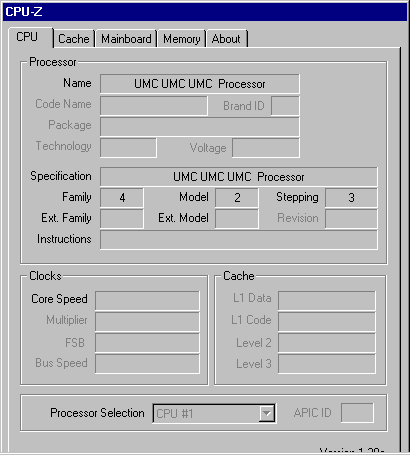
And yes, cachechk determines the frequencies of all processors correctly. Exceptions: 486DLC (45 MHz defined) and U5S (849 MHz defined).
And closes the “synthetics” test 3D bench 1.0c, the predecessor of 3D Mark, which does not use, however, not only 3D accelerators, but even a mathematical coprocessor. Only fixed point, only hardcore.
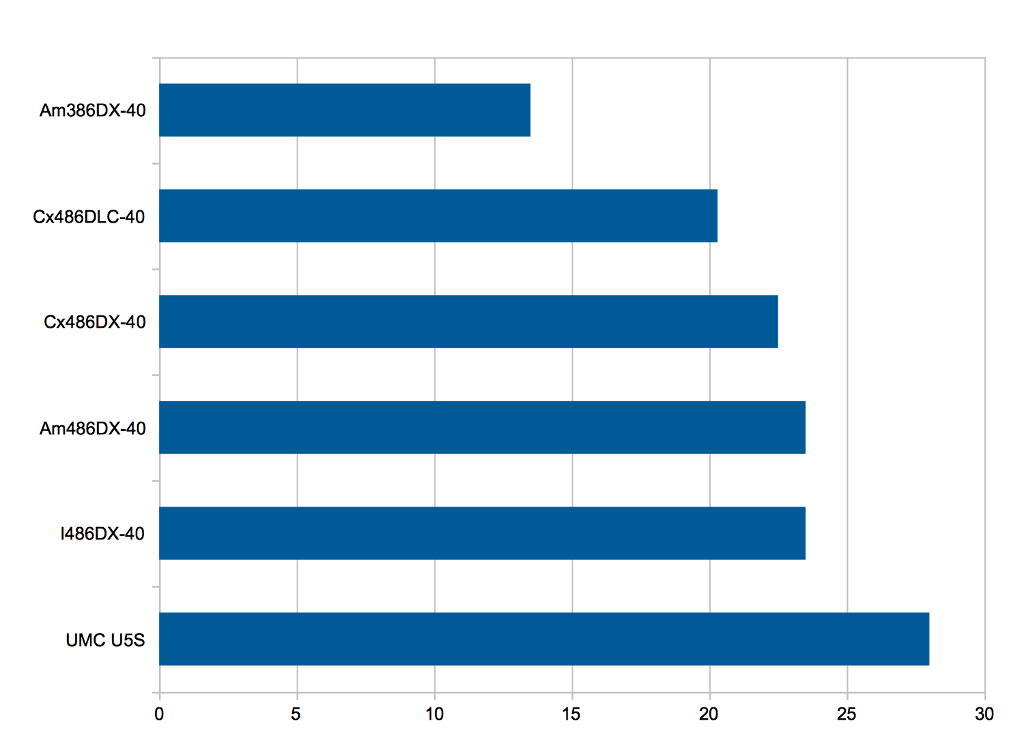
And here, UMC is significantly ahead of its rivals, although in this test you can already see the "brake" video card. If you replace it with a normal VLB-card, the result will increase significantly even for the 386th processor (yes, the later boards for the 386th supported the VLB bus. In general, the address and data buses on the 386DX and 486 processors are identical, and there were even "hybrid" boards where you can was to install either the 386th or 486th processor, to choose from). 486DLC is still much closer to 486 processors than to 386 processor, losing only about 10% first. Most likely, the Cx486S-40 would have shown a similar result.
Well, and most importantly, why everything was started - Doom. Used shareware version of the game 1.9. Test - demo3. Full screen, but the bottom panel is visible. High detail.

It seems to me that here the U5S fell victim to the "native" video card. Anyway, the 486th processor at 40 MHz may well play Doom. 10 FPS is still not level 486. Nevertheless, even here, albeit a very modest one, the U5S won. The 486DLC is exactly in the middle between the slowest 486x and the fastest (and only) of the 386x. Of course, you can put a normal video card and "test", but ... why? After all, here it is about UMC, and not about Doom at 486m.
So, U5S really was an interesting processor. Really very fast 486m, and it worked very well for a budget computer. The absence of a block of floating-point operations was not decisive: for a home user, the mathematical coprocessor will become important after 2 years, with the release of the Quake game, for which the speed of any of the tested processors is still not enough (it will even start at 386 m, yes, but play with pleasure will not work). And those users for whom the mathematical coprocessor was important, during the U5S distribution, they were gradually switching to Pentium (yes, and here they were waiting for a surprise in the form of FDIV BUG).
In general, it would be sad without you.
Good that you were.
386DX-40, however, was quite a competitor for the 486SX-25. From 50 to 70% of the 486DX-40 he provided. Well, and the 486DLC, nevertheless, really is the 486th processor in terms of performance, albeit the slowest, and is installed in the 386th socket.
UMC introduced a clone of the 486th processor shortly before the first Intel Pentium appeared in 1993. In 1994, Intel sued UMC for patent infringement on a 486 processor, which is why the sale of UMC processors in the United States was banned, which was noted directly on the processor case. As a result, after not too long disputes, UMC refused to further manufacture x86 compatible processors, and the U5 processor in a few modifications remained the only x86 UMC chip in history.
The processor itself was extremely interesting. Unlike the clones from AMD, which are practically indistinguishable from Intel 486 in performance, and the slower ones from Cyrix 486, the UMC processor was faster than Intel 486 at the same frequency. According to Wikipedia, UMC engineers focused on optimizing the microcode (although I can hardly imagine how it is possible to optimize the microcode as much as indicated in the article without touching the pipeline itself. Probably some new execution units were added, nevertheless) and achieved certain successes. But more interestingly, UMC provided assemblers with a “comprehensive” product. At a time when AMD and Cyrix released only the processors themselves, and Intel only recently started producing chipsets for its processors, UMC released almost everything that was needed to build the computer.
Somehow long ago I wanted to build a UMC computer. And here is what came of it:
The processor itself, UMC U5S-SUPER33. The processor contains 8 KB of cache in the first level and does not contain a built-in block of operations with a floating point, which had not yet become the standard in those years, but already present in expensive models of competitors. The processor worked without problems at a frequency of 40 MHz, also at a reduced voltage, 3.45 Volts instead of 5 Volts. In addition to this processor version, there were others: U5SX was no different from U5S, U5SD had a 486DX pinout, although, like U5S, it did not contain a floating point unit, unlike the 486DX and U5D from UMC itself. U5SF, U5SLV and U5FLV were produced in a QFP package for non-removable mounting, the last two were officially designed for a 3.3 V supply voltage. They say that rare U486DX2s with a multiplication of the bus frequency are found in nature, however, this statement cannot be verified.
The UMC UM8498F chipset motherboard has ISA and VLB bus connectors, supports up to 128 MB EDO memory, while the rest of the chipsets for 486 processors (with the exception of the late revisions of the SIS chipsets for the PCI bus) only supported FPM. The board has 256 KB of L2 cache, also typed in UMC chips. With the cache, the story is funny, although quite typical for inexpensive motherboards under the 3rd socket. At that time, the SRAM chips used for the cache were very expensive, and dishonest manufacturers were selling boards with a "dummy" cache. Dummies of microcircuits were installed on the board, and the BIOS of the computer always showed the presence of a cache. Some motherboards, especially often manufactured by PC Chips, didn’t even have tracks connecting the cache with the processor and chipset, so it was impossible to understaff such motherboards with a cache. Others
The video card is based on the UM85C408AF chipset, reports about 512 KB of on-board memory, although judging by the soldered DRAM chips, it is 768 KB there. The card is designed for the ISA bus and is rather slow, its speed is sorely lacking 486mu. When installing a more modern card for the VLB bus, for example, on the Cirrus Logic 5428 chipset, everything (games) works much more fun, however, Cirrus Logic is not UMC. There are in nature video cards based on the UMC chipset for VLB (on the UM85C418F chip), and are even found on Ibei, but they ask a lot for them and often they are not working. I don’t have such a card.
The boards for the 486 processor rarely had I / O controllers on board, and my board is no exception. Therefore, to connect disks, I use a multicard based on the UMC UM8672 / UM82C863 chipset. This card contains controllers for all the main ports (RS232, IEEE 1284, a port for connecting a joystick, as well as controllers for floppy disks and 2 IDE ports) and has very strange delays in operation. So, a similar Winbond-based card detects a CD-ROM when loading MS DOS in about 3 seconds. This board needs more than 10 seconds. In steel, there are no complaints about the board. The board is designed to connect to the VLB bus and supports 32-bit disk access, but does not work in DMA mode.
The network board is based on the UM9003AF chipset. NE2000-compatible, 10 Mbps, thin ethernet. A popular choice at the time, and it works pretty well. There are versions of the board for twisted pair.
There is no sound card in the computer. I found a mention of the UMC synthesizer chip, a clone of some ancient Yamaha, but I personally did not see the chip itself, or even the datasheet on it. However, datasheets on UMC chips are a separate and rather sad story.
To understand whether the UMC U5S was as fast as they say, we need competitors. Unfortunately, I didn’t find any competitors without a floating-point operations unit, so the U5S will fight against the Intel 486DX-50, which will be slowed down to 40 MHz:
AMD 486DX-40:
Cyrix 486DX-40:
In the case of Intel and AMD, the presence of a mathematical coprocessor does not affect the performance of integer operations in any way (however, the SuperPi test cannot be used, at least I could not turn off the coprocessor under Windows), but in the case of Cyrix the situation is different: Cx486S-40 is different from Cx486DX-40 also the size of the cache of the 1st level, and in general, it is simply a “re-locked” Cyrix 486DLC, an upgrade processor for 386x motherboards.
Such a 486DLC, also at 40 MHz, albeit under the TI brand, will also take part in the “battle”:
However, it will work on a motherboard with another chipset, the OPTi 495SX. OPTi chipsets were a very reliable solution (even Intel released motherboards with these chipsets for OEMs), but rather slow, so the 486DLC initially loses a little, especially since the 386 system has a different cache management: there was one cache in the 386x , and located on the board itself.
Well, for completeness, let's take the most ordinary 386 processor at 40 MHz:
So it will be possible to understand at the same time how much the 486DLC justified the name “486”. The role of the "usual 386go" will be AMD 386DX-40. The processor was very popular at the time of the "early" 486x. They said that he could compete on an equal footing with the 486SX-25, being much cheaper (not only the chip itself, but also the motherboards for it were much cheaper). The 486th processor at 25MHz will not be in the test, but suppose that with an increase in frequency in those ancient times, when there were no frequency multipliers in the processors, productivity also linearly increased. Thus, if the 386th shows more than 60% of the speed of 486 operating at the same frequency, we will assume that they were telling the truth.
There will be few tests, more precisely 3. Synthetic benchmarks are opened by the cachechk test, which tests the volume and speed of processor caches, and also demonstrates the speed of working with RAM:
This clearly shows the superiority of the UMC processor over competitors. In terms of exchange rate with any memory level, it is the fastest. Also, this is the only processor for which the benchmark was able to accurately determine the presence and speed of the 1st level cache. Although, perhaps, the UMC chipset "plays along" with the UMC processor. But this is only an assumption, especially since motherboards based on UMC chipsets at the time of 486x were still considered one of the fastest, despite the processor. And UMC processors then were, nevertheless, in a global minority. Cx486DLC-40 works very well with the 2nd level cache located on the board, however, paired with the OPTi chipset, it loses much to the “real” 486m in speed when working with RAM. But his “elder brother” behaved strangely: the difference in the speeds of RAM and the 2nd level cache is so low that cachechk did not “see” the cache.
In addition, only in U5S there is a line with the processor name: "UMC UMC UMC".
And yes, cachechk determines the frequencies of all processors correctly. Exceptions: 486DLC (45 MHz defined) and U5S (849 MHz defined).
And closes the “synthetics” test 3D bench 1.0c, the predecessor of 3D Mark, which does not use, however, not only 3D accelerators, but even a mathematical coprocessor. Only fixed point, only hardcore.
And here, UMC is significantly ahead of its rivals, although in this test you can already see the "brake" video card. If you replace it with a normal VLB-card, the result will increase significantly even for the 386th processor (yes, the later boards for the 386th supported the VLB bus. In general, the address and data buses on the 386DX and 486 processors are identical, and there were even "hybrid" boards where you can was to install either the 386th or 486th processor, to choose from). 486DLC is still much closer to 486 processors than to 386 processor, losing only about 10% first. Most likely, the Cx486S-40 would have shown a similar result.
Well, and most importantly, why everything was started - Doom. Used shareware version of the game 1.9. Test - demo3. Full screen, but the bottom panel is visible. High detail.
It seems to me that here the U5S fell victim to the "native" video card. Anyway, the 486th processor at 40 MHz may well play Doom. 10 FPS is still not level 486. Nevertheless, even here, albeit a very modest one, the U5S won. The 486DLC is exactly in the middle between the slowest 486x and the fastest (and only) of the 386x. Of course, you can put a normal video card and "test", but ... why? After all, here it is about UMC, and not about Doom at 486m.
So, U5S really was an interesting processor. Really very fast 486m, and it worked very well for a budget computer. The absence of a block of floating-point operations was not decisive: for a home user, the mathematical coprocessor will become important after 2 years, with the release of the Quake game, for which the speed of any of the tested processors is still not enough (it will even start at 386 m, yes, but play with pleasure will not work). And those users for whom the mathematical coprocessor was important, during the U5S distribution, they were gradually switching to Pentium (yes, and here they were waiting for a surprise in the form of FDIV BUG).
In general, it would be sad without you.
Good that you were.
386DX-40, however, was quite a competitor for the 486SX-25. From 50 to 70% of the 486DX-40 he provided. Well, and the 486DLC, nevertheless, really is the 486th processor in terms of performance, albeit the slowest, and is installed in the 386th socket.