July 30, 2010 at 11:38
Virtualization Technologies in Management

As a rule, when creating or launching a new product, they try to first test it in conditions close to combat. So, in the work of the system administrator, instead of deploying any system on a running server, a run-in is first performed on a test bench, where the features and nuances of the system’s operation, as well as possible options for rollback to the initial state, are clarified. But this option is almost impossible when it comes to business management. It is unlikely that anyone will spend money on creating an enterprise to learn how to manage such a test enterprise, and then, after finding out possible problems, create an enterprise that will work without failures. And it will take orders of magnitude more time than raising a test server.
However, the initial experience and management skills of the company must be acquired somewhere, and it is desirable that without deplorable consequences. One of these options, so to speak, for “training on cats” is to use some kind of business simulator. In this topic, I would like to briefly talk about one of the most popular business simulators - a simulator on the Global Management Challenge project, in which we managed to participate.

“The action program carries risks and costs, but they are much less than the long-term risks and costs that convenient inaction can lead to”
Intro
Since 2008, according to statistics on search queries and the popularity of discussions in the blogosphere in the Russian segment of the Internet, the popularity of such queries as “innovation”, “startup”, “small business” has grown from 3 to 5 times.
The pulse of the blogosphere at the request of innovation, startups and small businesses
Habré often has articles on startups. Unfortunately, on average, no more than 10% of startups survive to a state of financial maturity. There are various reasons for this. Based on the first available link , you can list the most popular of them:
• Lack of experience;
• Lack of funds;
• Inadequate sales;
• High operating costs;
• Inability to compete;
• Unsuccessful location;
• Lack of plan or goals;
• Lack of self-esteem;
• Unjustified cash flows;
• Taking money out of business;
• In unprofessional bookkeeping;
• Too high accounts receivable;
• High overstock;
• Too high investment in fixed assets;
• Unskilled employees.
Most of the above relates to management problems. Since the creation of innovations requires knowledge in areas close to the technical direction, situations often arise when creating your own enterprise with a good (almost realized) idea, but without knowledge in the field of management (general, strategic, financial, personnel, etc.) ), after some time it turns out that the company died in a cradle.
If it is trivial to refer only to theory, then it will be necessary to read and try to understand the following sources:
General management;
Financial management;
Personnel Management;
Strategic management, etc., each of which draws a minimum of pages for 500 sleeping pills. But a theory without practice will still give nothing but a general idea of terminology in this field of knowledge.
The best option, so to speak, for “training on cats” is to use some kind of business simulator to understand how the company is managed, because with the exception of the difference in the product being produced or the service being provided, all other fundamental processes in all enterprises in general are similar: financial management is subject to tax legislation, personnel management is subject to the labor code, etc ...
The most popular business simulator is the simulator on the Global Management Challenge project, which is constantly being improved at the Operational Research Department of the University of Strathclyde in Scotland. In Russia, it is represented by the Global Management Challenge project and in a somewhat simplified form in the Business Battle .
It is clear that in Moscow this simulator has been known for a long time and quite well, but nevertheless, I want to share my impressions on behalf of the participants, who are also residents of Habr, who reached the final of the Russian championship.
A few words about the championship format
The game model is a simulator of a company in the FMCG market (consumer goods), competing with other companies in the global markets of the Internet, Russia and the EU. In fact, it is a unique “simulator” that prepares managers and project teams for work in competitive markets according to international management standards.
Rules for participation
Teams participating in GMC-Russia are divided into groups of 4-8 teams.
Each group is a local market, where teams directly compete with each other.
Each round of the Championship consists of 5 periods: five consecutive tacts of decision-making.
Teams with the highest share price in their groups will reach the next round according to the results of the 5th period.
What is needed for this
Create a team of (3-5 people) and register it on the website www.globalmanager.ru
Wait for the start of the test rounds or the official start of the championship.
Download the history of your virtual company and develop a development strategy for 1 year and 3 months.
Analyze management reports and make decisions in the areas of production, marketing, finance and personnel management.
And now a little more
How GMC works
GMC virtual company model:

Participants become top managers of virtual companies.
“Your company has several departments for which you are
responsible for managing :
• The marketing department analyzes the market to prepare a forecast of likely
• sales volumes.
• The production department is responsible for the production and shipment for the sale of
• the necessary quantity of products, and also controls the availability of
• labor and production resources.
• The personnel management department regulates wages and is responsible for
• the working conditions of company employees.
• The finance department oversees the process as a whole and is responsible for the profitability of the
company and • efficient use of the resources available to it.
Each department must maintain the company's long-term strategic goal and
work towards its achievement. ” (GMC manual).
At the first stage, you get the history of the company in the form of management reports for five quarters. Each quarter represents 12 weeks.
The team will need to analyze reports that present in some way
accounting and management reports describing the state of the company, the actions of competing teams (their costs for advertising, development, product prices, the value of their assets, etc.) and the situation international financial markets.
From management reports it is clear what decisions were made and how they influenced the current situation. According to the history of the company, a preliminary strategy is being built, some parameters for its calculation model are being specified.
Next, you need to make 66 management decisions every week. What prices to set, how to change R&D funding, what will be the costs of advertising, how much to produce, etc. To answer these questions, you need to try to make forecasts, how the market will behave, competitors create a model for this.
With each decision you receive a management report - the results of your decision and the decisions of the opposing teams.
Based on their initial forecasts and what came in the management report, conclusions are drawn on how accurately the calculation model works. Further, errors and inaccuracies in the calculation model are clarified and corrected. And so, step by step, with each decision making, the calculations become more accurate and accurate. But do not forget about the basic strategy! Indeed, even with a very accurate calculation model, an erroneous strategy may not lead to the best result.
Companies operate in conditions close to real ones .
Teams compete with each other for 5 quarters in the simulator (5 decisions = 5 weeks in real life) - the winner is determined by the price of the shares.

First sheet of management report

The second sheet of management report
Own impressions
The instruction for the game seemed very valuable, where the knowledge contained in 500 page folios with sleeping pills, which were discussed above, was archived on 80 pages.
Based on the instructions, it will be necessary to develop your own model that describes the behavior of the simulator. At the first stage, this is the most resource-consuming task (both in time and in laboriousness), but in the future it will all pay off and decision-making will take place in one day. We, like all other participants, created our own model of the game based on the functionality of Microsoft Excel 2007. Some excerpts, from which you can find the links:
Tab from the model for making decisions ;
A tab from the model that helps predict demand .
Participation in GMC provides an opportunity to quickly learn the basics of what is vital for a manager. To test knowledge in practice, to evaluate how much all the basic parameters are interconnected with each other when making managerial decisions. This gives a completely different perception from what can be taken from textbooks.
So, for example, the dynamics of the stock price in our subgroup looked:
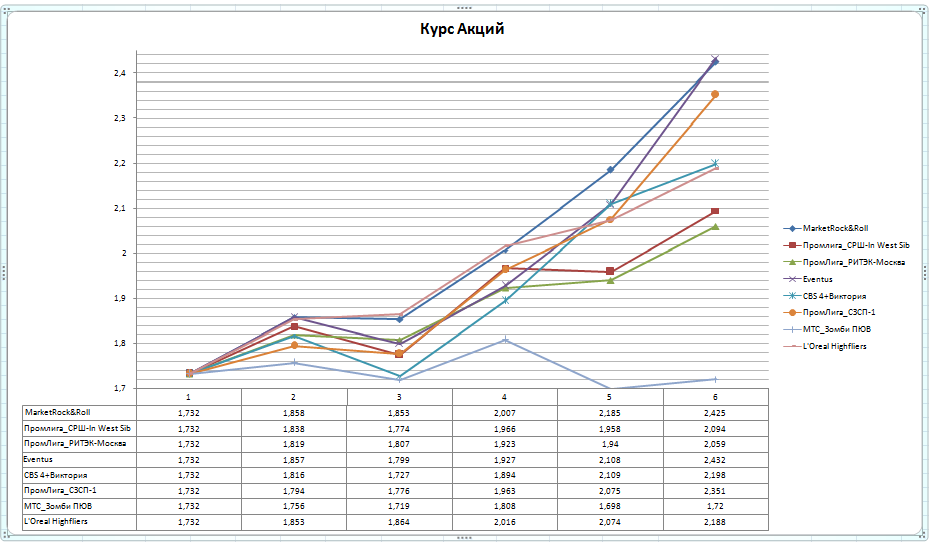
According to the value of shares at the end of the game round, the team goes to the next round of the game. We managed to get to the finals of the Russian Championship, which is traditionally held in Moscow at the President Hotel.


The winner of the Russian stage goes to the international finals. This year, the international finals took place in Russia in the city of Khanty-Mansiysk, because last year, the Russian team became the winner of the international super final. This year, a team from Russia took 3rd place. The team of Ukraine won this year.
Results of the international super final 2010:
1st place. Ukraine - 1.843
2nd place. Finland - 1.825
3rd place. RUSSIA - 1.817
4th place. Hong Kong - 1.779
5th place. Turkey - 1.740
6th place. China - 1.733
7th place. Macau - 1.720
8th place. Germany - 1.587
By the way, the Finnish team included the Chinese. Therefore, we can say that half of the participants in the international super final are Chinese, which is not surprising, given the performance of their economy as a whole.
You can watch a video report from this year’s international finale.
Outro
For a successful performance at this championship, it is not at all necessary to study as a manager or economist, or to work in a managerial position in a large company. The winner of the past years is studying at the magistracy in the direction of business informatics.
The main purpose of this article is to seek to interest in participating in such events. The main thing is that these “amusing fights” lead to the emergence of truly successful Russian companies competing in the world market. It is no coincidence that teams from China have been participating in this championship for a number of years and have become winners of the international super final 6 times ...
PS I would like to thank vikds and lena_sakhno without them participation in the GMC and this article would hardly have succeeded.
UPDATE1:To participate in the Global Management Challenge tournament, you need to pay an organizational fee from the team in the amount of 40 to 50 tyr (depending on the conditions of participation). There is the opportunity to participate for free, or at a significant discount, provided that the test rounds of your team will be passed with the best result.
UPDATE2: To participate in the in-person tour of the Global Management Challenge, it is necessary that the team has at least 3 and no more than 5 people. Fewer participants can participate in test tours.
UPDATE3: Registration fee is not required to participate in Business Battle, but there are restrictions for participants - these must be university students who entered the study no later than a certain year. And access to the international finals in Business Battle is not provided.