
 July 1, 2010 at 08:14
The beginning of the atomic era. Godiva device
The nuclear physicists at the Los Alamos National Laboratory were not only talented, but also poetic in their own way. Robert Oppenheimer, inspired by the poem of an English poet of the 17th century, gave the code name for the first nuclear weapon test in history - Trinity. The bombs dropped on Hiroshima and Nagasaki, and later on the Bikini Atoll, had their own names. Finally, a device for conducting experiments with a critical state of a radioactive substance was named after Lady Godiva, the wife of Duke Leofric of Coventry.

Lady Godiva, according to legend, rode through the streets of the city naked so that her husband would reduce taxes for his subjects. Whether this legend is true or not is not known, but since then its name has become a symbol of both courage and openness, defenselessness.
After the tragic events with the Devil's core, experiments with critical states began to be carried out using remotely controlled devices. Why was playing with fire at all, or, in the words of Feynman, “tickling the dragon's tail”? Firstly, the behavior of the substance itself was studied, and secondly, along the way, various samples, materials and laboratory animals were irradiated with a powerful flux of neutrons and gamma rays.
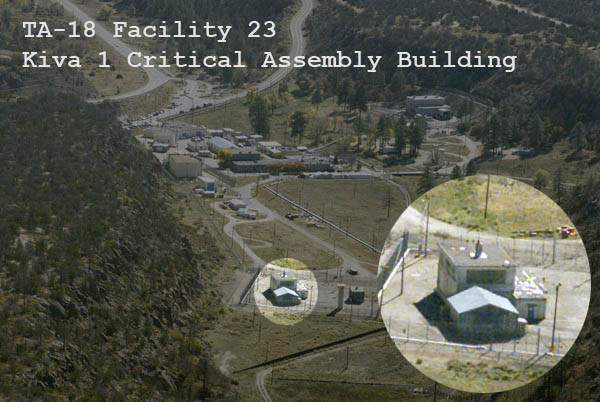
General view of the TA-18 zone, the Kiva 1 building is highlighted - “Godiva House”
For these purposes, the technical zone TA-18 was used - a complex of several buildings located 6 kilometers southeast of Los Alamos. The TA-18 functioned successfully until the end of 2006. Many devices of various designs were assembled in it, and up to hundreds of different experimental programs were simultaneously conducted. In December 2006, the last four machines were disassembled and moved to another technical zone for storage. Los Alamos' Battle Leaflet (LANL Newsletter) triumphantly announced the end of an era of critical experimentation and compared the cars with precious retro cars sent for storage to the garage museum. But we are getting ahead of ourselves.
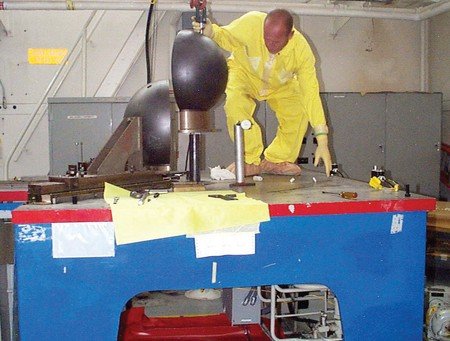
Dismantling the Flattop, one of four pulse reactors, before being stored
When experimenting with critical conditions, it was important to stop on time. The uncontrolled development of a chain reaction could lead to a real nuclear explosion. Back in 1942, when creating the first nuclear reactor in Chicago, cadmium control rods (safety rods) were used. Cadmium absorbs neutrons, and in the case of "emergency braking" of the reactor, it was necessary to quickly introduce rods into the core. A specially trained person with an ax ready (ax man) was responsible for this. Emergency rods were suspended on ropes, which were chopped with an ax at the right time. The whole system "man-ax-rope-rod" was called SCRAM - safety control rod ax man. In English, scram also means "hasty flight." The term later became part of the professional English-language slang of nuclear scientists,
So, returning to critical devices - in fact, they were the same primitive nuclear reactors in which the chain reaction was not constantly supported, but started for a short period of time. Later, the class of such devices was called "pulse reactors". Godiva's predecessor was a machine called Jamima, and it was designed in such a way that in the event of an accident, "hastily escape" on its own from an avalanche of chain reaction. It consisted of two sets of uranium disks: one pack was fixed motionless, and the second rose up to it, forming a total mass of radioactive substance close to critical. On April 18, 1952, due to incorrect calculations, an extra number of disks were “charged” into the device, and the car entered a critical state. However, the explosion did not occur.

Godiva's “Godfather” is Professor Otto Frisch. The list of his merits is extensive: these are studies on the behavior of neutrons, calculations of the fission energy of uranium nuclei, and an estimate of the critical mass of uranium needed to carry out a nuclear explosion. He was one of the key physicists involved in the Manhattan project. The name of the beautiful lady came to his mind, since the whole structure, in his opinion, was "naked and naked."
However, the device looked more like a two-meter mechanical skeleton with an “atomic heart” inside. This design was chosen to minimize neutron reflection, which could lead to a chain reaction getting out of control.

Godiva's “heart” is a ball of enriched (93.7%) uranium-235 with a diameter of about 17 centimeters and a total mass of 53 kilograms, divided into three parts. For comparison, the mass of the uranium charge of the “Baby” dropped on Hiroshima was 64.1 kilograms. For “fine tuning”, 14 recesses were made on the surface of the ball, into which small uranium disks weighing from 50 to 100 grams were inserted.
During the experiments, parts of the ball were connected together, and a uranium rod was quickly introduced into it through the upper tube, starting a chain reaction. This stage was carried out remotely, however, Godiva was serviced, and in particular, the addition of uranium disks was performed manually.
Despite a significant step forward in comparison with the experiments of the 40s, carried out with almost bare hands, new critical devices remained extremely dangerous. On one of the days of 1954, Frisch almost died: he was next to Godiva’s collected “heart”. The human body reflects much fewer neutrons than tungsten carbide or beryllium, but a small amount was enough to start a chain reaction. Frisch noticed this by the light of the indicator lamp and managed to react by bouncing off the ball and disconnecting it into parts. A moment of delay would have led to his death.

The experiments continued until February 12, 1957, when Godiva entered a critical state. This time, as in the case of Jemima, the device automatically turned off. But the energy of the chain reaction seriously damaged the metal frame, and Godiva was declared unsuitable for repair. The personnel conducting the experiment were in a protected area, none of the scientists were injured. During her life, Godiva produced about a thousand neutron pulses.
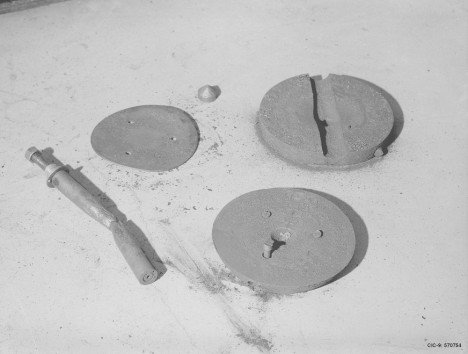
Godiva melted parts after the incident. Left - the uranium rod that triggers the reaction
To replace Godiva in 1957, a new device was built - Godiva II, Godiva II. It was similar in design and operating principle to its predecessor. But, paradoxically as it sounds, she was much better protected. For her, a separate building was equipped with concrete walls half a meter thick, also with her own name - Kiva (Kiva), in honor of the ritual structures of the ancient Indians.
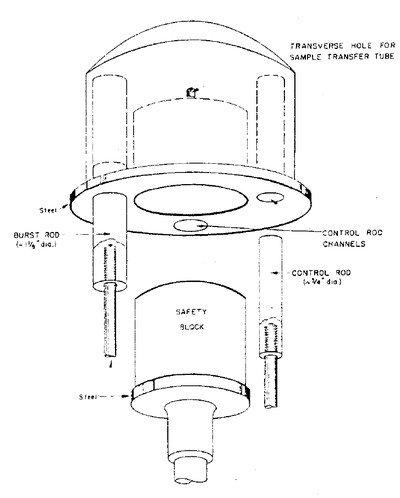
Instead of a ball, a uranium cylinder with a cutout was now used, into which a cylinder of a smaller diameter was inserted from below (the so-called safety block). The total mass of uranium has been increased to 57 kilograms. The launching rod was introduced into one of the three channels drilled in the main cylinder, the other two were designed for control rods. In addition, a transverse channel was drilled in the main cylinder for irradiated samples and materials. The core was surrounded by a metal mesh. She did not allow to bring any object reflecting neutrons to the cylinder and accidentally start a chain reaction, as happened with Otto Frisch.
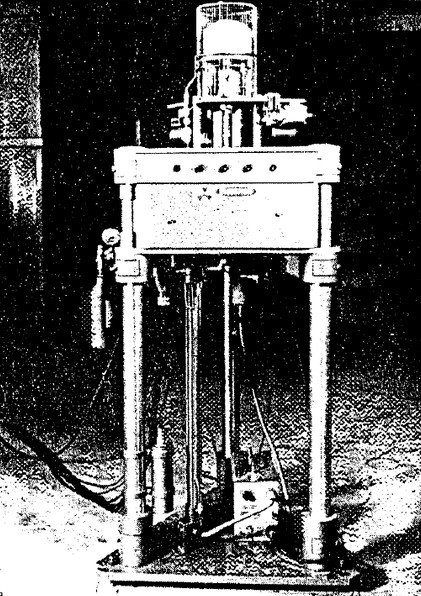
The machine was controlled completely remotely, there was no need to manually insert uranium disks, as in Godiva I, the mass was adjusted by control rods. A cooling system is also provided - each pulse strongly heated uranium cylinders. The position of the launching rod was verified in advance with an accuracy of tenths of a millimeter, and the entire experiment lasted about 40 milliseconds. Instead of a man with an ax, radiation level sensors were used here, which included at the right moment a pneumatic system that lowered the inner cylinder and stopped the reaction.
Later, other Godiva “sisters” were built, as well as more complex structures with a pulse power several orders of magnitude greater than the first devices. The last machine, Godiva IV, has successfully worked for over 30 years.

The End of an Era: LANL Specialists Prepare to Dismantle Godiva the Fourth
Godiva Device on Wikipedia
Applications of Godiva II Neutron Pulses (PDF)
A. Lukin. Physics of Pulse Nuclear Reactors (PDF)
Los Alamos Critical Assemblies Facility (PDF)
A Review of Criticality Accidents: 2000 Revision (PDF)
LANL Newsletter, Nov. 21, 2005 (PDF)
LANL Newsletter, Dec. 4, 2006 (PDF)
Lady Godiva, according to legend, rode through the streets of the city naked so that her husband would reduce taxes for his subjects. Whether this legend is true or not is not known, but since then its name has become a symbol of both courage and openness, defenselessness.
Technical Area TA-18
After the tragic events with the Devil's core, experiments with critical states began to be carried out using remotely controlled devices. Why was playing with fire at all, or, in the words of Feynman, “tickling the dragon's tail”? Firstly, the behavior of the substance itself was studied, and secondly, along the way, various samples, materials and laboratory animals were irradiated with a powerful flux of neutrons and gamma rays.
General view of the TA-18 zone, the Kiva 1 building is highlighted - “Godiva House”
For these purposes, the technical zone TA-18 was used - a complex of several buildings located 6 kilometers southeast of Los Alamos. The TA-18 functioned successfully until the end of 2006. Many devices of various designs were assembled in it, and up to hundreds of different experimental programs were simultaneously conducted. In December 2006, the last four machines were disassembled and moved to another technical zone for storage. Los Alamos' Battle Leaflet (LANL Newsletter) triumphantly announced the end of an era of critical experimentation and compared the cars with precious retro cars sent for storage to the garage museum. But we are getting ahead of ourselves.
Dismantling the Flattop, one of four pulse reactors, before being stored
Man with an ax
When experimenting with critical conditions, it was important to stop on time. The uncontrolled development of a chain reaction could lead to a real nuclear explosion. Back in 1942, when creating the first nuclear reactor in Chicago, cadmium control rods (safety rods) were used. Cadmium absorbs neutrons, and in the case of "emergency braking" of the reactor, it was necessary to quickly introduce rods into the core. A specially trained person with an ax ready (ax man) was responsible for this. Emergency rods were suspended on ropes, which were chopped with an ax at the right time. The whole system "man-ax-rope-rod" was called SCRAM - safety control rod ax man. In English, scram also means "hasty flight." The term later became part of the professional English-language slang of nuclear scientists,
So, returning to critical devices - in fact, they were the same primitive nuclear reactors in which the chain reaction was not constantly supported, but started for a short period of time. Later, the class of such devices was called "pulse reactors". Godiva's predecessor was a machine called Jamima, and it was designed in such a way that in the event of an accident, "hastily escape" on its own from an avalanche of chain reaction. It consisted of two sets of uranium disks: one pack was fixed motionless, and the second rose up to it, forming a total mass of radioactive substance close to critical. On April 18, 1952, due to incorrect calculations, an extra number of disks were “charged” into the device, and the car entered a critical state. However, the explosion did not occur.
Otto Frisch and Godiva First
Godiva's “Godfather” is Professor Otto Frisch. The list of his merits is extensive: these are studies on the behavior of neutrons, calculations of the fission energy of uranium nuclei, and an estimate of the critical mass of uranium needed to carry out a nuclear explosion. He was one of the key physicists involved in the Manhattan project. The name of the beautiful lady came to his mind, since the whole structure, in his opinion, was "naked and naked."
However, the device looked more like a two-meter mechanical skeleton with an “atomic heart” inside. This design was chosen to minimize neutron reflection, which could lead to a chain reaction getting out of control.
Godiva's “heart” is a ball of enriched (93.7%) uranium-235 with a diameter of about 17 centimeters and a total mass of 53 kilograms, divided into three parts. For comparison, the mass of the uranium charge of the “Baby” dropped on Hiroshima was 64.1 kilograms. For “fine tuning”, 14 recesses were made on the surface of the ball, into which small uranium disks weighing from 50 to 100 grams were inserted.
During the experiments, parts of the ball were connected together, and a uranium rod was quickly introduced into it through the upper tube, starting a chain reaction. This stage was carried out remotely, however, Godiva was serviced, and in particular, the addition of uranium disks was performed manually.
Despite a significant step forward in comparison with the experiments of the 40s, carried out with almost bare hands, new critical devices remained extremely dangerous. On one of the days of 1954, Frisch almost died: he was next to Godiva’s collected “heart”. The human body reflects much fewer neutrons than tungsten carbide or beryllium, but a small amount was enough to start a chain reaction. Frisch noticed this by the light of the indicator lamp and managed to react by bouncing off the ball and disconnecting it into parts. A moment of delay would have led to his death.
The experiments continued until February 12, 1957, when Godiva entered a critical state. This time, as in the case of Jemima, the device automatically turned off. But the energy of the chain reaction seriously damaged the metal frame, and Godiva was declared unsuitable for repair. The personnel conducting the experiment were in a protected area, none of the scientists were injured. During her life, Godiva produced about a thousand neutron pulses.
Godiva melted parts after the incident. Left - the uranium rod that triggers the reaction
Godiva Second
To replace Godiva in 1957, a new device was built - Godiva II, Godiva II. It was similar in design and operating principle to its predecessor. But, paradoxically as it sounds, she was much better protected. For her, a separate building was equipped with concrete walls half a meter thick, also with her own name - Kiva (Kiva), in honor of the ritual structures of the ancient Indians.
Instead of a ball, a uranium cylinder with a cutout was now used, into which a cylinder of a smaller diameter was inserted from below (the so-called safety block). The total mass of uranium has been increased to 57 kilograms. The launching rod was introduced into one of the three channels drilled in the main cylinder, the other two were designed for control rods. In addition, a transverse channel was drilled in the main cylinder for irradiated samples and materials. The core was surrounded by a metal mesh. She did not allow to bring any object reflecting neutrons to the cylinder and accidentally start a chain reaction, as happened with Otto Frisch.
The machine was controlled completely remotely, there was no need to manually insert uranium disks, as in Godiva I, the mass was adjusted by control rods. A cooling system is also provided - each pulse strongly heated uranium cylinders. The position of the launching rod was verified in advance with an accuracy of tenths of a millimeter, and the entire experiment lasted about 40 milliseconds. Instead of a man with an ax, radiation level sensors were used here, which included at the right moment a pneumatic system that lowered the inner cylinder and stopped the reaction.
Later, other Godiva “sisters” were built, as well as more complex structures with a pulse power several orders of magnitude greater than the first devices. The last machine, Godiva IV, has successfully worked for over 30 years.
The End of an Era: LANL Specialists Prepare to Dismantle Godiva the Fourth
References
Godiva Device on Wikipedia
Applications of Godiva II Neutron Pulses (PDF)
A. Lukin. Physics of Pulse Nuclear Reactors (PDF)
Los Alamos Critical Assemblies Facility (PDF)
A Review of Criticality Accidents: 2000 Revision (PDF)
LANL Newsletter, Nov. 21, 2005 (PDF)
LANL Newsletter, Dec. 4, 2006 (PDF)